


Winter Rules Additions Focus on Safety
December 5, 2013
Rules promoting greater player safety and improved coach-player communication highlight the playing rules changes for the winter sports season now underway at Michigan High School Athletic Association member schools across the state.
The winter sports season involves eight different sports and approximately 70,000 student-athletes. Practices began as early as late October; and tournaments begin in mid-February, running through the end of March. Competition is already underway in Girls Basketball, Bowling in the Upper Peninsula, Girls Competitive Cheer, Girls Gymnastics, Ice Hockey, and Upper Peninsula Swimming & Diving. On Saturday (Dec. 7), competition begins for Bowling and Swimming in the Lower Peninsula, as well as Wrestling. The Boys Basketball season begins on Monday (Dec. 9), and Skiing events may begin on Dec. 14.
Ice Hockey has several rules changes promoting player safety. “Blind-side” hits, checks to an unsuspecting or vulnerable player, can now be penalized; and the rule prohibiting a player form pushing, charging, cross or body-checking an opponent from behind into the boards or goal frame has reinstated the discretion for the official to issue a game disqualification when flagrant. Another safety change stops play when the goalkeeper’s glove is displaced – expanding a rule where the displacement of the keeper’s mask or helmet stops play.
Additionally, an embellishment rule has been added to discourage players from taking dives to draw penalties and exaggerating the severity of the impact of a play in which a penalty is called. Finally, when the attacking team bats the puck directly on goal, it shall result in an immediate whistle and a resulting faceoff at the defensive zone faceoff spot of the offending team.
In Basketball and Wrestling, electronic devices may now be used on the bench or in the corner for coaching purposes – for example, to show plays or keep statistics. Devices may not be used to dispute officials’ calls.
The head coach in Basketball may enter the court without penalty when a fight may break out or has broken out to prevent the situation from escalating. Players and assistant coaches who leave the bench in such situations will continue to be assessed flagrant technical fouls and be disqualified from the contest.
In keeping with rules book language published a few years ago in football, the basketball rules have added a section which limits public address announcers’ action during play. PA announcers, during game action, are limited to announcing who scores baskets and commits fouls. Any other announcements during play, like time remaining, are inappropriate. General announcements during time outs are still allowed.
In Wrestling, forfeits are no longer considered as matches when considering the five-matches-in-one-day limit for competition.
Winter tournaments begin the first full week of February in wrestling. The first MHSAA Finals of the season are the Upper Peninsula Swimming & Diving Finals on February 15, and tournaments conclude with the Boys Basketball Semifinals & Finals, March 21-22.
Vermontville Ace Joins NFHS Hall (Video)
August 15, 2016
By Geoff Kimmerly
Second Half editor
Michigan celebrated its eighth inductee to the National High School Sports Hall of Fame with the honoring of Vermontville baseball star Ken Beardslee during the annual National Federation of State High School Associations summer meeting, this summer in Reno, Nevada.
 Beardslee, who died in 2007, has been proclaimed as “prep baseball’s first ace” in the NFHS National High School Sports Record Book and was featured in the former print version of the book for his incredible feats from 1947-49. In his three years on the mound for Vermontville, Beardslee won 24 of his 25 starts (the team was 31-1 during that time). His 24 victories included eight no-hitters, with two perfect games, and seven one-hitters.
He set seven national records, and two still stand after 66 years: his per-game season strikeout mark of 19.0 and his per-game career strikeout mark of 18.1. He was drafted by the New York Yankees immediately after graduating from high school and pitched in the minor leagues from 1949 to 1956, when an injury ended his playing career. Beardslee went on to scout for the Pittsburgh Pirates for 21 years, and he received a World Series ring after the team’s championship win in 1971. He also went on to write eight books including novels, poetry and an instructional on pitching.
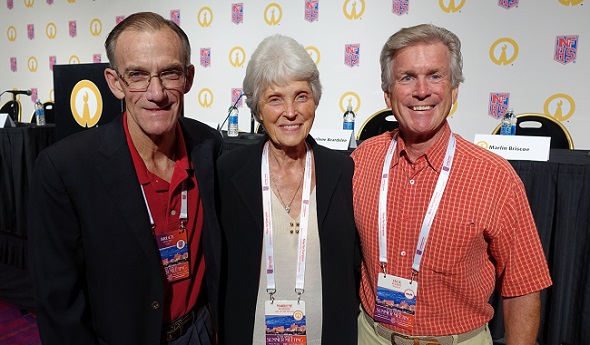
He was one of 12 individuals, including five athletes, inducted as part of this year’s class. His wife Marilene represented Beardslee in accepting the honor, and offered this as to the role high school athletics played in her husband’s life and career:
“My time with Ken was long after his high school days. I'm sure Ken's career gave him joy, happiness. It allowed him to accomplish goals. It opened doors; it opened doors to friendships throughout his life ... Terry Collins with the Mets, Doug Melvin (who) just this year stepped down with the Milwaukee Brewers. Those are things that high school opened doors for him.”
Beardslee was nominated for the NFHS Hall of Fame by the Michigan High School Athletic Association after years of research by Charlotte resident Terry Lowery. Lowery didn't have an immediate connection to Beardslee and only moved to Eaton County as an adult. But during a funeral for one of Beardslee’s high school teammates, Lowery heard the stories of the high school ace – and went to work building his application.
Below is the video produced by the NFHS that played during Beardslee’s portion of the induction ceremony and includes a touching interview with Marilene, who received Ken’s plaque from MHSAA assistant director Kathy Vruggink Westdorp.
PHOTOS: (Top) Marilene Beardslee stands with the NFHS’s Bruce Howard (left) and MHSAA Executive Director Jack Roberts during the Hall of Fame festivities in Reno, Nev. (Middle) Ken Beardslee, during his high school days at Vermontville. (Top photo courtesy of Terry Lowery.)