


Winter Rules Changes Focus on Safety
December 6, 2016
By Geoff Kimmerly
Second Half editor
Seasons are underway for teams participating in 12 winter sports for which the Michigan High School Athletic Association sponsors postseason tournaments, with a continuing focus on safety highlighting rules changes taking effect with the first days of competition.
Beginning with ice hockey’s first games Nov. 14, six sports started play during the final weeks of November, while the rest will be underway by the end of this week; Wrestling on Dec. 7 and Boys and Girls Skiing on Dec. 10 will be the final winter sports to begin competition.
Basketball, wrestling and ice hockey are among sports with noticeable changes to enhance safety this winter. In basketball, a change has been made to further protect the free-throw shooter from being displaced immediately after attempting a shot. Players occupying marked free-throw lane spaces may enter the lane on the release of the ball but may not touch or cross the free-throw line extended, into the semicircle, until the ball is released and touches the ring or backboard. Other players not occupying marked lane spaces may not have either foot beyond the vertical plane of the free-throw line extended and the 3-point line which is farther from the basket until the ball touches the ring or until the free throw ends. Both are designed to keep the free-throw shooter free from contact and alone in the semicircle directly following the shot attempt.
Also in basketball, non-playing personnel including cheerleaders, media and school supervisors must remain outside the playing area during a timeout 30 seconds or shorter. Non-playing personnel also must remain throughout the game in the areas between the free-throw lines extended and sidelines, to provide a safer environment free of possible collisions for both playing and non-playing personnel.
Officials will be on the lookout in wrestling for a hold that could lead to a competitor being dropped to the mat after a lift without the ability to use his or her arms to break the fall because they are trapped as part of the hold. If a wrestler, from a standing position, is placed in a body lock with one or both arms trapped, the offensive wrestler is required to safely return that defensive wrestler to the mat through a variety of legal moves. Officials will stop the match if a lift is coming or imminent that would result in the defensive wrestler being unable to break his or her fall because of an arm trap.
Hockey contact to the head or neck area will be penalized with multiple levels of severity in 2016-17, depending on the extent and intent of that contact. If contact to the head or neck area is deemed to be direct – that is, with the initial force of the contact occurring to the neck or head area – that contact will be considered a flagrant foul and result in a major penalty or game disqualification. If the contact is deemed indirect – with the initial force of the contact beginning below the neck and progressing upward to the head or neck area – the result will be a minor penalty unless the indirect contact is deemed by officials to be flagrant, which again will result in a major or game disqualification.
Also of note in hockey, all players (excluding goaltenders) must now take a stationary position on all faceoffs before the puck is dropped. By eliminating motion prior to faceoffs, this rule change is designed to also eliminate any possible advantage gained by players previously working for better position.
The 2016-17 Winter campaign culminates with postseason tournaments beginning with the Upper Peninsula Girls and Boys Swimming & Diving Finals on Feb. 18, and wraps up with the Boys Basketball Finals on March 25. Here is a complete list of winter tournament dates:
Boys Basketball
Districts – March 6, 8 & 10
Regionals – March 13 & 15
Quarterfinals – March 21
Semifinals – March 23-24
Finals – March 25
Girls Basketball
Districts – Feb. 27, March 1 & 3
Regionals – March 7 & 9
Quarterfinals – March 14
Semifinals – March 16-17
Finals – March 18
Girls & Boys Bowling
Team Regionals – Feb. 24
Singles Regionals – Feb. 25
Team Finals – March 3
Singles Finals – March 4
Girls Competitive Cheer
Districts – Feb. 17-18
Regionals – Feb. 25
Finals: March 3-4
Girls Gymnastics
Regionals – March 4
Team Finals – March 10
Individual Finals – March 11
Ice Hockey
Pre-Regionals – Feb. 27-March 3
Regional Finals – March 3-4
Quarterfinals – March 7-8
Semifinals – March 9-10
Finals – March 11
Girls & Boys Skiing
Regionals – Feb. 13-17
Finals – Feb. 27
Girls & Boys Swimming & Diving
U.P. Girls & Boys Finals – Feb. 18
L.P. Boys Diving Regionals – March 2
L.P. Boys Finals – March 10-11
Wrestling
Team Districts – Feb. 8-9
Individual Districts – Feb. 11
Team Regionals – Feb. 15
Individual Regionals – Feb. 18
Team Quarterfinals – Feb. 24
Team Semifinals & Finals – Feb. 25
Individual Finals – March 2-4
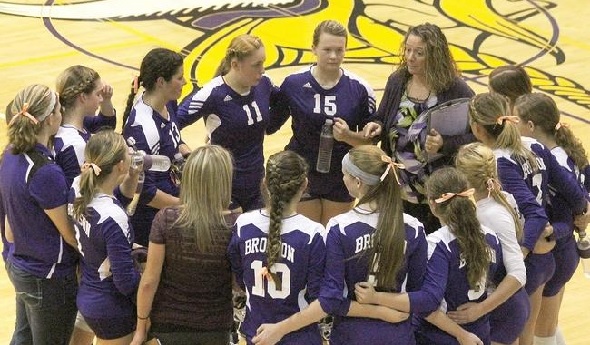
LaClair Leads as Coach, AD, Mentor
February 18, 2015
By Geoff Kimmerly
Second Half editor
Leasa Griffith was introduced to Bronson’s Jean LaClair while officiating one of LaClair’s volleyball tournaments.
She received further insight into LaClair’s care for her athletes when, a few years later, LaClair asked Griffith to serve as a Legacy Official mentor to a Bronson player.
With LaClair leading as athletic director, Bronson moved this school year into the first-year Berrien-Cass-St. Joseph Conference. So did Mendon – where Griffith is co-athletic director – and that’s given her another opportunity to appreciate LaClair’s mentorship firsthand.
“I look to Jean whenever I have a question, or even if I just want to run an idea past someone. She is always readily available and gives me great advice,” Griffith said. “I honestly cannot think of another person who deserves to be recognized by the MHSAA for a ‘Women in Sports Leadership Award’ more than Jean LaClair.”
LaClair will receive the MHSAA’s 28th WISL Award during the Class A Girls Basketball Final on March 21 at Michigan State University’s Breslin Center.
The honor, given annually by the MHSAA Representative Council, recognizes the achievements of women coaches, officials and athletic administrators affiliated with the MHSAA who show exemplary leadership capabilities and positive contributions to athletics.
“I never would’ve thought I’d receive this award,” LaClair said. “I just go out and do my job to the best of my ability every day. The people before me have done magnificent things. I’m just doing the daily grind of my job.”
She downplays as well the numbers that come with her reputation as an elite coach. LaClair is best known for leading high-achieving athletes for more than two decades as one of the winningest varsity volleyball coaches in MHSAA history.
Her accomplishments speak volumes on their own.
She has built a career record of 958-327-85 over 21 seasons as a varsity volleyball coach at Midland Dow, Pinconning, and for the last 15 seasons Bronson High School. She ranks 10th on the MHSAA career victory list for volleyball coaching wins and led her 2009 Bronson team to the Class C championship.
 She also has served as Bronson’s athletic director since fall 2000 and hosted a variety of MHSAA tournament events in addition to sitting on a number of MHSAA and Michigan Interscholastic Athletic Administrators Association committees. LaClair was a speaker at MHSAA Women in Sports Leadership conferences in 2006 and 2008 and also has been a registered MHSAA official for 14 years.
“Jean LaClair is a role model for her athletes, and also for administrators who look to her for expertise and mentorship,” said John E. “Jack” Roberts, executive director of the MHSAA. “She is a respected voice who offers valuable knowledge and guidance to those at every level of educational athletics. We’re delighted to honor her with the Women In Sports Leadership Award.”
LaClair is a 1984 graduate of Midland Dow High School and 1989 graduate for Saginaw Valley State University, and she also earned a Master’s in sports administration from Central Michigan University. She began her varsity coaching career at Dow during the 1987-88 season and coached through 1990. She led Pinconning’s varsity from 1996-97 through 1999, then came to Bronson as the athletic director only that fall. She then resumed her coaching career in fall of 2000.
In addition to the 2009 MHSAA title, her teams have won five Regional championships. Her 1997-98 Pinconning team finished Class B runner-up.
LaClair is a member of both the MIAAA and National Interscholastic Athletic Administrators Association, and served as MIVCA president for six years, vice president for three and as a board member for 13 years. She also served a term as president of the St. Joseph Valley League and as an instructor for the MHSAA’s Coaches Advancement Program.
“I love coaching. It’s the time I get to deal with some good kids. We have a great summer, and it feeds into the fall,” LaClair said. “I feel when kids leave my program, they could be coaches. I do try to get them in involved in officiating as well.”
LaClair was inducted into the Michigan Interscholastic Volleyball Coaches Hall of Fame in 2006 and was named that body’s Coach of the Year in 2009. She was named Michigan High School Coaches Association volleyball Coach of the Year in 2010 and was a National High School Athletic Coaches Association volleyball Coach of the Year finalist in 2011. She also was named a Regional Athletic Director of the Year by the MIAAA in 2009.
She previously taught mathematics and physical education before becoming a full-time athletic director, and also became as assistant principal at Bronson High School during the 2010-11 school year. She continues to pull off the time-consuming coach-athletic director double in part because of superior organizational skills, but mostly because of supportive administrators who with another game manager help her to make sure everything is covered especially during the volleyball season.
“Jean is a professional in every sense of the word. She has been able to lead seeking not only what is best for Bronson, but what is best for everyone,” said Buchanan athletic director Fred Smith, whose school also is part of the Berrien-Cass-St. Joseph Conference. “She is a role model not only for female athletic administrators, but all athletic administrators.”
Past Women In Sports Leadership Award recipients
1990 – Carol Seavoy, L’Anse
1991 – Diane Laffey, Harper Woods
1992 – Patricia Ashby, Scotts
1993 – Jo Lake, Grosse Pointe
1994 – Brenda Gatlin, Detroit
1995 – Jane Bennett, Ann Arbor
1996 – Cheryl Amos-Helmicki, Huntington Woods
1997 – Delores L. Elswick, Detroit
1998 – Karen S. Leinaar, Delton
1999 – Kathy McGee, Flint
2000 – Pat Richardson, Grass Lake
2001 – Suzanne Martin, East Lansing
2002 – Susan Barthold, Kentwood
2003 – Nancy Clark, Flint
2004 – Kathy Vruggink Westdorp, Grand Rapids
2005 – Barbara Redding, Capac
2006 – Melanie Miller, Lansing
2007 – Jan Sander, Warren Woods
2008 – Jane Bos, Grand Rapids
2009 – Gail Ganakas, Flint; Deb VanKuiken, Holly
2010 – Gina Mazzolini, Lansing
2011 – Ellen Pugh, West Branch; Patti Tibaldi, Traverse City
2012 – Janet Gillette, Comstock Park
2013 – Barbara Beckett, Traverse City
2014 – Teri Reyburn, DeWitt
PHOTOS: (Top) Bronson volleyball coach Jean LaClair huddles with her team during a match. (Middle) LaClair, also Bronson's athletic director, sits in on a league and conference meeting at the MHSAA office this winter. (Top photo courtesy of the Coldwater Daily Reporter).