


Wrestling Additions Highlight Winter Rules Changes
December 5, 2017
By Geoff Kimmerly
Second Half editor
The re-definition of the competition area to reward offensive wrestling in the down position is among the most significant rules changes taking effect with the start of 2017-18 competition in 12 winter sports for which the Michigan High School Athletic Association sponsors postseason tournaments.
Beginning with ice hockey’s first games Nov. 13, six sports started play during the final weeks of November, while the rest will be underway by the end of this week. Wrestling on Dec. 6 and Boys & Girls Skiing on Dec. 9 will be the final winter sports to begin competition.
New this winter, wrestlers in the down position will continue competing as long as the supporting point(s) of either wrestler are inbounds. Previously, wrestling stopped when one competitor’s supporting point(s) went out of bounds.
This change creates a larger scoring area and is intended to reduce match stoppages that take place when action moves out of bounds. Supporting points include the parts of the body touching, or within, the wrestling area that bear the wrestler’s weight, other than those parts with which the wrestler is holding the opponent.
Also in wrestling this season, two-piece uniforms are allowed as well as the traditional singlet provided the two-piece uniform follows a list of requirements and does not extend below the knee. In addition, to enhance safety, three maneuvers were made illegal including a front flip or hurdle over an opponent who is in the standing position.
A few notable rules changes in basketball and swimming & diving also will be apparent this winter:
• In basketball, an official may now provide an official warning to the head coach – with that warning then recorded in the scorebook – for misconduct by the coach or other bench personnel including players in and outside the coaching box. This warning is intended to make the message clear that there is misconduct and promote a change in behavior before a technical foul is called. However, a warning is not required prior to calling a technical foul if the misconduct is determined to be major.
• As with Lower Peninsula girls season in the fall, to promote safer take-offs during boys and Upper Peninsula girls swimming relays this winter, the second, third and fourth swimmers must have at least one foot in contact with the starting platform in front of the starting block wedge during take-off. Those second, third and fourths swimmers may not take off with both feet on top of the starting block wedge.
• Divers in the Lower Peninsula will need only four regular-season wins (instead of the previous five) to qualify for the Regional Diving Qualification Meet. A diver also may qualify if he places ahead of all divers from opposing schools in varsity competition in at least four meets, even if he does not finish ahead of his teammates. (This applies only in the Lower Peninsula where Regionals are conducted; Upper Peninsula divers qualify for Finals based on regular-season performance.)
The 2017-18 Winter campaign culminates with postseason tournaments beginning with the Upper Peninsula Girls and Boys Swimming & Diving Finals on Feb. 17, and wraps up with the Boys Basketball Finals on March 24. A reminder: The MHSAA Individual Wrestling Finals that are moving to Ford Field will be a two-day event this winter as opposed to a three-day event as in past seasons.
Here is a complete list of winter tournament dates:
Boys Basketball
Districts – March 5, 7 & 9
Regionals – March 12 & 14
Quarterfinals – March 20
Semifinals – March 22-23
Finals – March 24
Girls Basketball
Districts – Feb. 22, 28 & March 2
Regionals – March 6 & 8
Quarterfinals – March 13
Semifinals – March 15-16
Finals – March 17
Girls & Boys Bowling
Team Regionals – Feb. 23
Singles Regionals – Feb. 24
Team Finals – March 2
Singles Finals – March 3
Girls Competitive Cheer
Districts – Feb. 16-17
Regionals – Feb. 24
Finals: March 2-3
Girls Gymnastics
Regionals – March 3
Team Finals – March 9
Individual Finals – March 10
Ice Hockey
Pre-Regionals/Regionals – Feb. 26-March 3
Quarterfinals – March 6-7
Semifinals – March 8-9
Finals – March 10
Girls and Boys Skiing
Regionals – Feb. 12-16
Finals – Feb. 26
Girls & Boys Swimming & Diving
U.P. Girls & Boys Finals – Feb. 17
L.P. Boys Diving Regionals – March 1
L.P. Boys Finals – March 9-10
Wrestling
Team Districts – Feb. 7-8
Individual Districts – Feb. 10
Team Regionals – Feb. 14
Individual Regionals – Feb. 17
Team Quarterfinals – Feb. 23
Team Semifinals & Finals – Feb. 24
Individual Finals – March 2-3
The MHSAA is a private, not-for-profit corporation of voluntary membership by more than 1,500 public and private senior high schools and junior high/middle schools which exists to develop common rules for athletic eligibility and competition. No government funds or tax dollars support the MHSAA, which was the first such association nationally to not accept membership dues or tournament entry fees from schools. Member schools which enforce these rules are permitted to participate in MHSAA tournaments, which attract more than 1.4 million spectators each year.
-0-
Bedford's Gandee Honored for 'Spirit'
March 13, 2017
By John Gillis
Special from NFHS
Hunter Gandee, a student-athlete at Temperance Bedford High School, has been selected as the 2017 Section 4 recipient of the “National High School Spirit of Sport Award” by the National Federation of State High School Associations (NFHS).
The National High School Spirit of Sport Award was created by the NFHS to recognize those individuals who exemplify the ideals of the spirit of sport that represent the core mission of education-based athletics.
The mark of a “good big brother” is often to what lengths he might go to assist his younger siblings.
That sense of familial assistance has perhaps never been taken to the extremes that Hunter Gandee has repeatedly done for his younger brother Braden.
A standout student, Hunter is a junior with a 3.92 grade-point average and a member of the National Honor Society.
On the sports side, Hunter is in his third season on the varsity wrestling team, and participates in Greco-Roman and freestyle wrestling during the offseason. He's also a member of the MHSAA Student Advisory Council.
While those accomplishments are unquestionably outstanding, they might pale in comparison to what he has done for Braden.
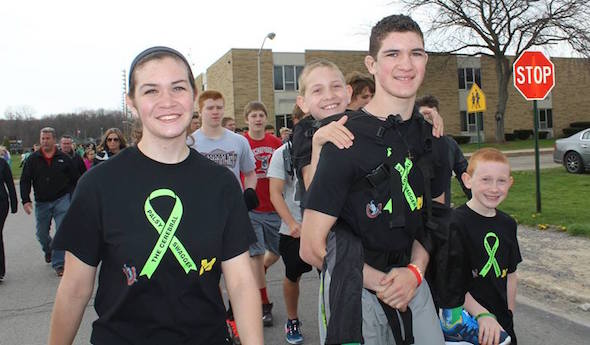
Born with cerebral palsy, Braden has limited use of his legs. Nonetheless, Hunter has taken it upon himself to help Braden know what it feels like to walk long distances – and he’s done it three times. Organized for the purpose of raising awareness of cerebral palsy, Hunter literally carries Braden on his back for long walks known as “CP Swaggers.”
In 2014, Hunter carried Braden 40 miles from the Bedford Junior High School wrestling room to the University of Michigan’s Bahna Wrestling Center. The following year, they upped the trek’s mileage to 57 miles.
However, that couldn’t foreshadow what was to follow in April 2016 when Hunter carried Braden on his back an amazing 111 miles – some 14 miles more than the first two walks combined.
About the Award: The NFHS divides the nation into eight geographical sections. The states in Section 4 are Michigan, Illinois, Indiana, Iowa and Wisconsin.
Nominations for this award were generated through NFHS member state associations and reviewed by the NFHS Spirit of Sport Award Selection Committee composed of state association staff members.
While the national winner will be recognized June 29 at the NFHS Summer Meeting in Providence, Rhode Island, the section winners will be recognized within their respective states and will receive awards before the end of the current school year.
PHOTO: Hunter Gandee, second from right, carries his brother Braden as part of their effort to bring awareness to cerebral palsy. (Photo courtesy of The Cerebral Palsy Swagger.)