

New Math: Division & Multiplication Problems
July 25, 2017
By Jack Roberts
MHSAA Executive Director
This is the second part in a series on MHSAA tournament classification, past and present, that will be published over the next two weeks. This series originally ran in this spring's edition of MHSAA benchmarks.
High school tournament classifications went viral before there was social media and most of us knew what “viral” meant.
Much as a virus infects computers today or has created epidemics of disease around the world for centuries, high school tournament classification – once introduced – tends to spread uncontrollably. Once started, it tends to keep expanding and rarely contracts.
While we are still some distance from providing every team a trophy as a result of expanding high school tournament classification across the country, there is criticism nevertheless that we are headed in that direction – a philosophy which is supposed to exist only in local youth sports for our youngest children.
Michigan could be blamed for all this. Michigan is generally accepted as the first state to provide different classifications for season-ending tournaments for different sized schools. It started a century ago. Today, every state has various classifications for its tournaments in most if not all sports. And it is a bit ironic that Michigan – creator of the classification chaos – more than most other states has kept the number of tournament classes or divisions under control.
Yes, there is evidence that tournament classifications have expanded over the years in Michigan, especially with the relatively recent introduction of tournaments in football and the late 1990s’ move from classes to divisions in most MHSAA tournaments. But the MHSAA Representative Council has held true to its word when it expanded the playoffs for football from four classes to eight divisions: this is needed because of unique factors of football, factors that exist in no other sport; and all other sports should be capped at a maximum of four classes or divisions.
Kentucky is the preeminent defender of single-class basketball. All of its 276 high schools compete for the single state championship for each gender. In Indiana, there are still open wounds from its move in 1998 from one to four classes for its 400 schools in basketball.
Multi-class tournaments have tended to increase the number of non-public school champions, which some states are trying to lower through enrollment “multipliers,” and also tend to increase the number of repeat champions, which some states are trying to affect with “success factors” which lift smaller schools into classifications for larger schools if they take home too many trophies.
While there is considerable evidence that state tournaments do as much bad as good for educational athletics, state associations persist in providing postseason tournaments because, on balance, the experiences are supposed to be good for student-athletes. And once we reach that conclusion it is just a small leap to believe that if the tournaments are good for a few, they must be better for more – which leads to creating more and more tournament classifications. One becomes two classes, then three, then four and so forth.
While the argument is that more classifications or divisions provides more students with opportunities to compete and win, it is undeniable that the experience changes as the number of tournament classifications expands. It is not possible for state associations to provide the same level of support when tournament classifications expand to multiple venues playing simultaneously. For example, there is less audio and video broadcast potential at each venue, and less media coverage to each venue. Focus is diluted and fans diminished at each championship.
No one can argue reasonably that today's two-day MHSAA Football Finals of eight championship games has the same pizazz as the one-day, four-games event conducted prior to 1990.
In some states the number of divisions has grown so much that it is difficult to see much difference between the many season-ending state championship games and a regular-season event in the same sport.
It is a balancing act. And Michigan has been studying that balance longer than any other state, and charting a steadier course than most.
Addition by Division
The shift to Divisions for MHSAA Tournament play in numerous sports has added up to a greater number of champions for teams and individuals across the state. Following are the sports currently employing a divisional format, and the procedures for determining enrollment and classification.
In 23 statewide or Lower Peninsula tournaments, schools which sponsor the sport are currently divided into nearly equal divisions. They are:
- Baseball - 4 Divisions
- Boys Bowling - 4 Divisions
- Girls Bowling - 4 Divisions
- Girls Competitive Cheer - 4 Divisions
- LP Boys Cross Country - 4 Divisions
- LP Girls Cross Country - 4 Divisions
- LP Boys Golf - 4 Divisions
- LP Girls Golf - 4 Divisions
- Ice Hockey - 3 Divisions
- Boys Lacrosse - 2 Divisions
- Girls Lacrosse - 2 Divisions
- Boys Skiing - 2 Divisions
- Girls Skiing - 2 Divisions
- LP Boys Soccer - 4 Divisions LP
- Girls Soccer - 4 Divisions
- Girls Softball - 4 Divisions
- LP Boys Swimming & Diving - 3 Divisions
- LP Girls Swimming & Diving - 3 Divisions
- LP Boys Tennis - 4 Divisions
- LP Girls Tennis - 4 Divisions
- LP Boys Track & Field - 4 Divisions
- LP Girls Track & Field - 4 Divisions
- Wrestling - 4 Divisions
Lists of schools for each division of these 23 tournaments are posted on MHSAA.com approximately April 1. Listings of schools in Upper Peninsula tournaments for their sports are also posted on MHSAA.com. The lists are based on school memberships and sports sponsorships in effect or anticipated for the following school year, as known to the MHSAA office as of a date in early March.
In football, the 256 schools which qualify for MHSAA 11-player playoffs are placed in eight equal divisions annually on Selection Sunday. Beginning in 2017, the 8-player divisions will be determined in a like manner on Selection Sunday as well, with 32 qualifying schools placed in two divisions.
Schools have the option to play in any higher division in one or more sports for a minimum of two years.
The deadlines for "opt-ups" are as follows:
- Applications for fall sports must be submitted by April 15
- Applications for winter sports must be submitted by Aug. 15
- Applications for spring sports must be submitted by Oct. 15
Subsequent to the date of these postings for these tournaments, no school will have its division raised or lowered by schools opening or closing, schools adding or dropping sports, schools exercising the option to play in a higher division, or approval or dissolution of cooperative programs.
When the same sport is conducted for boys and girls in the same season (e.g., track & field and cross country), the gender that has the most sponsoring schools controls the division breaks for both genders.
Preview: Era of Wrestling Dominance Opens Opportunities for Suspense
By
Geoff Kimmerly
MHSAA.com senior editor
February 20, 2025
We’re experiencing an era of unmatched dominance in Michigan high school team wrestling.
Lowell has won a record 11 straight Division 2 Finals championships. Dundee is up to seven in a row in Division 3, Hudson has won three straight in Division 4, and Detroit Catholic Central is seeking its third consecutive in Division 1. And all four are seeded first again in their respective divisions for Team Finals weekend at Wings Event Center.
It’s something to behold – and would make any potential challenges that much more spectacular.
Competition begins Friday at noon with the first of four sets of Quarterfinals. Semifinals are Saturday morning and noon, with championship matches on four adjacent mats at 3:45 p.m. Brackets for all four divisions, links to buy tickets and watch online can be found on the Wrestling page. See below for glances at all 32 hopefuls, listed by division and seed.
Division 1
#1 DETROIT CATHOLIC CENTRAL
Record/rank: 24-5, No. 1
League finish: First in Catholic High School League
Coach: Mitch Hancock, 18th season (407-65)
Championship history: Seventeen MHSAA championships (most recent 2024), four runner-up finishes.
Individual Finals qualifiers: 113 Cadon Waatti (29-12) jr., 120 Wyatt Lees (32-5) jr., 120 Ryan Totten (41-10) soph., 126 Mack Moscovic (21-8) soph., 126 Jamison Gregory (33-5) soph., 132 Nathan Walkowiak (25-10) sr., 132 Meyer Murray (27-10) fr., 144 Grayson Fuchs (36-1) soph., 150 Alexander Buskirk (33-10) jr., 157 Braxten Roche (30-12) fr., 165 Andrew White (31-10) sr., 175 Caden Krueger (28-11) soph., 190 Lee Krueger (34-8) sr., 215 Connor Bercume (41-0) sr.
Outlook: DCC has won two straight Division 1 team championships and six of the last eight with runner-up finishes the other two seasons during that time, and it’s tough to imagine the dominance ending with only four seniors among 14 Individual Finals qualifiers. Lees and Bercume will both wrestle next week for third individual championships, and Fuchs will wrestle for his second straight. White, Lee Krueger, junior Ben Eziuka (5-1), Totten, Gregory, Moscovic and Walkowiak all were Finals placers as well last season.
#2 BRIGHTON
Record/rank: 27-0, No. 2
League finish: First in Kensington Lakes Activities Association West
Coach: Shawn Scott, fifth season (109-27)
Championship history: Division 1 champion 2015, runner-up 2019 and 2018.
Individual Finals qualifiers: 106 Jameson Wood (40-2) soph., 113 Bronson Shinkonis (43-2) fr., 126 Drake Pollins (35-9) jr., 132 Beck Yurkunas (33-12) fr., 144 Xander Courneya (30-9) jr., 150 Kaden Tindall (40-5) jr., 165 Dominic Nauss (40-9) fr., 165 Mason Gardner (39-9) jr., 175 Nate Stark (41-5) sr., 190 Sullivan Haas (37-3) soph., 215 Sean O’Keefe (33-1) sr., Girls-120 Rayna Richardson (30-6) soph., Girls-125 Emme Delisle (32-9) jr.
Outlook: Brighton is making its second-straight Quarterfinals appearance under Scott and after just missing making the Semifinals last year with a one-point Friday loss. Stark, O’Keefe and Jackson Johnson (132, 16-5) are the only senior starters, making this another team that should continue to be in the mix. The Bulldogs won three of four playoff matches by shutout, with only No. 10 Grand Ledge scoring on them during this run. Junior Ethan Smith (120, 33-4) was the individual runner-up at 106 last season, and O’Keefe and Pollins also were Finals placers.
#3 DAVISON
Record/rank: 17-3, No. 3
League finish: N/A, Saginaw Valley League
Coach: Jason Mester, first season (17-3)
Championship history: Ten MHSAA championships (most recent 2022), six runner-up finishes.
Individual Finals qualifiers: 120 Steve Vaughn (25-10) soph., 132 Dominic Perez (22-10) sr., 138 Calvin Martz (12-2) jr., 144 Tanner McDunnah (29-7) sr., 144 Tobias Pacheco (23-13) fr., 150 Julius Pacheco (29-7) soph., 157 Kyle Jelinek (26-5) sr., 165 Race Eckles (24-12) sr., 175 Brayden Bundy (13-6) jr., 190 Cameron Savage (24-9) jr., 215 Brandon Glisson (29-8) jr., Girls-105 Aubrey Bowman (18-4) fr.
Outlook: Davison is returning to Kalamazoo after posting one of the most impressive runs of the 2024 Finals weekend, when as a No. 6 seed the Cardinals upset third-seeded Brighton in the Quarterfinal and fell to second-seeded Hartland only 37-31 in the Semifinal. Seeded much higher this time, Davison will make its move with Vaughn the reigning individual champion at 106, McDunnah the returning runner-up at 144 and Julius Pacheco, Jelinek and Martz also Individual Finals placers a year ago.
#4 CLARKSTON
Record/rank: 25-2, No. 5
League finish: First in Oakland Activities Association Red
Coach: Brian Gibbs, fifth season (90-20)
Championship history: Class A champion 1991, runner-up 1995.
Individual Finals qualifiers: 106 Joseph Hahn (28-12) fr., 106 Jay Wilson (23-9) fr., 113 Gavin Culloty (34-6) soph., 126 Archer Anderson (40-2) sr., 138 Preston Lefevre (43-1) sr., 144 Ayden Mutter (30-9) jr., 150 Nathaniel Carter (36-6) jr., 165 Trey Setter (30-10) jr., 285 Camden Neumann (30-4) sr.
Outlook: Clarkston is back at Finals weekend for the first time since 2021 and another team that looks good to stick around with only four senior starters and only three among nine Individual Finals qualifiers. The Wolves defeated Hartland 42-35 to advance, ending the Eagles’ run of 23 straight Regional titles. Anderson was the individual champion at 120 last season and Lefevre the runner-up, and Carter also is a returning Finals placer.
#5 TEMPERANCE BEDFORD
Record/rank: 33-1, No. 6
League finish: First in Southeastern Conference
Coach: Kevin Vogel, 14th season (343-70)
Championship history: Eleven MHSAA championships (most recent 2001), seven runner-up finishes.
Individual Finals qualifiers: 113 Cody Duvendack (46-7) soph., 120 Griffin Tibai (43-10) soph., 126 Tristan King (49-8) jr., 138 Lucas Gerber (34-10) sr., 144 Noah Benore (53-5) sr., 165 Zach Miracle (51-3) jr., 175 Connor Hall (40-13) sr., 285 Chase Norbury (49-4) sr..
Outlook: Bedford is making its fourth-straight Finals trip and advanced with a 43-24 Regional Final win over Westland John Glenn. The lone dual loss came to Clarkston on Dec. 4. A group of six seniors and five juniors anchor the lineup, and Benore, Norbury and Duvendack all were Individual Finals placers in 2024.
#6 ROCKFORD
Record/rank: 26-6, No. 8
League finish: First in Ottawa-Kent Conference Red
Coach: Brian Richardson, 16th season (366-135)
Championship history: Two MHSAA championships (most recent 2009), three runner-up finishes.
Individual Finals qualifiers: 113 Layne Martin (39-3) soph., 120 Keagen Elliott (13-9) soph., 126 Logan Welmerink (28-13) fr., 138 Liam Fitzpatrick (35-9) jr., 157 Braylenn Aulbach (40-2) sr., 190 Logan Hammingh (40-6) jr.
Outlook: Make it six trips to the Finals over the last seven seasons for Rockford, which reached the Semifinals a year ago. While Aulbach is the only senior Individual Finals qualifier, he’s also one of five senior starters anchoring the upper weights. Fitzpatrick and Hammingh were Finals placers last season.
#7 MACOMB DAKOTA
Record/rank: 20-6, unranked
League finish: First in Macomb Area Conference Red
Coach: Ed Skowneski, 13th season (335-72)
Championship history: Has never advanced to an MHSAA Final.
Individual Finals qualifiers: 120 Landon Smith (27-18) sr., 126 Carl Nihranz (41-6) IV jr., 138 Ozia Wilson (40-6) sr., 144 Ryan Tucker (33-13) sr., 150 Lucas Harper (39-10) jr., 215 Logan Criteser (40-1) sr., 285 Brady Hamby (40-4) sr.
Outlook: Dakota is another Finals weekend regular, with this the Cougars’ second-straight trip but 11th total during Skowneski’s 13 seasons. Wilson, Criteser, Hamby and Nihranz all were Individual Finals placers a year ago.
#8 ROMEO
Record/rank: 26-13, unranked
League finish: Second in MAC Red
Coach: Jim Cali, 33rd season (754-338-7)
Championship history: Has never advanced to an MHSAA Final.
Individual Finals qualifiers: 106 Nico Adamo (43-13) fr., 113 Justin Rizzo (32-20) jr., 120 Valentino Adamo (40-12) soph., 126 Bryce Holt (36-12) jr., 144 Owen Perry (19-2) jr., 157 Jake Turley (37-11) sr., 190 Thomas Jaynes (50-5) jr.
Outlook: Excitement should be brewing for Romeo. Not only did the Bulldogs earn a second Regional title over the last three seasons, but they’ve won District championships five straight years and defeated No. 7 Rochester Adams 45-26 as part of this run. There are only four senior starters, all at upper weights, and Perry, Valentino Adamo and Holt are all returning Individual Finals placers.
Division 2
#1 LOWELL
Record/rank: 27-4, No. 1
League finish: First in River Cities Alliance
Coach: R.J. Boudro, 11th season (220-34)
Championship history: Fourteen MHSAA championships (most recent 2024), six runner-up finishes.
Individual Finals qualifiers: 106 John McKay (34-12) fr., 113 Jarrett Smith (36-3) jr., 113 Carson Blum (31-6) fr., 120 Cole Cichocki (23-15) soph., 126 Carter Cichocki (31-10) sr., 132 Jackson Blum (41-0) sr., 144 Logan Dawson (35-9) jr., 150 Trevor Boone (31-13) jr., 165 Owen Segorski (38-4) sr., 190 Casey Engle (35-8) sr., 215 Juan Acosta (23-13) sr., Girls-100 Veronica Tapia (28-1) jr., Girls-105 Tatianna Castillo (24-0) fr.
Outlook: Lowell’s record championship streak continues to have plenty of fuel with another crew of younger standouts joining the seven seniors including Blum, who will wrestle next weekend for a fourth Individual Finals title. Segorski won titles last year and as a freshman, and Smith and Carter Cichocki also are returning champions from 2024. Cole Cichocki was the runner-up last season to Smith at 106, and Boone, Dawson, Engle, senior Braddock King (120, 30-9) and Tapia also were Individual Finals placers.
#2 FREELAND
Record/rank: 22-3, No. 6
League finish: Second in Tri-Valley Conference
Coach: Jon Rosebush, first season (22-3)
Championship history: Division 2 runner-up 2024.
Individual Finals qualifiers: 144 Buddy Leonard (43-2) sr., 175 Fabian Facundo (37-1) sr., 215 Brigham Smith (32-4) jr.
Outlook: Freeland reached the season’s final dual last year for the first time, but there should be plenty of good times to come as Leonard and Facundo are among only four seniors on a roster with 13 underclassmen among 22 wrestlers total. Rosebush previously coached Saginaw Heritage and has a 365-176 record total over 17 seasons. Facundo was the runner-up at 150 last season, and junior Easton Rosebush (106, 37-7) was eighth at 106. Leonard was the Division 3 runner-up at 130 competing for Alma.
#3 NEW BOSTON HURON
Record/rank: 25-2, No. 7
League finish: First in Huron League
Coach: Logan Ritchie, fourth season (73-29)
Championship history: Class B champion 1981 and 1978.
Individual Finals qualifiers: 106 Caleb Frazier (37-9) jr., 126 Daniel Gemmel (45-3) soph., 132 Jason Downs (47-6) jr., 138 Cayden Banko (41-9) soph., 144 Braydon Hall (53-5) soph., 157 Drew Ladach (50-3) sr., 157 Nathan Matsos (45-9) jr., 165 Garrett Marentette (30-16) fr., Girls-130 Hailey Wisler (20-1) jr.
Outlook: Huron has made a solid jump in its fourth season under Ritchie – an Individual Finals champion for the Chiefs in 2014 and 2015 – winning their first league, District and Regional titles under his leadership. Huron had to navigate a tough road to return, with three of its four postseason wins coming by six points or fewer, but did so with only two senior starters and eight underclassmen in the lineup. Ladach and Wisler were Individual Finals placers last season.
#4 THREE RIVERS
Record/rank: 25-0, No. 2
League finish: First in Wolverine Conference
Coach: Jeff Smith, ninth season (146-81)
Championship history: Has never advanced to an MHSAA Final.
Individual Finals qualifiers: 126 Jak Monroe (44-6) jr., 132 Gaven Babcock (38-10) soph., 138 Ethan Moreland (43-8) soph., 144 Ayden Keller (46-6) sr., 165 Braylon Faile (42-7) soph., 175 Louis Smith (41-6) jr., 215 Jaxon Smith (42-6) jr.
Outlook: Three Rivers has firmly established itself among the best in Division 2 the last two seasons, missing the Semifinals last year with a one-point Quarterfinal loss but bouncing back to bring a combined 55-1 record over the last two campaigns into this weekend. The Wildcats still have just four senior starters but six sophomores bolstering the lineup including Ethan Moreland, who finished sixth at 126 to cap his freshman season.
#5 GREENVILLE
Record/rank: 32-8, No. 8
League finish: Third in River Cities Alliance
Coach: Stephen Hilliker, first season (32-8)
Championship history: Division 2 champion 2008, runner-up 2011.
Individual Finals qualifiers: 157 Chayson Eberspeaker (24-12) soph., 215 Case Johnson (53-1) sr.
Outlook: After a decade away, Greenville has reached Finals weekend the last two seasons and this time under Hilliker, a two-time individual placer for the Yellowjackets before graduating in 2017. He’ll bring 28 wrestlers to Kalamazoo with six seniors including five who start. Johnson was the individual runner-up at 215 last season.
#6 LINDEN
Record/rank: 45-0, No. 4
League finish: First in Flint Metro League
Coach: Aaron Lawrence, second season (77-11)
Championship history: Has never advanced to an MHSAA Final.
Individual Finals qualifiers: 106 Tyler Sage (55-1) fr., 113 Luciano Luna (49-8) fr., 144 Adoniah Delgado (56-2) jr., 165 Lucus Lewandowski (41-12) fr., 175 Jordan Brennan (37-12) sr., 190 Josh Ezell (49-9) sr.
Outlook: This will be Linden’s first Finals weekend appearance since 2007 – and keep an eye on this team moving forward. Lawrence took over last season after most recently assisting at Lake Fenton for nearly a decade, and he will graduate only three from an undefeated league champion – with the majority of his top reserves freshmen.
#7 FOWLERVILLE
Record/rank: 33-4, No. 3
League finish: First in Capital Area Activities Conference Red
Coach: Dan Coon, 28th season (record N/A).
Championship history: Class B champion 1994.
Individual Finals qualifiers: 113 Matt Jeffrey (46-10) sr., 132 Connor Stankov (36-16) jr., 144 Levi Baker (17-4) sr., 150 Jacob Hodge (47-5) fr., 165 Waylon Lamkin (42-13) sr., 175 Brock Foster (24-6) jr., 190 Brayden Packer (28-8) jr., 215 Layne O’Neil (42-6) jr., 285 Liam O’Neil (39-4) fr., Girls-105 Cayden Taylor (25-17) jr., Girls-115 Anna Buurma (35-7) soph., Girls-130 Hannah Blyveis (36-4) sr., Girls-145 Margaret Buurma (34-3) sr.
Outlook: Fowlerville has won Regional titles two of the last three seasons, this time defeating formerly-ranked Mason 36-34 along the way. Layne O’Neal is a returning Individual Finals placer and Margaret Buurma is three-time individual champion in the girls division, with Blyveis and Anna Buurma also returning placers.
#8 WARREN WOODS TOWER
Record/rank: 10-7, unranked
League finish: Third in MAC Red
Co-coaches: Greg Mayer, 25th season (439-295); Russell Correll, 12th season (202-83)
Championship history: Division 2 runner-up 2017.
Individual Finals qualifiers: 138 Dominic Gumtow (19-1), 190 Amari Richardson (43-1), 215 Joshua Golding (34-10).
Outlook: Warren Woods Tower is headed back to the Quarterfinals for the first time since 2021, coming off also its 12th-straight District title and emerging from a MAC Red that also has two teams in the Division 1 bracket. Gumtow was the individual runner-up at 120 last season, and Richardson and Golding also are returning placers.
Division 3
#1 DUNDEE
Record/rank: 20-0, No. 1
League finish: First in Lenawee County Athletic Association
Co-coaches: Nate Hall & Garrett Stevens, third seasons (34-7)
Championship history: Sixteen MHSAA championships (most recent 2024), eight runner-up finishes.
Individual Finals qualifiers: 113 Mason Katschor (28-5) soph., 120 Haydn Nutt (27-6) jr., 120 Mason Haines (31-5) jr., 126 Bryan Sterling (28-12) jr., 132 Braden Broderick (28-10) jr., 138 Wyatt Burns (31-9) soph., 144 Stone Redmon (38-13) fr., 144 Avery Lane (29-7) soph., 150 Blake Cosby (30-0) jr., 157 Jeremy Amrhein (38-6) jr., 165 Donny Beaufait (40-1) jr., 175 Kole Katschor (38-4) sr., 175 Owen Motylinski (22-11) jr., 190 Rocco Redmon (21-4) jr., Girls-100 McKenzie Mantei (25-2) fr.
Outlook: Dundee has an argument as the state’s best team this season thanks to a championship at the Detroit Catholic Central Invitational last month. The Vikings haven’t had a single-digit Division 3 championship match during their seven-year title run since 2019. The scariest part? Kole Katschor is the only senior starter. Cosby, Mason Katschor and Kole Katschor are reigning individual champions, and Kole Katschor actually will wrestle next weekend for a third Individual Finals title, while Nutt also won at the 2023 event. Beaufait was the runner-up at 150 last year, Nutt was the runner-up at 113, and Amrhein, Haines, Broderick and Burns all were placers.
#2 YALE
Record/rank: 30-2, No. 3
League finish: Second in Blue Water Area Conference
Co-coaches: Rob Majcher & Adam Sopha, 12th seasons (188-166)
Championship history: Has never advanced to an MHSAA Final.
Individual Finals qualifiers: 113 Mackey McClelland (39-2) fr., 120 Landon Sopha (51-4) sr., 120 Logan Rhodes (26-11) soph., 132 Kersten McClelland (47-8) jr., 144 Caiden Hackett (29-11) jr., 165 Cole McLaughlin (48-7) sr., 190 William Spain (38-16) sr., 285 Shawn Coarse (33-18) soph., Girls-105 Gianna Hoskins (25-5) soph., Girls-190 Ember Marriott (20-10) sr.
Outlook: The Blue Water Area Conference continues to be one of the strongest wrestling leagues in the state, and Algonac and Yale entered the postseason ranked Nos. 2 and 3, respectively in Division 3, with Yale edging their league rival 32-31 in the Regional Final. Yale as a sixth seed missed upsetting third-seeded Clinton in the Quarterfinals last year, falling 34-27, and brings back Individual Finals placers Sopha, McLaughlin and Hoskins. Sopha and McLaughlin are among eight senior starters.
#3 WHITEHALL
Record/rank: 28-5, No. 5
League finish: First in West Michigan Conference Lakes
Coach: Justin Zeerip, seventh season (188-20)
Championship history: Division 3 runner-up 2024, 2023 and 2021, Class C runner-up 1984.
Individual Finals qualifiers: 120 Cody Manzo (42-9) jr., 138 Caden Varela (29-17) sr., 157 Liam Leeke (46-7) soph., 190 Gavin Craner (53-0) sr., 215 Wyatt Jenkins (49-2) sr., 215 Billy Darke Jr. (22-13) fr., Girls-115 Kassie Sapp (12-2) fr.
Outlook: Whitehall has become an annual contender under Zeerip, and that should continue as this roster has only five seniors among 28 wrestlers total. Craner was the champion at 175 pounds last season and hasn’t lost since sophomore year. Junior Kolten Weiler (132, 32-18) also was an Individual Finals placer last winter.
#4 ALLEGAN
Record/rank: 30-2, No. 4
League finish: Tied for first in Southwestern Athletic Conference
Coach: Chase Beard, fourth season (57-42)
Championship history: Two MHSAA titles (most recent 2007), two runner-up finishes.
Individual Finals qualifiers: 106 Jacob Collier (43-13) soph., 113 Sullivan Morgan (41-14) fr., 138 Luke Wedge (46-13) sr., 144 Treydan Vander Kooi (52-6) jr., 150 Landon Coulson (46-11) sr., 157 Ryan Sparks (41-6) jr., 175 Rysten Williams (50-6) jr. Girls-135 Dawn DeGood (28-5) sr.
Outlook: Allegan won its first Regional title since 2016 and has made a jump every season under Beard, a 2017 grad. The Tigers went from just three dual wins his first season to 10, then 14 and now 30 this winter. A 33-30 Regional Semifinal win over Constantine was especially key to this run. Four seniors anchor the lineup including as well Aiden Pearce (157, 41-14) and Sylar Bush (215, 28-25).
#5 HART
Record/rank: 29-4, No. 7
League finish: First in WMC Rivers
Coach: Rocky Smith, second season (55-10)
Championship history: Has never advanced to an MHSAA Final.
Individual Finals qualifiers: 106 Jordan Thies (36-9) fr., 113 Kole Thomas (42-8) soph., 113 Michael Chavira (22-9) soph., 132 Halen Boos (31-11) jr., 138 Ty Thomas (41-5) sr., 144 Logan Jorissen (38-15) jr., 165 Haegan Hansen (40-12) soph., 175 Alex Hicks (49-2) sr., 285 Adrian Lara (42-7) jr.
Outlook: Hart has reached the Quarterfinals both seasons under Smith, both times as the fifth seed but this time with nearly twice as many Individual Finals qualifiers. Of nine who will wrestle next weekend at Ford Field, only two are seniors, and four more seniors help fill out the starting lineup. Hicks is a returning individual placer from a year ago.
#6 LAKE ODESSA LAKEWOOD
Record/rank: 39-7, No. 6
League finish: First in CAAC White
Coach: Anthony Harmer, fifth season (123-37)
Championship history: Has never advanced to an MHSAA Final.
Individual Finals qualifiers: 126 Vincent Stamm (30-3) fr., 150 Bryson Boucher (41-7) soph., 285 Joel Simon (44-4) sr.
Outlook: Lakewood also is making a return trip to Kalamazoo, but seeded two spots higher than a year ago. The Vikings also moved up one spot to win their league and have their most wins of Harmer’s five seasons. Simon and Stamm were Individual Finals placers last year.
#7 ADRIAN MADISON
Record/rank: 25-8, No. 10
League finish: Fourth in LCAA
Coach: Scott Hall, 17th season (240-167)
Championship history: Five MHSAA titles (most recent 1979)
Individual Finals qualifiers: 113 Jacob Byrd (37-9) sr., 126 Malaki Mosher (38-9) sr., 132 Paul McClure (33-10) jr., 150 Landon Mohr (33-13) sr., 165 Jalonn Borders (46-5) sr., 285 Logan Russell (41-13) sr.
Outlook: One of the most senior-heavy lineups at Wings this weekend has Madison making the trip to the Quarterfinals for the first time since the present-day MHSAA Team Tournament was created in 1988 (although Madison’s first three championships came via an abbreviated dual format from 1974-76). The five seniors who advanced to the Individual Finals are part of a group of 10 senior starters total. Mosher, Borders and senior Lukas Leonard (144, 33-16) were individual placers in 2024.
#8 OGEMAW HEIGHTS
Record/rank: 23-8, unranked
League finish: Fourth in Jack Pine Conference
Coach: Dominic Goulette, 12th season (229-115)
Championship history: Division 2 champion 1998.
Individual Finals qualifiers: 113 Roman Goulette (30-9) soph., 120 Charles Bruder (28-22) jr., 138 Jackson Ziegler (41-11) soph., 175 Conner Lambert (44-9) jr., 215 Calvin Marshall (29-1) jr.
Outlook: Ogemaw Heights is celebrating a historic accomplishment as well as this trip to the Quarterfinals will be the team’s first since its championship season of 1998. The Falcons have won District titles five straight seasons and seven of the last nine, but they’ve achieved this run with only one senior starter – which should mean more good things to come.
Division 4
#1 HUDSON
Record/rank: 26-5, No. 1
League finish: Second in LCAA
Coach: Scott Marry, 37th season (943-210)
Championship history: 11 MHSAA championships (most recent 2024), four runner-up finishes.
Individual Finals qualifiers: 106 Jaxton Kimling (33-15) soph., 126 Nicholas Sorrow (46-1) jr., 132 Colt Perry (35-10) jr., 138 Julien Kimling (17-2) sr., 144 Beckett Campbell (45-3) fr., 144 Owen Loop (28-17) soph., 157 Jacob Pickford (39-10) sr., 165 Devon Brigman (29-19) jr., 190 Barron Mansfield (29-16) sr., 215 Kenny Sledge (23-12) jr., 285 Malachi Marshall (31-20) jr.
Outlook: Hudson has won at least three team championships in a row three times and this weekend can add a second streak of at least four. The Tigers have defeated five teams competing at Wings this time, including Dakota and Romeo from Division 1, and their losses were to Dundee, Clarkston, Davison and two Ohio teams. Sorrow defeated Perry in the 120-pound individual championship match last season, and Julian Kimling was the champ at 126. Pickford, Jaxton Kimling and sophomore Chase Clark (120, 35-10) also are returning placers.
#2 ST. LOUIS
Record/rank: 28-0, No. 2
League finish: First in Jack Pine Conference
Coach: Kevin Kuhn, 18th season (375-108)
Championship history: Division 4 runner-up 2024, Class C-D runner-up 1995.
Individual Finals qualifiers: 106 Rudy Clapp (35-12) fr., 113 Owen Fogel (42-2) jr., 120 Alex Rodriguez (48-3) jr., 120 Cole Grollimund (30-11) fr., 132 Colin Kuhn (49-3) sr., 138 Laythan Haworth (10-0) jr., 150 Maddox Cline (34-7) sr., 165 Drew Challender (46-7) jr., 175 Justin Rodriguez (29-16) sr., 215 Ray Frye (31-16) sr.
Outlook: St. Louis will be seeking to return to the championship match for the second-straight season and defeated No. 7 Lakeview to advance to Finals weekend for the fourth year in a row. All but three starters are seniors or juniors. Alex Rodriguez is the reigning champion at 113 pounds, and Challender, Fogel and Colin Kuhn were all Individual Finals placers as well last winter.
#3 CLIMAX-SCOTTS/MARTIN
Record/rank: 24-1, No. 5
League finish: Tied for first in Southwestern Athletic Conference
Co-coaches: Logan Curry & Mike Reitz, third seasons (79-11)
Championship history: Martin was Class D champion in 1998, with three runner-up finishes.
Individual Finals qualifiers: 113 Urijah Joostberns (29-11) fr., 120 Logan Gilbert (37-5) sr., 132 Cole Reitz (31-12) sr., 138 Jayce Ritchie (38-13) sr., 144 Haylen Buell (47-4) jr., 157 Jack Bagwell (34-16) sr., 165 Jakub Tomyslak (38-17) sr., 215 Sam Bleeker (36-14) sr.
Outlook: CSM has jumped up four seeds from a year ago, with its only loss this season to Division 3 quarterfinalist Allegan – and CSM then shared the SAC title by winning the league tournament. All six seniors in the starting lineup also will compete next weekend at Ford Field. Gilbert (106) and Buell (132) are reigning individual champions, and Bagwell, Reitz and Ritchie are returning placers as well.
#4 OTISVILLE LAKEVILLE MEMORIAL
Record/rank: 35-1, No. 4
League finish: First in Mid-Michigan Activities Conference
Coach: Dan Huggler, 12th season (273-133)
Championship history: Has never advanced to an MHSAA Final.
Individual Finals qualifiers: 120 Izayah Richards (25-19) sr., 126 Tommy Heatwole (45-8) sr., 132 Adam Hoch (46-6) soph., 138 Adrian Wing (35-18) sr., 144 Andrew Tucker (32-15) soph., 157 Gavin Bodnar (29-11) jr., 165 Fred Hammond (49-1) jr., 165 Randy Loewen (21-7) jr., 190 Aiden Tucker (47-2) sr., 215 Jake Hascall (39-9) jr., 285 Doug Hoyt (43-10) sr.
Outlook: Otisville LakeVille has reached the Quarterfinals for the first time since 1993, with its only loss to Division 3 second seed Yale and four commanding postseason wins by a combined score of 297-21. Hammond was a Finals placer last year and is one of five Falcons with at least 40 wins this season.
#5 CLINTON
Record/rank: 26-10, No. 6
League finish: Third in LCAA
Coach: Casey Randolph, 11th season (318-71)
Championship history: Two MHSAA championships (most recent 2021), one runner-up finish.
Individual Finals qualifiers: 113 Zach Taylor (41-9) soph., 126 Brock Worden (33-22) fr., 132 Braylon Long (33-2) sr., 157 Cliff Jones (31-3) jr., 190 Bryce Randolph (37-4) jr., 215 Owen Wright (24-18) soph.
Outlook: Tough competition pays off as Clinton is making its ninth-straight trip to Finals weekend, emerging as one of four teams from the LCAA. The Redwolves reached the Semifinals in Division 3 a year ago, as Bryce Randolph finished individual runner-up in that division at 175 pounds and Long also placed.
#6 UNION CITY
Record/rank: 26-4, No. 9
League finish: Second in Big 8 Conference
Coach: Jason Counterman, seventh season (141-37)
Championship history: Division 4 runner-up 1997, Class C-D runner-up 1972.
Individual Finals qualifiers: 106 Blayne Crance (34-15) soph., 120 Kaden Russell (34-14) fr., 126 Mitchell Graham (35-9) soph., 132 Mason Hawthorne (37-8) sr., 138 Logan Mears (36-3) sr., 144 Aidan Taylor (42-5) sr., 150 Alex Boyer (40-3) sr., 157 Montana Connell (20-7) sr.
Outlook: Often a factor in the Big 8 and a District winner for the fourth time in six seasons, Union City broke through for its first Regional title since 2000 in part thanks to a District Semifinal win over rival Bronson. The Chargers load five straight seniors through the middle weights, and all five are Individual Finals qualifiers as well. Connell is the reigning champion at 150, Mears was runner-up at 132 last year, and Taylor and Boyer also were placers.
#7 CHARLEVOIX
Record/rank: 15-8, unranked
League finish: First in Northern Shores Conference
Coach: Mike Hinkle, 12th season (record N/A)
Championship history: Has never advanced to an MHSAA Final.
Individual Finals qualifiers: 150 Collin Jess (44-12) fr., 157 Logan Wilks (32-10) sr., 175 Brady Warchol (37-17) sr., 190 Ryan Glass (26-14) soph., 215 Sawyer Blaszczyk (48-5) jr., 285 Connor Ortiz (35-15) sr.
Outlook: Charlevoix is making its first trip to Finals weekend coming off a dominating run to its first Regional title. The Rayders will have to take a void at 113, but have a foundation that could see them back in the hunt the next few seasons with six freshman starters and only three seniors in the lineup.
#8 ROSCOMMON
Record/rank: 17-9, unranked
League finish: Second in the Highland Conference
Coach: Drake Lewandowski, first season (17-9)
Championship history: Division 3 runner-up 2006.
Individual Finals qualifiers: 106 Kasen Spencer (34-15) fr., 120 Mason Hodnett (29-10) soph., 165 Crew Tyler (41-3) jr., 175 Toby Bigford (37-10) jr.
Outlook: Roscommon has reached the Quarterfinals for the first time since 2012, Lewandowki’s junior season on the team. He was an assistant the last two years as the Bucks won two straight District titles – an incredible rise as the program had only six wrestlers four seasons ago. The starting lineup will graduate only one senior but could have six returning senior starters next winter.
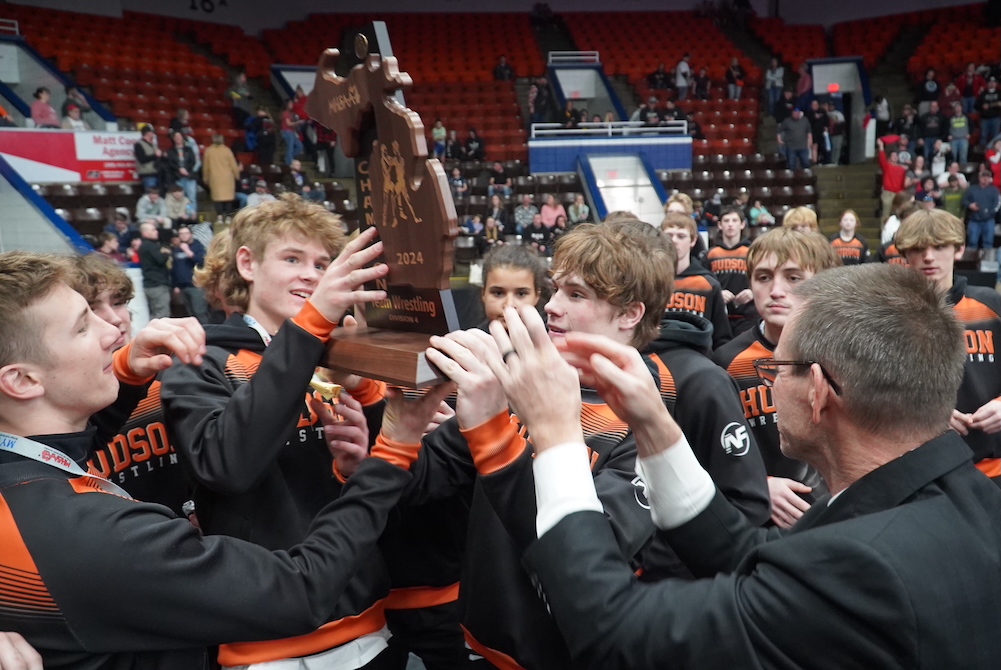
PHOTO Hudson accepts its Division 4 championship trophy last season at Wings Event Center. (Click for more from High School Sports Scene.)