

New Math: Division & Multiplication Problems
July 25, 2017
By Jack Roberts
MHSAA Executive Director
This is the second part in a series on MHSAA tournament classification, past and present, that will be published over the next two weeks. This series originally ran in this spring's edition of MHSAA benchmarks.
High school tournament classifications went viral before there was social media and most of us knew what “viral” meant.
Much as a virus infects computers today or has created epidemics of disease around the world for centuries, high school tournament classification – once introduced – tends to spread uncontrollably. Once started, it tends to keep expanding and rarely contracts.
While we are still some distance from providing every team a trophy as a result of expanding high school tournament classification across the country, there is criticism nevertheless that we are headed in that direction – a philosophy which is supposed to exist only in local youth sports for our youngest children.
Michigan could be blamed for all this. Michigan is generally accepted as the first state to provide different classifications for season-ending tournaments for different sized schools. It started a century ago. Today, every state has various classifications for its tournaments in most if not all sports. And it is a bit ironic that Michigan – creator of the classification chaos – more than most other states has kept the number of tournament classes or divisions under control.
Yes, there is evidence that tournament classifications have expanded over the years in Michigan, especially with the relatively recent introduction of tournaments in football and the late 1990s’ move from classes to divisions in most MHSAA tournaments. But the MHSAA Representative Council has held true to its word when it expanded the playoffs for football from four classes to eight divisions: this is needed because of unique factors of football, factors that exist in no other sport; and all other sports should be capped at a maximum of four classes or divisions.
Kentucky is the preeminent defender of single-class basketball. All of its 276 high schools compete for the single state championship for each gender. In Indiana, there are still open wounds from its move in 1998 from one to four classes for its 400 schools in basketball.
Multi-class tournaments have tended to increase the number of non-public school champions, which some states are trying to lower through enrollment “multipliers,” and also tend to increase the number of repeat champions, which some states are trying to affect with “success factors” which lift smaller schools into classifications for larger schools if they take home too many trophies.
While there is considerable evidence that state tournaments do as much bad as good for educational athletics, state associations persist in providing postseason tournaments because, on balance, the experiences are supposed to be good for student-athletes. And once we reach that conclusion it is just a small leap to believe that if the tournaments are good for a few, they must be better for more – which leads to creating more and more tournament classifications. One becomes two classes, then three, then four and so forth.
While the argument is that more classifications or divisions provides more students with opportunities to compete and win, it is undeniable that the experience changes as the number of tournament classifications expands. It is not possible for state associations to provide the same level of support when tournament classifications expand to multiple venues playing simultaneously. For example, there is less audio and video broadcast potential at each venue, and less media coverage to each venue. Focus is diluted and fans diminished at each championship.
No one can argue reasonably that today's two-day MHSAA Football Finals of eight championship games has the same pizazz as the one-day, four-games event conducted prior to 1990.
In some states the number of divisions has grown so much that it is difficult to see much difference between the many season-ending state championship games and a regular-season event in the same sport.
It is a balancing act. And Michigan has been studying that balance longer than any other state, and charting a steadier course than most.
Addition by Division
The shift to Divisions for MHSAA Tournament play in numerous sports has added up to a greater number of champions for teams and individuals across the state. Following are the sports currently employing a divisional format, and the procedures for determining enrollment and classification.
In 23 statewide or Lower Peninsula tournaments, schools which sponsor the sport are currently divided into nearly equal divisions. They are:
- Baseball - 4 Divisions
- Boys Bowling - 4 Divisions
- Girls Bowling - 4 Divisions
- Girls Competitive Cheer - 4 Divisions
- LP Boys Cross Country - 4 Divisions
- LP Girls Cross Country - 4 Divisions
- LP Boys Golf - 4 Divisions
- LP Girls Golf - 4 Divisions
- Ice Hockey - 3 Divisions
- Boys Lacrosse - 2 Divisions
- Girls Lacrosse - 2 Divisions
- Boys Skiing - 2 Divisions
- Girls Skiing - 2 Divisions
- LP Boys Soccer - 4 Divisions LP
- Girls Soccer - 4 Divisions
- Girls Softball - 4 Divisions
- LP Boys Swimming & Diving - 3 Divisions
- LP Girls Swimming & Diving - 3 Divisions
- LP Boys Tennis - 4 Divisions
- LP Girls Tennis - 4 Divisions
- LP Boys Track & Field - 4 Divisions
- LP Girls Track & Field - 4 Divisions
- Wrestling - 4 Divisions
Lists of schools for each division of these 23 tournaments are posted on MHSAA.com approximately April 1. Listings of schools in Upper Peninsula tournaments for their sports are also posted on MHSAA.com. The lists are based on school memberships and sports sponsorships in effect or anticipated for the following school year, as known to the MHSAA office as of a date in early March.
In football, the 256 schools which qualify for MHSAA 11-player playoffs are placed in eight equal divisions annually on Selection Sunday. Beginning in 2017, the 8-player divisions will be determined in a like manner on Selection Sunday as well, with 32 qualifying schools placed in two divisions.
Schools have the option to play in any higher division in one or more sports for a minimum of two years.
The deadlines for "opt-ups" are as follows:
- Applications for fall sports must be submitted by April 15
- Applications for winter sports must be submitted by Aug. 15
- Applications for spring sports must be submitted by Oct. 15
Subsequent to the date of these postings for these tournaments, no school will have its division raised or lowered by schools opening or closing, schools adding or dropping sports, schools exercising the option to play in a higher division, or approval or dissolution of cooperative programs.
When the same sport is conducted for boys and girls in the same season (e.g., track & field and cross country), the gender that has the most sponsoring schools controls the division breaks for both genders.
Preview: Returning Champions Set to Build on Past Seasons' Successes
By
Geoff Kimmerly
MHSAA.com senior editor
May 30, 2024
A blend of strong seeds and substantial postseason experience could make catching three of last year’s champions difficult as those teams again pursue repeat titles at this weekend’s Lower Peninsula Girls Tennis Finals.
But the race for the Division 1 championship might be one of the most intriguing in some time.
While Birmingham Seaholm in Division 2, Bloomfield Hills Cranbrook Kingswood in Division 3 and Ann Arbor Greenhills in Division 4 remain the teams to chase in those respective brackets, Clarkston should give Ann Arbor Pioneer a mighty challenge as the latter pursues a fourth-straight Finals title.
All four divisions again will be played Friday and Saturday over multiple locations, with semifinals and finals to be played at the first sites listed below in each division. Play begins between 8:15-8:30 each morning.
Below is a glance at the highest-ranked teams in each division and additional No. 1 singles players expected to be in contention. Click for full brackets and more from MHSAA.com.
LP Division 1 at Midland Tennis Center
Top-ranked: 1. Clarkston, 2. Ann Arbor Pioneer, 3. Novi.
Clarkston: The Wolves finished third a year ago and are seeking their second team championship to go with the Division 1 title won in 2011. All eight flights are seeded, including four top seeds – freshman Sydney Geisz at No. 2 singles, freshman Kayla Lemke at No. 3, junior Charlotte Partchenko at No. 4, and senior Katarina Fisher and junior Ava Henkel at No. 2 doubles. A flight champion would be the team’s first since 2014. Partchenko finished No. 4 singles runner-up last season, and Henkel and now-sophomore Lana Sloan reached the semifinals at No. 3 doubles; Sloan and senior Lauren Sielinski are the second seed at that flight this weekend.
Ann Arbor Pioneer: The Pioneers have won the last three Division 1 championships (sharing with Bloomfield Hills in 2021), and the majority of Finals experience returns in doubles or with doubles players from 2023. Senior Noa Gluskin and sophomore Jessica Primus are the fifth seed at No. 2 after winning the No. 4 doubles title a year ago, and senior Casey Roe and junior Natalie Guo are the second seed at No. 1 with Roe having been part of last season’s runner-up at No. 2 and Guo half of a semifinalist at the top flight. Junior Arella He was part of the runner-up at No. 3 doubles in 2023 and this time is seeded third at No. 4 singles, and senior Eleanor Vogel teamed with Roe last year and this weekend is seeded third at No. 3 singles.
Novi: The Wildcats have never won or finished runner-up at the Finals, but did tie for fourth a year ago and enter this weekend with six seeded flights and especially strong points potential in doubles. Seniors Haruka Ishibashi and Arushi Singh are the top seed at No. 3 doubles, and sophomores Samaara George and Kyra Thomas are second-seeded at No. 4. George played No. 1 singles last season, and Ishibashi played No. 3. Singh was part of the runner-up at No. 4 doubles in 2023.
Gabrielle Sadkowski, Utica Eisenhower sophomore: Top seed Sadkowski’s only loss over two years of high school tennis was last season to eventual LPD1 No. 1 singles champion Sari Woo from Ann Arbor Skyline. Sadkowski is 11-0 this spring.
Nicole Fu, Rochester Adams junior: Fu has finished No. 1 singles runner-up the last two seasons, and she’s the second seed this weekend entering at 16-0 this year.
Brooke Nicholson & Alexis Gabriel, Utica Eisenhower senior/sophomore: This pair entered last season’s No. 1 doubles bracket as the fifth seed and reached the quarterfinals. They’re the top seed this time and 28-2 this spring.
Other returning 2023 flight champions: Troy seniors Hannah Lee & Michelle Baik (No. 3 doubles last season, No. 1 doubles this weekend).
LP Division 2 at Byron Center West Sports Complex & Grand Rapids South Christian
Top-ranked: 1. Birmingham Seaholm, 2. Grand Rapids Forest Hills Northern, 3. Farmington Hills Mercy.
Birmingham Seaholm: The Maples jumped past Forest Hills Northern into the top spot in the final coaches poll of the regular season, and the reigning LPD2 champion has finished first or second at this tournament nine times beginning in 2011. All eight flights are seeded this time, but the greatest scoring potential is in doubles with junior Jordyn Lusky and sophomore Lucy Jen seeded first at No. 3 and sophomore Anna Olekszyk and freshman Katie Joyce top-seeded at No. 4. Lusky and Jen were part of championship pairs at Nos. 3 and 4, respectively, last season, and seniors Katie Slazinski and Jenna Ting were champions at No. 2 and are the second seed this weekend at No. 1. Senior Stella North won with Jen a year ago and is seeded fifth this time at No. 2 doubles with freshman Sophia Arndt. Senior Courtney Marcum is seeded fourth at No. 1 singles after winning No. 2 a year ago, and sophomore Jada Josifovski is seeded third at No. 2 coming off a No. 3 runner-up finish as a freshman.
Grand Rapids Forest Hills Northern: Although only five flights are seeded, three are top-seeded as FHN looks to bump up from last year’s tie for second place and claim a third championship over the last four seasons. Seniors Ryan Morey and Paige McKenzie at No. 1 doubles and junior Lauren Jaklitsch and Morgan McKenzie at No. 2 carry those top seeds, with Morey and Paige McKenzie the reigning champs at the top flight and Jaklitsch part of last year’s runner-up at No. 2. Morey also was part of No. 2 doubles flight championships as both a freshman and a sophomore. Junior Andrea Wang adds another top seed at No. 2 singles, and sophomore Harriet Ogilvie is the fourth seed at No. 3 singles after winning No. 4 in 2023.
Farmington Hills Mercy: The Marlins have been surging with a powerful singles lineup that locked down top seeds at No. 1 with junior Megan Sullivan, No. 3 with sophomore Alexa Dueweke and No. 4 with sophomore Gabby Owens, and a second seed at No. 2 with sophomore Keira Kirkland. Mercy’s only top-two Finals finish was second place in Division 1 in 2013, and the Marlins tied for 11th in Division 1 last season. Two doubles flights also are seeded.
Lily Ohlman, Grand Rapids Forest Hills Central senior: The reigning champion at No. 1 singles is 24-2 and seeded second with her most recent loss coming to Sullivan on May 4 by a score of 7-6 (2), 6-7 (4), 10-8.
LP Division 3 at Kalamazoo College & Western Michigan University
Top-ranked: 1. Bloomfield Hills Cranbrook Kingswood, 2. Detroit Country Day, 3. Bloomfield Hills Marian.
Bloomfield Hills Cranbrook Kingswood: The Cranes have won the last two Division 3 titles after three straight runner-up finishes (not counting COVID-canceled 2020). There’s loads of championship experience and every flight is seeded, with four top seeds – junior Chiarra Martella at No. 3 singles, senior Olivia Zhang at No. 4, junior Madeline Day and senior Sanvi Upadhyayala at No. 3 doubles and juniors Michelle Chen and Jessica Hall at No. 4. Zhang has won No. 4 singles the last two seasons, and senior Sienna Ilitch has won No. 3 singles the last two seasons and is seeded eighth at No. 1 this weekend; both also were singles runners-up as freshmen. Martella was the runner-up at No. 2 a year ago. Seniors Daryn Krause and Kayli Lala are the second seed at No. 1 doubles after finishing runner-up last year, winning No. 4 in 2022 and finishing No. 3 runner-up in 2021. Junior Sophia Kouza and senior Grace Zhang are fourth-seeded at No. 2 doubles after winning that flight last year. Day and Upadhyayala were runners-up last spring at No. 3, and Chen and Hall were the runners-up at No. 4. Grace Zhang also was part of the No. 3 doubles champion in 2022 and the No. 4 runner-up in 2021.
Detroit Country Day: The Yellowjackets fell just two points shy of catching Cranbrook a year ago and return significant members of that lineup as well. Junior Sophia Grzesiak is the top seed at No. 1 singles after reaching the semifinals last season, followed by freshman Quinn Norland seeded first at No. 2 and sophomore Helen Benjamin seeded second at No. 3 after finishing runner-up at No. 4 singles in 2023. Seniors Marin Norlander and Peja Liles are the top seed and reigning champs at No. 1 doubles, and Liles also was part of the winning pair in 2022 and runner-up pair in 2021. Sophomore Jiya Gill and senior Becca Borgia are the third seed at No. 3 doubles with Gill coming off a No. 4 doubles championship last year.
Bloomfield Hills Marian: The Mustangs finished fifth last year and were third in Division 2 just three seasons ago. All eight flights are seeded, led by a pair of second-seeded doubles – sophomore Audrey Agbay and freshman Yana Higgins at No. 3 and senior Lauren Higdon and freshman Stella Glorio at No. 4.
Natalie Poortenga, Grand Rapids Christian senior: Last season’s champion at No. 2 singles is the third seed at No. 1 this time, and took Forest Hills Central’s Ohlman to three sets in an April loss.
Lilah Zaskowski, Ada Forest Hills Eastern freshman: She’s 22-3 and the second seed at No. 1 singles heading into her first Finals, with two of her three losses coming over the last two weeks in tune-ups against Ohlman and Forest Hills Northern’s Wang.
Other returning 2023 flight champions: Grand Rapids Christian sophomore Avah Jerke (No. 3 doubles last season, No. 4 singles this weekend).
LP Division 4 at University of Michigan & Ann Arbor Greenhills
Top-ranked: 1. Ann Arbor Greenhills, 2. Pontiac Notre Dame Prep, 3. Traverse City St. Francis.
Ann Arbor Greenhills: The Gryphons also are seeking their third-straight Finals team championship, and nearly doubled up the next-highest finisher a year ago. Junior Maddie Morgan is the reigning champion at No. 1 singles and seeded second this weekend, while junior Shangyang Xia is the top seed at No. 3 after winning No. 2 in 2023 and sophomore Danica Rakic-Dennis the top seed at No. 4 after winning at No. 3 a year ago. They moved with freshman Ellie Kim is the top seed at No. 2 singles. Greenhills has all four top seeds in doubles as well – sophomore Lauren Ye and freshman Nina Malani at No. 1, juniors Sophie Chen and Sophia Kleer at No. 2, juniors Meera Tewari and Meera Pandey at No. 3, and senior Parini Rao and freshman Alyssa Hong at No. 4. Chen and Ye were runners-up at No. 1 last season, and Pandey and Tewari were the runners-up at No. 3.
Pontiac Notre Dame Prep: The Fighting Irish should provide a nice challenge after finishing fourth in Division 3 last season and with all eight flights seeded fourth or higher. Junior Francheska Daugaru at No. 2 singles and senior Addison Bellows at No. 3 lead with second seeds. Bellows was the Division 3 runner-up at No. 4 singles as a sophomore, and senior Julia Gurne – seeded third at No. 1 singles this weekend – was the Division 3 runner-up at No. 1 as a freshman.
Traverse City St. Francis: The Gladiators were fourth a year ago and have finished runner-up four of the last nine years, most recently in 2021. All but one flight is seeded, and five are seeded fourth or higher led by senior Ava Pomaranski with the second seed at No. 4 singles.
Ayva Johnstone, Elk Rapids senior: She reached the quarterfinals at No. 1 singles as the fourth seed last season and returns this weekend as the top seed and 25-0.
Other returning 2023 flight champions: Bloomfield Hills Academy of the Sacred Heart senior Kayla Nafso (No. 1 doubles last season, No. 1 singles this weekend), Bloomfield Hills Academy of the Sacred Heart senior Maggie Pulte (No. 2 doubles last season and this weekend).
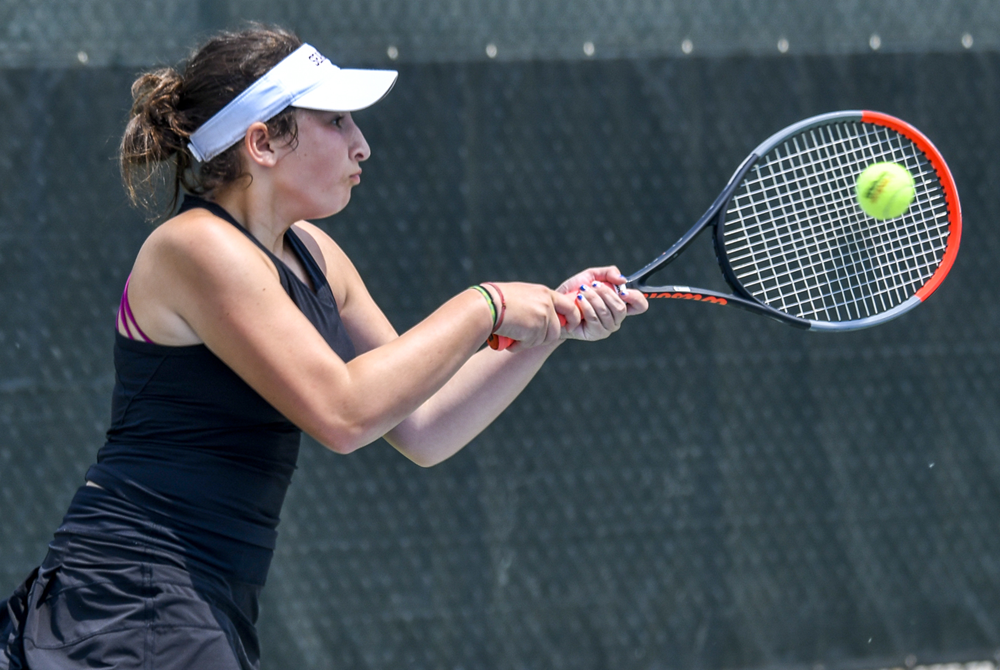
PHOTO Birmingham Seaholm's Jordyn Lusky returns a volley during last season's LPD2 Finals championship match at No. 3 doubles. (Click for more from High School Sports Scene.)