

New Math: Division & Multiplication Problems
July 25, 2017
By Jack Roberts
MHSAA Executive Director
This is the second part in a series on MHSAA tournament classification, past and present, that will be published over the next two weeks. This series originally ran in this spring's edition of MHSAA benchmarks.
High school tournament classifications went viral before there was social media and most of us knew what “viral” meant.
Much as a virus infects computers today or has created epidemics of disease around the world for centuries, high school tournament classification – once introduced – tends to spread uncontrollably. Once started, it tends to keep expanding and rarely contracts.
While we are still some distance from providing every team a trophy as a result of expanding high school tournament classification across the country, there is criticism nevertheless that we are headed in that direction – a philosophy which is supposed to exist only in local youth sports for our youngest children.
Michigan could be blamed for all this. Michigan is generally accepted as the first state to provide different classifications for season-ending tournaments for different sized schools. It started a century ago. Today, every state has various classifications for its tournaments in most if not all sports. And it is a bit ironic that Michigan – creator of the classification chaos – more than most other states has kept the number of tournament classes or divisions under control.
Yes, there is evidence that tournament classifications have expanded over the years in Michigan, especially with the relatively recent introduction of tournaments in football and the late 1990s’ move from classes to divisions in most MHSAA tournaments. But the MHSAA Representative Council has held true to its word when it expanded the playoffs for football from four classes to eight divisions: this is needed because of unique factors of football, factors that exist in no other sport; and all other sports should be capped at a maximum of four classes or divisions.
Kentucky is the preeminent defender of single-class basketball. All of its 276 high schools compete for the single state championship for each gender. In Indiana, there are still open wounds from its move in 1998 from one to four classes for its 400 schools in basketball.
Multi-class tournaments have tended to increase the number of non-public school champions, which some states are trying to lower through enrollment “multipliers,” and also tend to increase the number of repeat champions, which some states are trying to affect with “success factors” which lift smaller schools into classifications for larger schools if they take home too many trophies.
While there is considerable evidence that state tournaments do as much bad as good for educational athletics, state associations persist in providing postseason tournaments because, on balance, the experiences are supposed to be good for student-athletes. And once we reach that conclusion it is just a small leap to believe that if the tournaments are good for a few, they must be better for more – which leads to creating more and more tournament classifications. One becomes two classes, then three, then four and so forth.
While the argument is that more classifications or divisions provides more students with opportunities to compete and win, it is undeniable that the experience changes as the number of tournament classifications expands. It is not possible for state associations to provide the same level of support when tournament classifications expand to multiple venues playing simultaneously. For example, there is less audio and video broadcast potential at each venue, and less media coverage to each venue. Focus is diluted and fans diminished at each championship.
No one can argue reasonably that today's two-day MHSAA Football Finals of eight championship games has the same pizazz as the one-day, four-games event conducted prior to 1990.
In some states the number of divisions has grown so much that it is difficult to see much difference between the many season-ending state championship games and a regular-season event in the same sport.
It is a balancing act. And Michigan has been studying that balance longer than any other state, and charting a steadier course than most.
Addition by Division
The shift to Divisions for MHSAA Tournament play in numerous sports has added up to a greater number of champions for teams and individuals across the state. Following are the sports currently employing a divisional format, and the procedures for determining enrollment and classification.
In 23 statewide or Lower Peninsula tournaments, schools which sponsor the sport are currently divided into nearly equal divisions. They are:
- Baseball - 4 Divisions
- Boys Bowling - 4 Divisions
- Girls Bowling - 4 Divisions
- Girls Competitive Cheer - 4 Divisions
- LP Boys Cross Country - 4 Divisions
- LP Girls Cross Country - 4 Divisions
- LP Boys Golf - 4 Divisions
- LP Girls Golf - 4 Divisions
- Ice Hockey - 3 Divisions
- Boys Lacrosse - 2 Divisions
- Girls Lacrosse - 2 Divisions
- Boys Skiing - 2 Divisions
- Girls Skiing - 2 Divisions
- LP Boys Soccer - 4 Divisions LP
- Girls Soccer - 4 Divisions
- Girls Softball - 4 Divisions
- LP Boys Swimming & Diving - 3 Divisions
- LP Girls Swimming & Diving - 3 Divisions
- LP Boys Tennis - 4 Divisions
- LP Girls Tennis - 4 Divisions
- LP Boys Track & Field - 4 Divisions
- LP Girls Track & Field - 4 Divisions
- Wrestling - 4 Divisions
Lists of schools for each division of these 23 tournaments are posted on MHSAA.com approximately April 1. Listings of schools in Upper Peninsula tournaments for their sports are also posted on MHSAA.com. The lists are based on school memberships and sports sponsorships in effect or anticipated for the following school year, as known to the MHSAA office as of a date in early March.
In football, the 256 schools which qualify for MHSAA 11-player playoffs are placed in eight equal divisions annually on Selection Sunday. Beginning in 2017, the 8-player divisions will be determined in a like manner on Selection Sunday as well, with 32 qualifying schools placed in two divisions.
Schools have the option to play in any higher division in one or more sports for a minimum of two years.
The deadlines for "opt-ups" are as follows:
- Applications for fall sports must be submitted by April 15
- Applications for winter sports must be submitted by Aug. 15
- Applications for spring sports must be submitted by Oct. 15
Subsequent to the date of these postings for these tournaments, no school will have its division raised or lowered by schools opening or closing, schools adding or dropping sports, schools exercising the option to play in a higher division, or approval or dissolution of cooperative programs.
When the same sport is conducted for boys and girls in the same season (e.g., track & field and cross country), the gender that has the most sponsoring schools controls the division breaks for both genders.
Grayling, High-Scoring Senior Off to Fast Start, Setting Sights Higher
By
Tom Spencer
Special for MHSAA.com
September 8, 2023
Grayling is not normally mentioned among the contenders for the Lake Michigan Conference soccer championship.
 Nor have deep postseason runs been expected.
All that may be changing. The Vikings are making it known they will challenge the likes of Elk Rapids, Harbor Springs and Charlevoix for the league title, with Kalkaska hoping to contend in the LMC as well.
Grayling is scoring goals. The Vikings (7-1) won their first seven contests this year scoring a combined 46 goals in the process. They picked up wins over Ogemaw Heights and Mount Pleasant along the way. They also won an early-season tournament they hosted.
Senior Mitchell Harrington is leading the way with 25 goals and eight assists.
“Mitch wasn’t on the radar last year preseason,” acknowledged Grayling coach Andy Moore. “He came back late preseason and then of course he gets all-state honorable mention last year as a junior.”
As a freshman Harrington played mostly defense for the Vikings. He switched to football his sophomore year. He came back to soccer last season and scored 26 goals and picked up five assists.
Now he has the single-season school scoring record in his sights along with challenging for the conference title and leading the Vikings into the postseason.
 Harrington is helping put the Vikings as a team on the radar screen too. They are coming off a 9-12-1 finish last year. They were 8-12-1 in 2021 and 12-6-1 in 2020, Moore’s first year at the helm.
Harrington is widely acclaimed for his speed and ability to put the ball in the net. Opposing coaches know they can never rest with a lead knowing Harrington is dangerous and can make the game interesting with his quick strikes.
“Mitch is a good kid,” Moore said of his senior star. “He’s a class act, and that’s what we tell these kids to be.”
Harrington is surrounded by talented soccer players, Moore is quick to say.
“We have a good supporting cast,” Moore asserted.
Junior Drake Dunham has six goals and 11 assists. Senior Alex Moore has contributed five goals and four assists, and sophomore Brody Cobb has six goals and an assist.
Center back Grant Dunham, also a junior, leads the defense in front of sophomore Jordan Peters, who gained valuable experience in net last year.
“For me, it starts with our center defender Grant Dunham,” Moore said. “And, Jordan is an amazing keeper.”
Grayling suffered its first loss of the season Thursday to perennial champ Elk Rapids. The Elks blew open a 1-1 second-half tie with five goals over the final 25 minutes of the contest. Harrington scored the Vikings’ lone goal.
“We had a learning experience,” Moore said of his team’s first loss. “We’ve got to adjust and move on and get ready for Harbor Springs.
“We’ve got to move forward as a team and get better.”
The Vikings will play next at Harbor Springs on Sept. 12. They get to host both Harbor and the Elks later in the season. They also will play Kalkaska in a home and home. The Blazers tied Harbor on Thursday and are off to a 1-0-1 league and 4-1-2 overall start.
 Harrington has high hopes of keeping the Vikings in the league race as he reaches for the school’s scoring record. The bar is set at 42.
“Mitch is aiming for the school record,” Moore pointed out. “He should get it, but we’ll see.”
Elk Rapids remains the measuring stick for much of the league, but especially Grayling’s fourth-year coach.
“Elk Rapids is the team where you want to be,” Moore said. “I always tell the kids this is the team you want to beat and want to compete against.
“Mentally, I think we’re there,” he continued. “I thought last year in the Districts we were there mentally as well, but we played nervous and fouled (and) gave up two early penalty kicks.”
The Elks defeated Grayling 5-2 last year in that contest on their way to the District and Regional titles. Harrington had both goals.
The Vikings, who will host the District tournament including both Elk Rapids and Kalkaska this fall, aren’t really surprised to be off to a 7-1 start.
“We kind of expected it a little bit with what we’ve been building on the last couple years,” Moore said. “We’re excited.
“We beat a couple of quality teams in Ogemaw Heights and Mount Pleasant,” Moore continued. “We feel pretty good about ourselves.”
 Tom Spencer is a longtime MHSAA-registered basketball and soccer official, and former softball and baseball official, and he also has coached in the northern Lower Peninsula area. He previously has written for the Saginaw News, Bay County Sports Page and Midland Daily News. He can be reached at [email protected] with story ideas for Manistee, Wexford, Missaukee, Roscommon, Ogemaw, Iosco, Alcona, Oscoda, Crawford, Kalkaska, Grand Traverse, Benzie, Leelanau, Antrim, Otsego, Montmorency, Alpena, Presque Isle, Cheboygan, Charlevoix and Emmet counties.
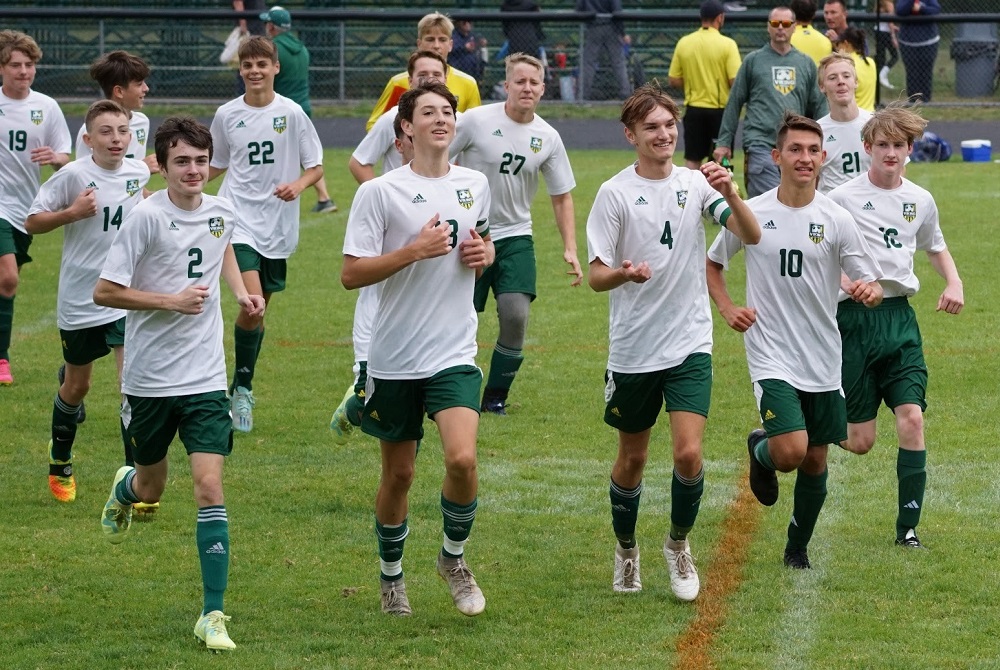
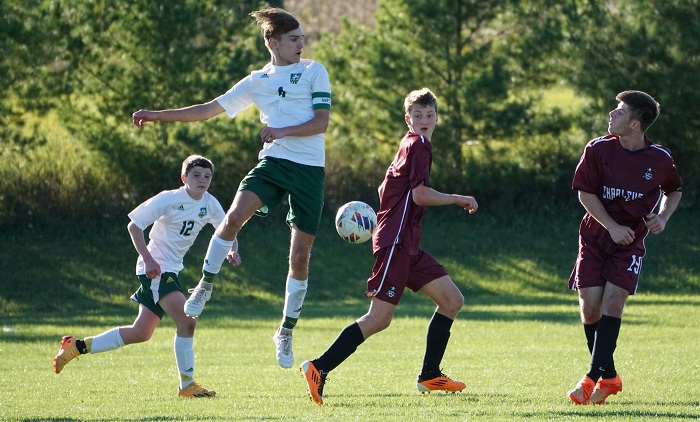
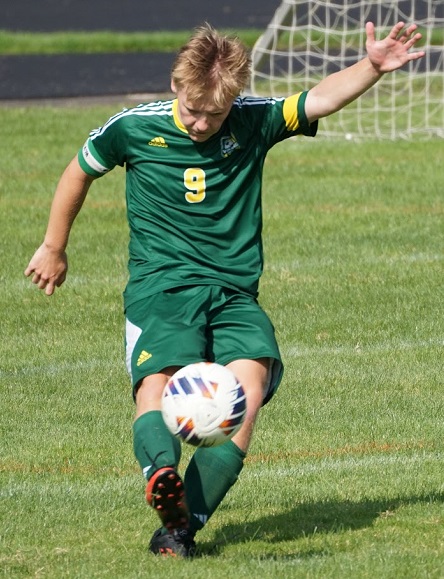
PHOTOS (Top) Grayling, including Caleb Baker (2), Ben Gardiner (13), Mitchel Harrington (4) and Gibsen Barnett (10), is off to a 7-1 start. (Middle) Harrington and Alex Moore (12) work to control possession against Charlevoix this season. (Below) Grant Dunham drives the ball downfield. (Photos by Stacy Moore.)