


New Math: Division & Multiplication Problems
July 25, 2017
By Jack Roberts
MHSAA Executive Director
This is the second part in a series on MHSAA tournament classification, past and present, that will be published over the next two weeks. This series originally ran in this spring's edition of MHSAA benchmarks.
High school tournament classifications went viral before there was social media and most of us knew what “viral” meant.
Much as a virus infects computers today or has created epidemics of disease around the world for centuries, high school tournament classification – once introduced – tends to spread uncontrollably. Once started, it tends to keep expanding and rarely contracts.
While we are still some distance from providing every team a trophy as a result of expanding high school tournament classification across the country, there is criticism nevertheless that we are headed in that direction – a philosophy which is supposed to exist only in local youth sports for our youngest children.
Michigan could be blamed for all this. Michigan is generally accepted as the first state to provide different classifications for season-ending tournaments for different sized schools. It started a century ago. Today, every state has various classifications for its tournaments in most if not all sports. And it is a bit ironic that Michigan – creator of the classification chaos – more than most other states has kept the number of tournament classes or divisions under control.
Yes, there is evidence that tournament classifications have expanded over the years in Michigan, especially with the relatively recent introduction of tournaments in football and the late 1990s’ move from classes to divisions in most MHSAA tournaments. But the MHSAA Representative Council has held true to its word when it expanded the playoffs for football from four classes to eight divisions: this is needed because of unique factors of football, factors that exist in no other sport; and all other sports should be capped at a maximum of four classes or divisions.
Kentucky is the preeminent defender of single-class basketball. All of its 276 high schools compete for the single state championship for each gender. In Indiana, there are still open wounds from its move in 1998 from one to four classes for its 400 schools in basketball.
Multi-class tournaments have tended to increase the number of non-public school champions, which some states are trying to lower through enrollment “multipliers,” and also tend to increase the number of repeat champions, which some states are trying to affect with “success factors” which lift smaller schools into classifications for larger schools if they take home too many trophies.
While there is considerable evidence that state tournaments do as much bad as good for educational athletics, state associations persist in providing postseason tournaments because, on balance, the experiences are supposed to be good for student-athletes. And once we reach that conclusion it is just a small leap to believe that if the tournaments are good for a few, they must be better for more – which leads to creating more and more tournament classifications. One becomes two classes, then three, then four and so forth.
While the argument is that more classifications or divisions provides more students with opportunities to compete and win, it is undeniable that the experience changes as the number of tournament classifications expands. It is not possible for state associations to provide the same level of support when tournament classifications expand to multiple venues playing simultaneously. For example, there is less audio and video broadcast potential at each venue, and less media coverage to each venue. Focus is diluted and fans diminished at each championship.
No one can argue reasonably that today's two-day MHSAA Football Finals of eight championship games has the same pizazz as the one-day, four-games event conducted prior to 1990.
In some states the number of divisions has grown so much that it is difficult to see much difference between the many season-ending state championship games and a regular-season event in the same sport.
It is a balancing act. And Michigan has been studying that balance longer than any other state, and charting a steadier course than most.
Addition by Division
The shift to Divisions for MHSAA Tournament play in numerous sports has added up to a greater number of champions for teams and individuals across the state. Following are the sports currently employing a divisional format, and the procedures for determining enrollment and classification.
In 23 statewide or Lower Peninsula tournaments, schools which sponsor the sport are currently divided into nearly equal divisions. They are:
- Baseball - 4 Divisions
- Boys Bowling - 4 Divisions
- Girls Bowling - 4 Divisions
- Girls Competitive Cheer - 4 Divisions
- LP Boys Cross Country - 4 Divisions
- LP Girls Cross Country - 4 Divisions
- LP Boys Golf - 4 Divisions
- LP Girls Golf - 4 Divisions
- Ice Hockey - 3 Divisions
- Boys Lacrosse - 2 Divisions
- Girls Lacrosse - 2 Divisions
- Boys Skiing - 2 Divisions
- Girls Skiing - 2 Divisions
- LP Boys Soccer - 4 Divisions LP
- Girls Soccer - 4 Divisions
- Girls Softball - 4 Divisions
- LP Boys Swimming & Diving - 3 Divisions
- LP Girls Swimming & Diving - 3 Divisions
- LP Boys Tennis - 4 Divisions
- LP Girls Tennis - 4 Divisions
- LP Boys Track & Field - 4 Divisions
- LP Girls Track & Field - 4 Divisions
- Wrestling - 4 Divisions
Lists of schools for each division of these 23 tournaments are posted on MHSAA.com approximately April 1. Listings of schools in Upper Peninsula tournaments for their sports are also posted on MHSAA.com. The lists are based on school memberships and sports sponsorships in effect or anticipated for the following school year, as known to the MHSAA office as of a date in early March.
In football, the 256 schools which qualify for MHSAA 11-player playoffs are placed in eight equal divisions annually on Selection Sunday. Beginning in 2017, the 8-player divisions will be determined in a like manner on Selection Sunday as well, with 32 qualifying schools placed in two divisions.
Schools have the option to play in any higher division in one or more sports for a minimum of two years.
The deadlines for "opt-ups" are as follows:
- Applications for fall sports must be submitted by April 15
- Applications for winter sports must be submitted by Aug. 15
- Applications for spring sports must be submitted by Oct. 15
Subsequent to the date of these postings for these tournaments, no school will have its division raised or lowered by schools opening or closing, schools adding or dropping sports, schools exercising the option to play in a higher division, or approval or dissolution of cooperative programs.
When the same sport is conducted for boys and girls in the same season (e.g., track & field and cross country), the gender that has the most sponsoring schools controls the division breaks for both genders.
Greenville's Martin Finds Future as On-Air Voice for Local Radio Broadcasts
By
Steve Vedder
Special for MHSAA.com
March 20, 2026
Gracelin Martin can actually point to the moment where she glimpsed the rest of her professional life.
The current Greenville senior had just completed her first full season of working as a play-by-play broadcaster for radio station WGLM, and her watchful eyes took in the moments following a tense Lowell-Greenville basketball game. If she hadn't figured it out before, it dawned on Martin she loved it all: the back-and-forth of the game's action, the noisy crowd and the responsibility of detailing into a live mic what she was witnessing while looking forward to interviewing the participants afterward.
It was right about that moment that Martin decided the whole frantic atmosphere would be paramount in her future.
"I felt very accomplished," she said. "I didn't think a person so young could be in this role. I was kind of proud of myself."
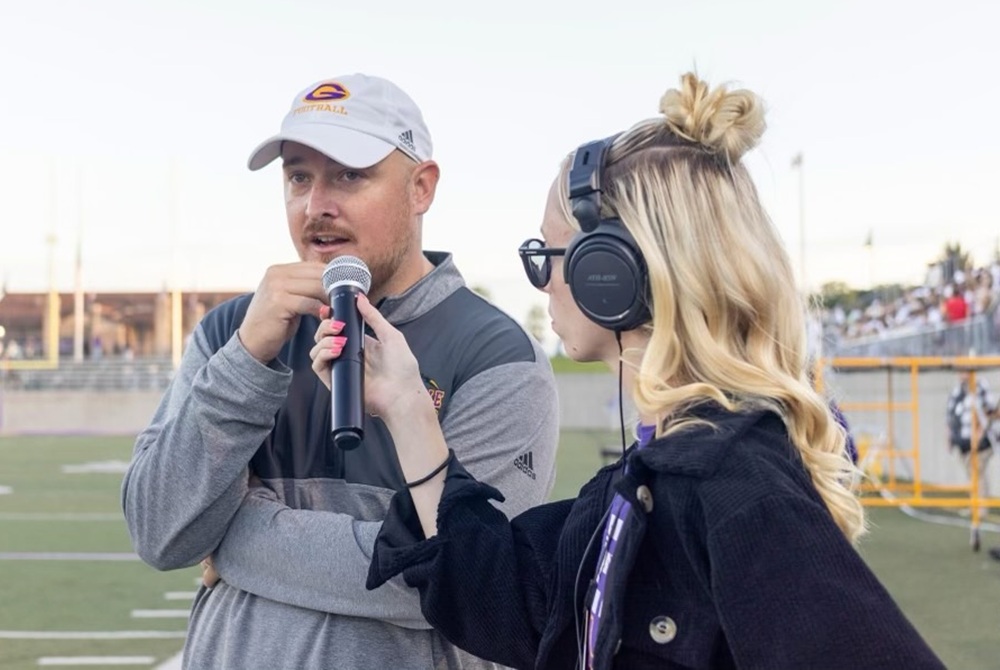
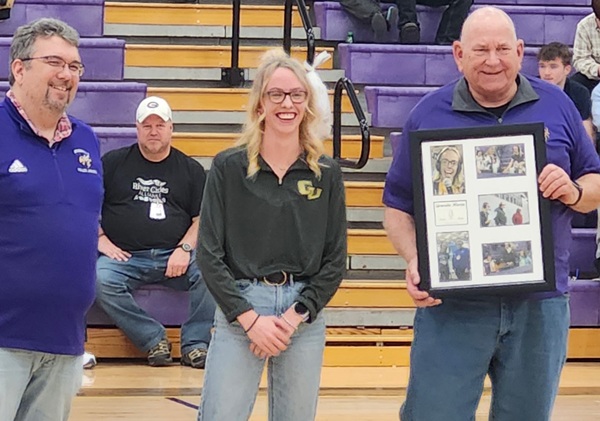
Martin wasn't even 18 years old when longtime Greenville public address announcer and WGLM employee Bill Wilson noticed this eager young teenager with obvious people-person skills chatting easily with friends when an idea popped into his mind. The station needed someone to replace Serena Schroeder, another young student sideline reporter at Greenville football and basketball games who was going off to Michigan State. Wilson engaged Martin, and his suspicions were quickly confirmed. This, Wilson thought, was what he was seeking.
 "He said I had this bubbly personality and would I consider broadcasting football and basketball games," said Martin, a basketball, track and cross country letter winner at Greenville. "Without hesitating, I said yes. I was 100-percent down with it.
"I saw an opportunity and took it. I never knew what could come of it."
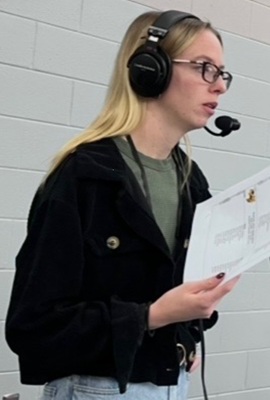
So despite being just a 15-year-old high school sophomore with absolutely no radio background, Martin quickly fell in love with everything about the business of being a sideline reporter in football and a play-by-play broadcaster in basketball.
Wilson, who works Greenville football, basketball, track and soccer games, said he knew nothing of Martin at first except remembering seeing her play varsity basketball as a freshman. It wasn't her voice, mannerisms or really anything else that immediately leaped out at him. It was simply a sixth sense about matching up an obviously effervescent personality with a microphone.
"I had never met her, but I knew we were looking for someone to replace Serena and things just kind of clicked," he said. "She has this good personality, I thought she could be the one. She said she was interested, and it went from there."
Martin admits there was a definite gamble in being a teenage novice with a microphone thrust in front of her mixing with longtime coaches and athletes who doubled as high school friends. Would she freeze, stutter, flub questions, seem obviously underqualified or, worst of all, unprepared?
But by doing her homework and always being prepared, Martin found she easily could hit on the information she needed through interviews.
 "The thought definitely crossed my mind," she said of the whole idea being a gamble. "I didn't know football inside-out like I knew basketball. I put pressure on myself to learn. But really, I felt ease from the beginning."
Dixon Huiet works as a WGLM analyst for Greenville football broadcasts. Part of a three-person crew, Huiet said Martin has an innate ability to grasp what intricacies fans need to know about what's happening on a football field or basketball court. The ability to pair the flow of a game with what fans want to know about what's happening is critical, he said.
"She's very fluid in understanding what needs to happen as a sideline reporter," he said. "And she knows how to step up, take the lead in broadcasting the play-by-play of a basketball game.
"She's come so far. She understands where to go and if she doesn't get the answer she wants, she can pivot. She's worked at it and evolved, and that's a skill."
Martin is astute enough to recognize where she can find help in improving as a broadcaster. She's noticed, for instance, how ESPN and ABC broadcaster Holly Rowe or the Big Ten Network's Dannie Rogers conduct their business on TV. Toss in tips from Schroeder, who recently graduated from Michigan State with a communications degree, and the confidence shown by Wilson and Huiet, and Martin feels comfortable in the business.
All broadcasters start somewhere, and Martin knows she's lucky enough to have started by interviewing coaches and athletes she's known for years. It's a crucial early stepping-stone which Martin doesn't underestimate.
"I knew a lot of the coaches and players from school and watched women like Holly and Dannie, and I thought this was something I could do," she said. "Honestly, you see a lot of females on TV, and bringing them into the broadcast business is a good thing. I enjoy learning from people who are better than me."
Martin’s upcoming plans include running cross country and track while entering Cornerstone University's communication program.
After honing skills in college, Martin said, who knows where her path will lead?
"I feel like not everything will be easy," she said, "but this will set me up and pave the road ahead."
PHOTOS (Top) Gracelin Martin interviews Greenville football coach Scott McDougall during a game this past season. (Middle) Martin receives “Senior Night” recognition from WGLM’s Bill Wilson and Will Wydeck this winter. (Below) Martin describes the action for her audience. (Photos provided by the Greenville athletic department.)