

New Math: Division & Multiplication Problems
July 25, 2017
By Jack Roberts
MHSAA Executive Director
This is the second part in a series on MHSAA tournament classification, past and present, that will be published over the next two weeks. This series originally ran in this spring's edition of MHSAA benchmarks.
High school tournament classifications went viral before there was social media and most of us knew what “viral” meant.
Much as a virus infects computers today or has created epidemics of disease around the world for centuries, high school tournament classification – once introduced – tends to spread uncontrollably. Once started, it tends to keep expanding and rarely contracts.
While we are still some distance from providing every team a trophy as a result of expanding high school tournament classification across the country, there is criticism nevertheless that we are headed in that direction – a philosophy which is supposed to exist only in local youth sports for our youngest children.
Michigan could be blamed for all this. Michigan is generally accepted as the first state to provide different classifications for season-ending tournaments for different sized schools. It started a century ago. Today, every state has various classifications for its tournaments in most if not all sports. And it is a bit ironic that Michigan – creator of the classification chaos – more than most other states has kept the number of tournament classes or divisions under control.
Yes, there is evidence that tournament classifications have expanded over the years in Michigan, especially with the relatively recent introduction of tournaments in football and the late 1990s’ move from classes to divisions in most MHSAA tournaments. But the MHSAA Representative Council has held true to its word when it expanded the playoffs for football from four classes to eight divisions: this is needed because of unique factors of football, factors that exist in no other sport; and all other sports should be capped at a maximum of four classes or divisions.
Kentucky is the preeminent defender of single-class basketball. All of its 276 high schools compete for the single state championship for each gender. In Indiana, there are still open wounds from its move in 1998 from one to four classes for its 400 schools in basketball.
Multi-class tournaments have tended to increase the number of non-public school champions, which some states are trying to lower through enrollment “multipliers,” and also tend to increase the number of repeat champions, which some states are trying to affect with “success factors” which lift smaller schools into classifications for larger schools if they take home too many trophies.
While there is considerable evidence that state tournaments do as much bad as good for educational athletics, state associations persist in providing postseason tournaments because, on balance, the experiences are supposed to be good for student-athletes. And once we reach that conclusion it is just a small leap to believe that if the tournaments are good for a few, they must be better for more – which leads to creating more and more tournament classifications. One becomes two classes, then three, then four and so forth.
While the argument is that more classifications or divisions provides more students with opportunities to compete and win, it is undeniable that the experience changes as the number of tournament classifications expands. It is not possible for state associations to provide the same level of support when tournament classifications expand to multiple venues playing simultaneously. For example, there is less audio and video broadcast potential at each venue, and less media coverage to each venue. Focus is diluted and fans diminished at each championship.
No one can argue reasonably that today's two-day MHSAA Football Finals of eight championship games has the same pizazz as the one-day, four-games event conducted prior to 1990.
In some states the number of divisions has grown so much that it is difficult to see much difference between the many season-ending state championship games and a regular-season event in the same sport.
It is a balancing act. And Michigan has been studying that balance longer than any other state, and charting a steadier course than most.
Addition by Division
The shift to Divisions for MHSAA Tournament play in numerous sports has added up to a greater number of champions for teams and individuals across the state. Following are the sports currently employing a divisional format, and the procedures for determining enrollment and classification.
In 23 statewide or Lower Peninsula tournaments, schools which sponsor the sport are currently divided into nearly equal divisions. They are:
- Baseball - 4 Divisions
- Boys Bowling - 4 Divisions
- Girls Bowling - 4 Divisions
- Girls Competitive Cheer - 4 Divisions
- LP Boys Cross Country - 4 Divisions
- LP Girls Cross Country - 4 Divisions
- LP Boys Golf - 4 Divisions
- LP Girls Golf - 4 Divisions
- Ice Hockey - 3 Divisions
- Boys Lacrosse - 2 Divisions
- Girls Lacrosse - 2 Divisions
- Boys Skiing - 2 Divisions
- Girls Skiing - 2 Divisions
- LP Boys Soccer - 4 Divisions LP
- Girls Soccer - 4 Divisions
- Girls Softball - 4 Divisions
- LP Boys Swimming & Diving - 3 Divisions
- LP Girls Swimming & Diving - 3 Divisions
- LP Boys Tennis - 4 Divisions
- LP Girls Tennis - 4 Divisions
- LP Boys Track & Field - 4 Divisions
- LP Girls Track & Field - 4 Divisions
- Wrestling - 4 Divisions
Lists of schools for each division of these 23 tournaments are posted on MHSAA.com approximately April 1. Listings of schools in Upper Peninsula tournaments for their sports are also posted on MHSAA.com. The lists are based on school memberships and sports sponsorships in effect or anticipated for the following school year, as known to the MHSAA office as of a date in early March.
In football, the 256 schools which qualify for MHSAA 11-player playoffs are placed in eight equal divisions annually on Selection Sunday. Beginning in 2017, the 8-player divisions will be determined in a like manner on Selection Sunday as well, with 32 qualifying schools placed in two divisions.
Schools have the option to play in any higher division in one or more sports for a minimum of two years.
The deadlines for "opt-ups" are as follows:
- Applications for fall sports must be submitted by April 15
- Applications for winter sports must be submitted by Aug. 15
- Applications for spring sports must be submitted by Oct. 15
Subsequent to the date of these postings for these tournaments, no school will have its division raised or lowered by schools opening or closing, schools adding or dropping sports, schools exercising the option to play in a higher division, or approval or dissolution of cooperative programs.
When the same sport is conducted for boys and girls in the same season (e.g., track & field and cross country), the gender that has the most sponsoring schools controls the division breaks for both genders.
Lawton's Rueff Caps Career Among State's All-Time Leading Rushers, Scorers
By
Geoff Kimmerly
MHSAA.com senior editor
April 28, 2023
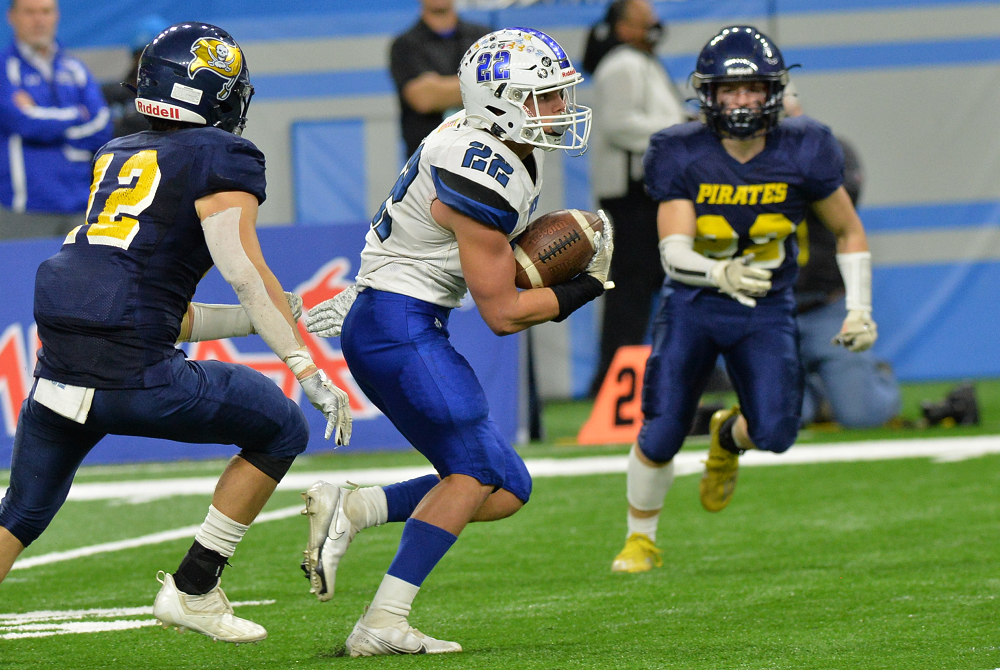
Lawton’s run to the 2021 Division 7 championship game frequently came on the legs of then-senior Jake Rueff, who posted some of the top performances in MHSAA football history.
He scored 298 points – fifth-most in 11-player history – with his 49 total touchdowns ranking fourth and his 46 rushing touchdowns third. He also made records lists with 2,370 rushing yards, 71 career touchdowns and 430 career points.
Lawton as a team scored 92 touchdowns, tying the record with 10 in one game, gained 5,662 yards of total offense and ran for 4,725 yards over 14 games.
Rueff plays at Michigan Tech.
See below for more recent additions to the 11-player football record book:
Football
Aiden Brunin stacked up many contributions on both sides of the field for Cedar Springs in 2021. But his less frequently-mentioned punting earned the senior a spot in the record book as he booted an 83-yard punt during a Nov. 6 playoff win over Muskegon that ranks as the fourth-longest in state history. The kick flew 62 yards in the air before taking a series of bounces and rolls. Brunin currently is a freshman baseball player at Spring Arbor.
Sturgis’ Jacob Thompson became the 10th to return two kickoffs for touchdowns in one game as a junior in 2021, scoring from 97 and 83 yards out against Paw Paw. Thompson also was added to the records for six rushing touchdowns in a Sept. 9, 2022, win over Plainwell – and he also threw for a score in the 55-34 victory.
Twenty years later, Coleman’s Joshua Moore has been added for a pair of interception returns for touchdowns Oct. 11, 2002, against Mount Pleasant Sacred Heart. Moore was a senior that season and scored off those turnovers during the third and fourth quarters.
Nearly a decade later, Cheboygan’s Ben Pearson also was added to the record book for a 99-yard rushing touchdown that tied the record for longest run. Pearson took the handoff deep in his own end zone and scored against Gaylord on Aug. 29, 2013. Pearson, a senior that season, went on to play at Northwood.
A trio of past Grand Ledge standouts have been entered for their achievements going back decades. Mitch Gulker made the record book for 1,002 receiving yards as a senior in 1976. Nick Kissane was added for his 170 completions, 297 pass attempts, 2,452 yards and 29 touchdowns through the air in 2008. Corey Arnouts made the tackles for loss list with 28 as a senior in 2011. Grand Ledge’s Division 1 championship run in 2000 came in part on the arm of Matt Bohnet, and he’s been added for his 2,052 yards passing that season. He went on to play at Iowa and Eastern Michigan. Arnouts went on to play at Ferris State, and Kissane went on to play baseball at Aquinas College.
Justin Brown had multiple returns for touchdowns as a junior at East Lansing in 2018, including a 99-yarder on Sept. 14. That kickoff return tied the record for longest on a list that now stands at 20 players.
Carson Roose earned his 10th record book listing when he threw for five touchdowns during the first half of Grosse Pointe Woods University Liggett’s 58-22 win over New Haven on Oct. 22, 2021. Roose graduated last spring.
Frankenmuth’s run to the Division 6 championship game in the fall saw the Eagles make team record book lists with 544 points and 72 touchdowns over 14 games, featuring as well a kicker who will bring an impressive extra point streak into the upcoming season. Junior Will Soulliere made 69 of 70 extra-point tries and has connected on 61 straight as he prepares for his senior season. Additionally, the Eagles’ defense was added after not allowing a first down during its Semifinal win over Detroit Country Day. Sam Barger was added for a 98-yard kickoff return in 2021, and Ryan Brenner was added for 45 extra points during the abbreviated 2020 season. Barger also is a senior this school year.
West Bloomfield’s run to the 2021 Regional Final was fueled in part by a tough defense, including a pair of pass rushers who rank among the all-time leaders in single-season sacks. Michael Williams II recorded 24 that fall, tied for fourth-most for one season, while Brandon Davis-Swain tied for 12th with 18. Williams, a senior that fall, plays for South Florida, while Davis-Swain is finishing his junior year at West Bloomfield.
PHOTO Lawton’s Jake Rueff (22) breaks into the open during his team’s Division 7 Final matchup with Pewamo-Westphalia in 2021.