

New Math: Division & Multiplication Problems
July 25, 2017
By Jack Roberts
MHSAA Executive Director
This is the second part in a series on MHSAA tournament classification, past and present, that will be published over the next two weeks. This series originally ran in this spring's edition of MHSAA benchmarks.
High school tournament classifications went viral before there was social media and most of us knew what “viral” meant.
Much as a virus infects computers today or has created epidemics of disease around the world for centuries, high school tournament classification – once introduced – tends to spread uncontrollably. Once started, it tends to keep expanding and rarely contracts.
While we are still some distance from providing every team a trophy as a result of expanding high school tournament classification across the country, there is criticism nevertheless that we are headed in that direction – a philosophy which is supposed to exist only in local youth sports for our youngest children.
Michigan could be blamed for all this. Michigan is generally accepted as the first state to provide different classifications for season-ending tournaments for different sized schools. It started a century ago. Today, every state has various classifications for its tournaments in most if not all sports. And it is a bit ironic that Michigan – creator of the classification chaos – more than most other states has kept the number of tournament classes or divisions under control.
Yes, there is evidence that tournament classifications have expanded over the years in Michigan, especially with the relatively recent introduction of tournaments in football and the late 1990s’ move from classes to divisions in most MHSAA tournaments. But the MHSAA Representative Council has held true to its word when it expanded the playoffs for football from four classes to eight divisions: this is needed because of unique factors of football, factors that exist in no other sport; and all other sports should be capped at a maximum of four classes or divisions.
Kentucky is the preeminent defender of single-class basketball. All of its 276 high schools compete for the single state championship for each gender. In Indiana, there are still open wounds from its move in 1998 from one to four classes for its 400 schools in basketball.
Multi-class tournaments have tended to increase the number of non-public school champions, which some states are trying to lower through enrollment “multipliers,” and also tend to increase the number of repeat champions, which some states are trying to affect with “success factors” which lift smaller schools into classifications for larger schools if they take home too many trophies.
While there is considerable evidence that state tournaments do as much bad as good for educational athletics, state associations persist in providing postseason tournaments because, on balance, the experiences are supposed to be good for student-athletes. And once we reach that conclusion it is just a small leap to believe that if the tournaments are good for a few, they must be better for more – which leads to creating more and more tournament classifications. One becomes two classes, then three, then four and so forth.
While the argument is that more classifications or divisions provides more students with opportunities to compete and win, it is undeniable that the experience changes as the number of tournament classifications expands. It is not possible for state associations to provide the same level of support when tournament classifications expand to multiple venues playing simultaneously. For example, there is less audio and video broadcast potential at each venue, and less media coverage to each venue. Focus is diluted and fans diminished at each championship.
No one can argue reasonably that today's two-day MHSAA Football Finals of eight championship games has the same pizazz as the one-day, four-games event conducted prior to 1990.
In some states the number of divisions has grown so much that it is difficult to see much difference between the many season-ending state championship games and a regular-season event in the same sport.
It is a balancing act. And Michigan has been studying that balance longer than any other state, and charting a steadier course than most.
Addition by Division
The shift to Divisions for MHSAA Tournament play in numerous sports has added up to a greater number of champions for teams and individuals across the state. Following are the sports currently employing a divisional format, and the procedures for determining enrollment and classification.
In 23 statewide or Lower Peninsula tournaments, schools which sponsor the sport are currently divided into nearly equal divisions. They are:
- Baseball - 4 Divisions
- Boys Bowling - 4 Divisions
- Girls Bowling - 4 Divisions
- Girls Competitive Cheer - 4 Divisions
- LP Boys Cross Country - 4 Divisions
- LP Girls Cross Country - 4 Divisions
- LP Boys Golf - 4 Divisions
- LP Girls Golf - 4 Divisions
- Ice Hockey - 3 Divisions
- Boys Lacrosse - 2 Divisions
- Girls Lacrosse - 2 Divisions
- Boys Skiing - 2 Divisions
- Girls Skiing - 2 Divisions
- LP Boys Soccer - 4 Divisions LP
- Girls Soccer - 4 Divisions
- Girls Softball - 4 Divisions
- LP Boys Swimming & Diving - 3 Divisions
- LP Girls Swimming & Diving - 3 Divisions
- LP Boys Tennis - 4 Divisions
- LP Girls Tennis - 4 Divisions
- LP Boys Track & Field - 4 Divisions
- LP Girls Track & Field - 4 Divisions
- Wrestling - 4 Divisions
Lists of schools for each division of these 23 tournaments are posted on MHSAA.com approximately April 1. Listings of schools in Upper Peninsula tournaments for their sports are also posted on MHSAA.com. The lists are based on school memberships and sports sponsorships in effect or anticipated for the following school year, as known to the MHSAA office as of a date in early March.
In football, the 256 schools which qualify for MHSAA 11-player playoffs are placed in eight equal divisions annually on Selection Sunday. Beginning in 2017, the 8-player divisions will be determined in a like manner on Selection Sunday as well, with 32 qualifying schools placed in two divisions.
Schools have the option to play in any higher division in one or more sports for a minimum of two years.
The deadlines for "opt-ups" are as follows:
- Applications for fall sports must be submitted by April 15
- Applications for winter sports must be submitted by Aug. 15
- Applications for spring sports must be submitted by Oct. 15
Subsequent to the date of these postings for these tournaments, no school will have its division raised or lowered by schools opening or closing, schools adding or dropping sports, schools exercising the option to play in a higher division, or approval or dissolution of cooperative programs.
When the same sport is conducted for boys and girls in the same season (e.g., track & field and cross country), the gender that has the most sponsoring schools controls the division breaks for both genders.
After Amputation, Wesaw's Return to Wrestling Provides Purpose, Self-Confidence
By
Scott Hassinger
Special for MHSAA.com
March 13, 2026
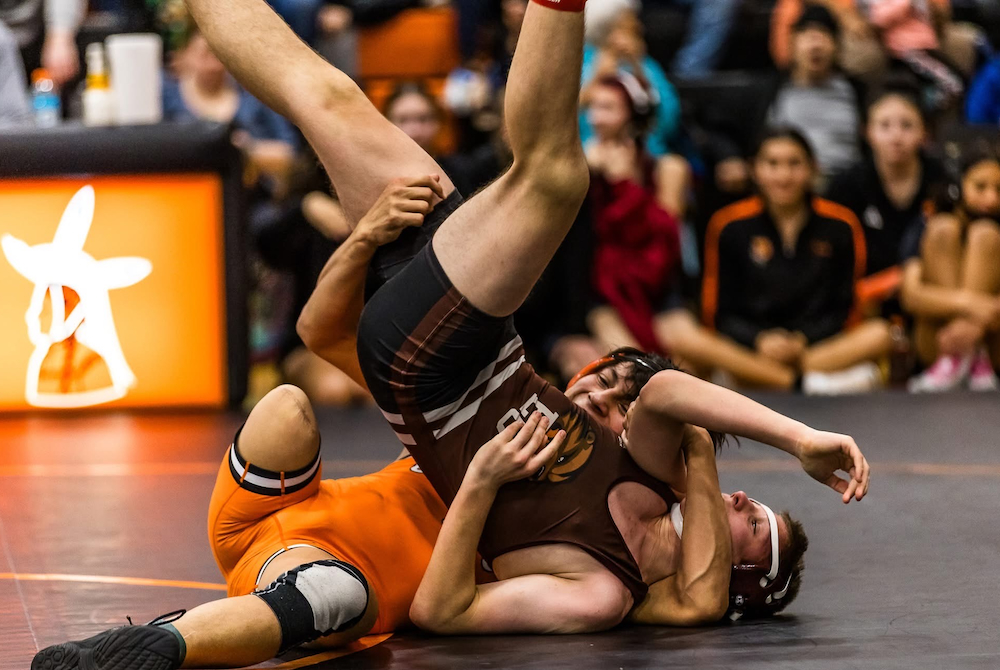
DOWAGIAC – Weski Wesaw found a purpose three years ago once he began competing for the Dowagiac wrestling team.
 Wesaw, a senior and the Chieftains' varsity starter at 150 pounds this winter, overcame a traumatic and life-altering event in junior high school to become a Regional qualifier on the mats.
During the summer before seventh grade, Wesaw was diagnosed with osteosarcoma, an aggressive primary bone cancer most common in children, teens and older adults.
"I found out I had bone cancer in my knee. The doctors told me I had two options,” Wesaw said. “They gave me the option to keep my leg ... or I could choose amputation.
“My aunt chose to keep her leg when she had cancer, and it spread throughout her body and she passed away due to it.”
Wesaw's desire to be active and participate in sports were two more big reasons he chose amputation.
"I had dreams and goals so I leaned towards amputation because they told me it was the only way I could compete in sports, was with its removal or a prosthetic," Wesaw said.
Wesaw went through rehabilitation but struggled for a long period with a bit of depression while adjusting to his new normal.
"I had always been an athlete. I played everything as a kid – lacrosse, football, baseball and wrestling,” Wesaw said. “Being a kid, then not being able to do things you once did, that's very difficult. Your friend group changes a bit too."
During his sophomore year, Wesaw and one of the school's athletic directors approached Dowagiac's varsity wrestling coach Colin Burandt with the idea of Wesaw trying wrestling again.
Burandt was aware of Wesaw at an early age when he participated in Dowagiac's Youth Wrestling Club.
"After everything happened to Weski, he was kind've reclusive a little bit. He felt kind've out of place as a freshman, but he came into his sophomore year with more drive and approached me about joining the team,” Burandt said. “We just got after it, and it's been awesome seeing how he has developed a new purpose through the sport."
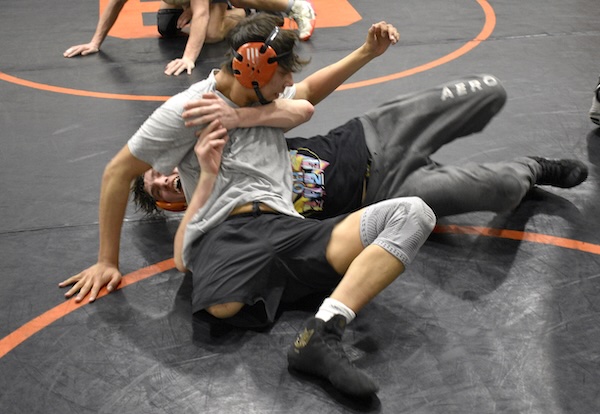 Wesaw admits that wrestling has changed his outlook on everything.
"Wrestling has had a big impact on my life. I wanted a purpose to come to school,” Wesaw said. “I had competed in MyWay when I was a kid with two legs, and I knew how to wrestle. Going back into it with just one leg was similar to learning to ride a bike again."
One of the biggest adjustments Wesaw had to make was learning how to shoot using his own style.
"Instead of using your knee to shoot, I had to figure out my own way to be able to move and slide through perfectly,” Wesaw said “When I'm on the mat, I just do what my mind tells me to do. I can adapt and match my opponent's energy. It's been a long process that has taken all the way up to my senior year to get the hang of things. Now I've gotten to the point where I can leave everything out on the mat.”
Wesaw finished with a win-loss record of 23-18 this season. He earned third place at the Division 3 Individual District Tournament at Dowagiac. The top four place finishers in each of the 14 weight classes advanced to the Belding Regional, where he was eliminated in the second round.
"Having the home crowd cheering for me in Districts was huge. I was really nervous,” Wesaw said. “Before every match I just told myself that I got this, and I left everything out there on the mat. My goal was to get to the state meet, and I fell just a bit short of that goal. I gave it my all, and the determination to reach my goal is what really drove me."
Wesaw also played a key factor as Dowagiac won its ninth-straight Team District title before losing in Team Regionals.
"I get butterflies just thinking about the big meets. We've been successful because everyone on this team brought something different to the table," Wesaw said.
"Self-confidence is a very important thing in wrestling. I have become much more confident in myself thanks to the great support I've received from my friends, family and the community. I just have to give a lot of thanks to them along with my coaches who have accepted me for who I am and made me into the person I am today," Wesaw said. "I approach everything I do with 100-percent effort so I have no regrets. I want to look back and know I have made a big impact on this program."
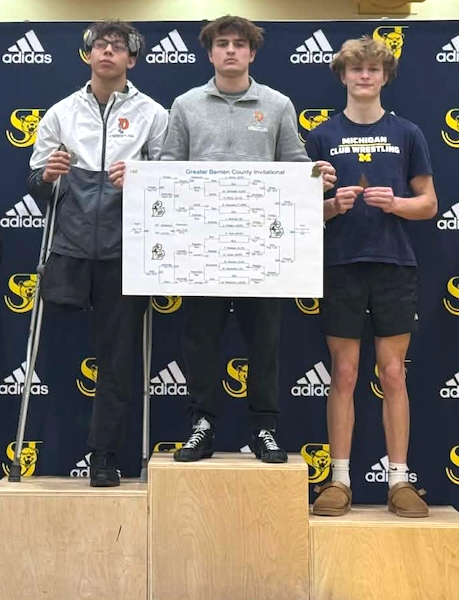 Wesaw was one of Dowagiac's most versatile grapplers and comes from a wrestling family.
"My dad was a wrestler and my uncle wrestled and later became a boxer. Even my little sister is on our wrestling team," Wesaw said. "My uncle (Eric Ortiz) has really helped me with my moves and helping me to think straight and remain calmer in my matches.”
Wesaw plans to continue wrestling in college and plans to pursue a double major in business and engineering.
One of his biggest inspirations is Anthony Robles.
Robles is an American wrestler who attended and competed for Arizona State, where he won a national championship in the 125-pound division in 2011 despite being born with just one leg. His story helped spawn the movie “Unstoppable.”
"Coaching someone like (Wesaw) is really no different than coaching anyone else,” Burandt said. “My approach is that every kid on our team is different. With Weski, his style is tailored to what he can do on top and offensive moves. With him there aren't necessarily challenges, but he just has to do what fits him best like working for a lot of reversals in a match.
“He's developed a pretty good shot from when he first began. Our strategy is for him to be aggressive in that first period. He's quick, very resilient, battles through the latter periods and is stronger than many of his opponents. Confidence in his ability, game planning and executing that plan and being a team player are some of his other assets.
"Weski is a great teammate, and everyone loves him. The other kids see his hard work and resiliency. They just view him as another guy on the team, and he's no different than anyone else. His mindset is great. He never makes excuses, and he just goes after it and figures things out on the way."
 Scott Hassinger is a contributing sportswriter for Leader Publications and previously served as the sports editor for the Three Rivers Commercial-News from 1994-2022. He can be reached at [email protected] with story ideas for Berrien, Cass, St. Joseph and Branch counties.
PHOTOS (Top) Dowagiac’s Weski Wesaw, in orange, works toward a pin during a tournament this season. (Middle) Wesaw, top position, works on a move against a practice partner during the week of Individual Regionals. (Below) Wesaw, far left, stands on the podium after earning a second-place finish at the Greater Berrien County Invitational. (Match and podium photos courtesy of Dowagiac’s athletic department. Practice photo by Scott Hassinger.)