

New Math: Division & Multiplication Problems
July 25, 2017
By Jack Roberts
MHSAA Executive Director
This is the second part in a series on MHSAA tournament classification, past and present, that will be published over the next two weeks. This series originally ran in this spring's edition of MHSAA benchmarks.
High school tournament classifications went viral before there was social media and most of us knew what “viral” meant.
Much as a virus infects computers today or has created epidemics of disease around the world for centuries, high school tournament classification – once introduced – tends to spread uncontrollably. Once started, it tends to keep expanding and rarely contracts.
While we are still some distance from providing every team a trophy as a result of expanding high school tournament classification across the country, there is criticism nevertheless that we are headed in that direction – a philosophy which is supposed to exist only in local youth sports for our youngest children.
Michigan could be blamed for all this. Michigan is generally accepted as the first state to provide different classifications for season-ending tournaments for different sized schools. It started a century ago. Today, every state has various classifications for its tournaments in most if not all sports. And it is a bit ironic that Michigan – creator of the classification chaos – more than most other states has kept the number of tournament classes or divisions under control.
Yes, there is evidence that tournament classifications have expanded over the years in Michigan, especially with the relatively recent introduction of tournaments in football and the late 1990s’ move from classes to divisions in most MHSAA tournaments. But the MHSAA Representative Council has held true to its word when it expanded the playoffs for football from four classes to eight divisions: this is needed because of unique factors of football, factors that exist in no other sport; and all other sports should be capped at a maximum of four classes or divisions.
Kentucky is the preeminent defender of single-class basketball. All of its 276 high schools compete for the single state championship for each gender. In Indiana, there are still open wounds from its move in 1998 from one to four classes for its 400 schools in basketball.
Multi-class tournaments have tended to increase the number of non-public school champions, which some states are trying to lower through enrollment “multipliers,” and also tend to increase the number of repeat champions, which some states are trying to affect with “success factors” which lift smaller schools into classifications for larger schools if they take home too many trophies.
While there is considerable evidence that state tournaments do as much bad as good for educational athletics, state associations persist in providing postseason tournaments because, on balance, the experiences are supposed to be good for student-athletes. And once we reach that conclusion it is just a small leap to believe that if the tournaments are good for a few, they must be better for more – which leads to creating more and more tournament classifications. One becomes two classes, then three, then four and so forth.
While the argument is that more classifications or divisions provides more students with opportunities to compete and win, it is undeniable that the experience changes as the number of tournament classifications expands. It is not possible for state associations to provide the same level of support when tournament classifications expand to multiple venues playing simultaneously. For example, there is less audio and video broadcast potential at each venue, and less media coverage to each venue. Focus is diluted and fans diminished at each championship.
No one can argue reasonably that today's two-day MHSAA Football Finals of eight championship games has the same pizazz as the one-day, four-games event conducted prior to 1990.
In some states the number of divisions has grown so much that it is difficult to see much difference between the many season-ending state championship games and a regular-season event in the same sport.
It is a balancing act. And Michigan has been studying that balance longer than any other state, and charting a steadier course than most.
Addition by Division
The shift to Divisions for MHSAA Tournament play in numerous sports has added up to a greater number of champions for teams and individuals across the state. Following are the sports currently employing a divisional format, and the procedures for determining enrollment and classification.
In 23 statewide or Lower Peninsula tournaments, schools which sponsor the sport are currently divided into nearly equal divisions. They are:
- Baseball - 4 Divisions
- Boys Bowling - 4 Divisions
- Girls Bowling - 4 Divisions
- Girls Competitive Cheer - 4 Divisions
- LP Boys Cross Country - 4 Divisions
- LP Girls Cross Country - 4 Divisions
- LP Boys Golf - 4 Divisions
- LP Girls Golf - 4 Divisions
- Ice Hockey - 3 Divisions
- Boys Lacrosse - 2 Divisions
- Girls Lacrosse - 2 Divisions
- Boys Skiing - 2 Divisions
- Girls Skiing - 2 Divisions
- LP Boys Soccer - 4 Divisions LP
- Girls Soccer - 4 Divisions
- Girls Softball - 4 Divisions
- LP Boys Swimming & Diving - 3 Divisions
- LP Girls Swimming & Diving - 3 Divisions
- LP Boys Tennis - 4 Divisions
- LP Girls Tennis - 4 Divisions
- LP Boys Track & Field - 4 Divisions
- LP Girls Track & Field - 4 Divisions
- Wrestling - 4 Divisions
Lists of schools for each division of these 23 tournaments are posted on MHSAA.com approximately April 1. Listings of schools in Upper Peninsula tournaments for their sports are also posted on MHSAA.com. The lists are based on school memberships and sports sponsorships in effect or anticipated for the following school year, as known to the MHSAA office as of a date in early March.
In football, the 256 schools which qualify for MHSAA 11-player playoffs are placed in eight equal divisions annually on Selection Sunday. Beginning in 2017, the 8-player divisions will be determined in a like manner on Selection Sunday as well, with 32 qualifying schools placed in two divisions.
Schools have the option to play in any higher division in one or more sports for a minimum of two years.
The deadlines for "opt-ups" are as follows:
- Applications for fall sports must be submitted by April 15
- Applications for winter sports must be submitted by Aug. 15
- Applications for spring sports must be submitted by Oct. 15
Subsequent to the date of these postings for these tournaments, no school will have its division raised or lowered by schools opening or closing, schools adding or dropping sports, schools exercising the option to play in a higher division, or approval or dissolution of cooperative programs.
When the same sport is conducted for boys and girls in the same season (e.g., track & field and cross country), the gender that has the most sponsoring schools controls the division breaks for both genders.
Champion Coaches - Including Local Legends - Unite to Restore Ravenna Glory
By
Scott DeCamp
Special for MHSAA.com
October 8, 2026
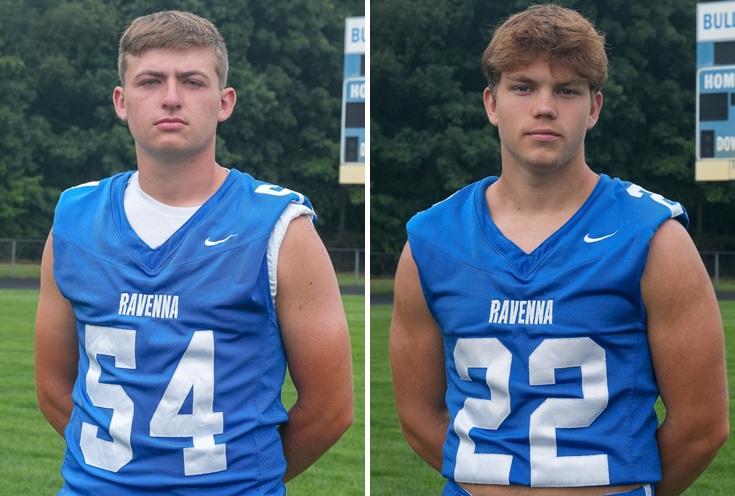
RAVENNA – Whether they want to or not, Ravenna seniors Joel Kantola and Colton Rolison hear about the glory days of Bulldogs football from their fathers.
 Kantola’s dad, Brandon, watches old games from the 1994 season when he was a two-way starter on Ravenna’s first MHSAA Finals championship team.
“He can’t remember very well, but he’ll see a play and he’s like, ‘Oh, I remember doing that play!’” Joel Kantola said. “It’s one of the best things to hear something (from that era). He loves it, too.”
Rolison’s dad, Willy, shares memorable stories from back in the day when he was a dynamic running back on the Bulldogs’ 1997 Class C title squad.
“It’s just insane that he still has all these stories that I’ve never heard. He’s still bringing them up, new ones every day,” Colton Rolison said with a smile.
Three decades have passed since the 1990s heyday of Ravenna football, when the Bulldogs won three of their program’s four Finals titles. But in the small town located on the eastern edge of Muskegon County, the band is back together, one might say.
Steve Czerwon was hired in March as Ravenna’s head football coach, coming from a highly successful 13-year tenure at his Muskegon Catholic Central alma mater where he guided the Crusaders to Division 8 championships all of his first four seasons (2013-16).
One of Czerwon’s first orders of business in Ravenna was securing the commitments of legendary coaches Dusty Fairfield and Randy Helsen – architects of the Bulldogs’ championship teams in 1994, 1996, 1997 and 2003 – to bring their wisdom and serve as a link from the storied era to this current one.
They agreed, others from the old guard hopped aboard, and a couple more experienced coaches joined Czerwon’s staff. Now, entering the final third of the 2026 regular season, the Bulldogs appear to have regained a little traction despite coming off three straight losing campaigns.
Ravenna carries a 5-1 overall record and five-game winning streak into this Friday’s West Michigan Conference Rivers home game against Hesperia.
Next week, Ravenna plays at North Muskegon with at least a share of the WMC Rivers title on the line. Should the Bulldogs win this Friday, they’ll take on the Norsemen for the outright league championship.
Since the WMC expanded and split into two divisions in 2022, North Muskegon has not lost a Rivers football game. Meanwhile, Ravenna has not won a conference title since sharing one with two teams in 2001.
In their football history, the Bulldogs have as many Finals titles as they do conference championships (four), illustrating the enduring strength of the West Michigan Conference.
This pack is hungry to etch its own history: Winning a conference title and making a run in the Division 7 playoffs. But, as Helsen laid out, there’s a price to pay.
“Steve addressed the fact (with the players),” Helsen recalled. “‘You wanted these guys to come back and you wanted what they had in the ’80s through the ’90s into the 2000s, and what it’s going to take is every effort you’ve got and even take it up from where you are. If you want to leave a legacy, that’s what you have to do. These guys (have) a legacy.’”
When Helsen says “these guys,” he’s referring to Fairfield and himself, but also other connections from the days of Ravenna football prominence.
In 20 seasons as Ravenna’s head coach covering two stints – the second ending in 2010 – Fairfield sported a 164-55 record. He’s a Michigan High School Football Coaches Association Hall of Famer.
Helsen served as Ravenna’s defensive coordinator for all of those seasons, and then some. He and Fairfield are both Ravenna Athletic Hall of Famers, their plaques side-by-side on the wall of the high school’s athletic wing.
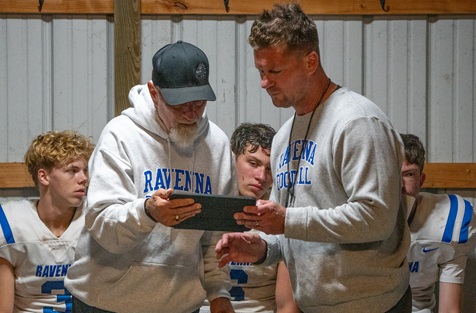
Fairfield and Helsen are both retired and they’re volunteer assistants on Czerwon’s staff. They are not at every practice, but they fill critical roles: The former works with the secondary and quarterbacks, plus he’s on the headset in the press box on game days, while the latter coaches defensive linemen.
“They have so much knowledge, and I think it really does connect the past to the current,” said Czerwon, who did his student teaching at Ravenna in the early 2000s and was a member of the Bulldogs coaching staff during their most recent state title season in 2003. “A lot of kids here, they heard from their uncles and their fathers about some really good teams that Ravenna had in the ’90s and early 2000s, and those guys are the actual link.
“I talk to Dusty daily, and he just reinforces the importance of relationships you have with the kids,” Czerwon added. “He’s second to none at that, and it reinforces to me the importance of that.”
Geoff Nelson, who was a starting lineman on Ravenna’s 1994 team, coaches the offensive line. Neil Sladick, who helped the Bulldogs win Finals titles in 1996 and 1997, works with linebackers. Mark Jacobs, who starred on Ravenna’s first Finals group in 1988, helps coach defensive backs.
Canaan Groff is Ravenna’s defensive coordinator, and Nate Smith specializes in offense. Both bring experience to the table, including as head coaches. Czerwon, Groff, Sladick, and Smith all work in Ravenna school buildings, which is an advantage for coaches.
“I think that we’re bringing back a lot of accountability. I think we don’t settle,” Nelson said about Ravenna’s coaching staff. “This has been a great group. We had to break a lot of bad habits, but they’re starting to form new habits and starting to go in the right direction.”
Ravenna got a reality check to start the season in a 33-7 loss to Division 8 top-ranked Beal City, a perennial small-school power. Czerwon admitted he may have asked too much of his players right away in terms of new schemes and such.
Since then, the Bulldogs have exhibited gradual improvement, including winning a couple of one-point games, and now they’re starting to establish an identity of physical football. That was at its peak in last week’s 28-0 win at Mason County Central, which by the way is coached by Ravenna alumnus David Smith, a former Bulldogs head coach who was a member of Class C championship teams in 1994 and 1996.
Things are moving in the right direction for Ravenna.
“There hasn’t really been a lot of drama or anything like that. We love each other. That wins games,” said Rolison, a linebacker who suffered a fractured collarbone in Week 3. Chances of a return this season are up in the air, he said.
“(The coaches have all) worked together before and nobody motivates like Dusty Fairfield – there’s not a single person out there who does,” Rolison added. “Coach Randy Helsen, he knows his stuff. He knows more than I probably ever will about football.”
According to Helsen, getting to know young people at the ground level is Fairfield’s specialty: Types of music they like, their hunting spots, etc.
In terms of accountability, everybody is responsible for that.
“We get after them if they’re not getting it done,” Helsen said. “Kids that were not getting after it five, six weeks ago and kind of rolling their eyes at me when I’m coaching them on scout defense, they’re now in the starting lineup. I said, ‘You’re getting coached by a guy that coached defense here for 27 years. I’m giving you the same coaching that our all-staters and all-conference players got.’”
Fairfield’s goal in returning was to help lay building blocks for current and future success. He believes the overall health of football in Ravenna is strong considering participation numbers from high school to youth levels, especially at a time when similarly small communities across the state are canceling varsity seasons or not fielding enough players to form junior varsity squads.
“It’s been a good experience, and it’s made me realize, you know, what we did in the past really meant something, and it made me realize how hard we worked because I’m totally invested in the team right now. It is fun with the camaraderie with not just the boys but also the coaches,” Fairfield said.
“You know, it’s my last hurrah where I get to experience what I did for a living for over 30 years. I get to experience it one more time before I, you know, go off into the sunset,” he added with a chuckle.
For families such as the Kantolas and Rolisons, things are coming full circle – and they could not be more excited. Brandon Kantola is enjoying his son’s senior season while also reminiscing about the good ol’ days.
“I think he was invested back then,” said Joel Kantola, Ravenna’s starting center, “but he’s more excited for us than I think he was back then.”

Scott DeCamp has worked more than 25 years in sports media, including 21 at MLive Media Group as a reporter and editor. He is founder and owner of DeCamp Creative Solutions. Email him at [email protected] with story ideas for Lake, Mason, Mecosta, Muskegon, Newaygo, Oceana, and Oceola counties.
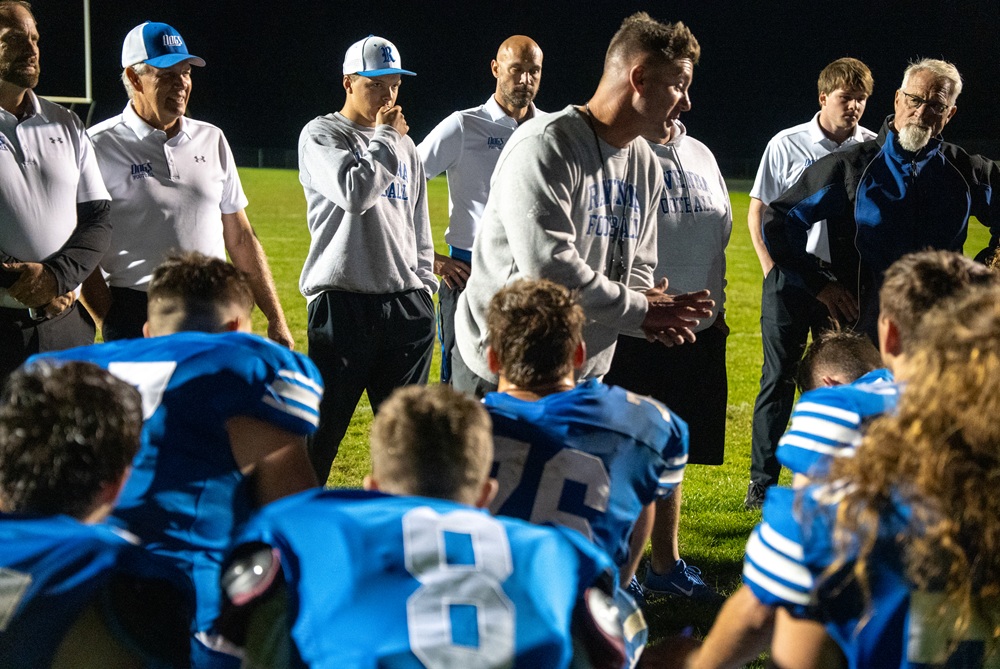
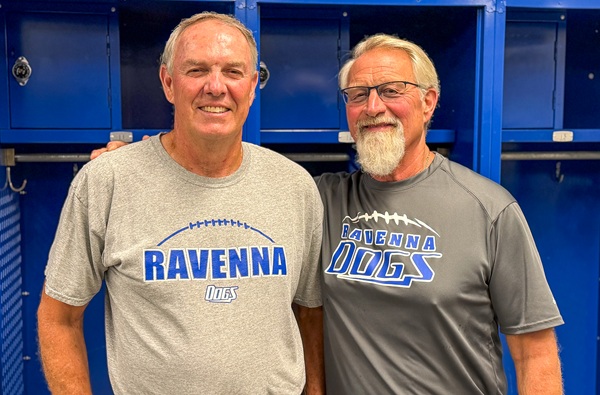
PHOTOS (Top) Ravenna head coach Steve Czerwon addresses the team following a 28-14 victory over Shelby on Sept. 25. (2) Ravenna assistant coaches Randy Helsen, left, and Dusty Fairfield are pictured in the Bulldogs' locker room in August. (3) Joel Kantola, left, is a senior center for the Ravenna football team, and Colton Rolison is a senior linebacker. (4) Fairfield, left, and Czerwon look at an iPad during halftime of a 28-0 victory over Mason County Central on Friday. (Photos by Scott DeCamp.)