

New Math: Division & Multiplication Problems
July 25, 2017
By Jack Roberts
MHSAA Executive Director
This is the second part in a series on MHSAA tournament classification, past and present, that will be published over the next two weeks. This series originally ran in this spring's edition of MHSAA benchmarks.
High school tournament classifications went viral before there was social media and most of us knew what “viral” meant.
Much as a virus infects computers today or has created epidemics of disease around the world for centuries, high school tournament classification – once introduced – tends to spread uncontrollably. Once started, it tends to keep expanding and rarely contracts.
While we are still some distance from providing every team a trophy as a result of expanding high school tournament classification across the country, there is criticism nevertheless that we are headed in that direction – a philosophy which is supposed to exist only in local youth sports for our youngest children.
Michigan could be blamed for all this. Michigan is generally accepted as the first state to provide different classifications for season-ending tournaments for different sized schools. It started a century ago. Today, every state has various classifications for its tournaments in most if not all sports. And it is a bit ironic that Michigan – creator of the classification chaos – more than most other states has kept the number of tournament classes or divisions under control.
Yes, there is evidence that tournament classifications have expanded over the years in Michigan, especially with the relatively recent introduction of tournaments in football and the late 1990s’ move from classes to divisions in most MHSAA tournaments. But the MHSAA Representative Council has held true to its word when it expanded the playoffs for football from four classes to eight divisions: this is needed because of unique factors of football, factors that exist in no other sport; and all other sports should be capped at a maximum of four classes or divisions.
Kentucky is the preeminent defender of single-class basketball. All of its 276 high schools compete for the single state championship for each gender. In Indiana, there are still open wounds from its move in 1998 from one to four classes for its 400 schools in basketball.
Multi-class tournaments have tended to increase the number of non-public school champions, which some states are trying to lower through enrollment “multipliers,” and also tend to increase the number of repeat champions, which some states are trying to affect with “success factors” which lift smaller schools into classifications for larger schools if they take home too many trophies.
While there is considerable evidence that state tournaments do as much bad as good for educational athletics, state associations persist in providing postseason tournaments because, on balance, the experiences are supposed to be good for student-athletes. And once we reach that conclusion it is just a small leap to believe that if the tournaments are good for a few, they must be better for more – which leads to creating more and more tournament classifications. One becomes two classes, then three, then four and so forth.
While the argument is that more classifications or divisions provides more students with opportunities to compete and win, it is undeniable that the experience changes as the number of tournament classifications expands. It is not possible for state associations to provide the same level of support when tournament classifications expand to multiple venues playing simultaneously. For example, there is less audio and video broadcast potential at each venue, and less media coverage to each venue. Focus is diluted and fans diminished at each championship.
No one can argue reasonably that today's two-day MHSAA Football Finals of eight championship games has the same pizazz as the one-day, four-games event conducted prior to 1990.
In some states the number of divisions has grown so much that it is difficult to see much difference between the many season-ending state championship games and a regular-season event in the same sport.
It is a balancing act. And Michigan has been studying that balance longer than any other state, and charting a steadier course than most.
Addition by Division
The shift to Divisions for MHSAA Tournament play in numerous sports has added up to a greater number of champions for teams and individuals across the state. Following are the sports currently employing a divisional format, and the procedures for determining enrollment and classification.
In 23 statewide or Lower Peninsula tournaments, schools which sponsor the sport are currently divided into nearly equal divisions. They are:
- Baseball - 4 Divisions
- Boys Bowling - 4 Divisions
- Girls Bowling - 4 Divisions
- Girls Competitive Cheer - 4 Divisions
- LP Boys Cross Country - 4 Divisions
- LP Girls Cross Country - 4 Divisions
- LP Boys Golf - 4 Divisions
- LP Girls Golf - 4 Divisions
- Ice Hockey - 3 Divisions
- Boys Lacrosse - 2 Divisions
- Girls Lacrosse - 2 Divisions
- Boys Skiing - 2 Divisions
- Girls Skiing - 2 Divisions
- LP Boys Soccer - 4 Divisions LP
- Girls Soccer - 4 Divisions
- Girls Softball - 4 Divisions
- LP Boys Swimming & Diving - 3 Divisions
- LP Girls Swimming & Diving - 3 Divisions
- LP Boys Tennis - 4 Divisions
- LP Girls Tennis - 4 Divisions
- LP Boys Track & Field - 4 Divisions
- LP Girls Track & Field - 4 Divisions
- Wrestling - 4 Divisions
Lists of schools for each division of these 23 tournaments are posted on MHSAA.com approximately April 1. Listings of schools in Upper Peninsula tournaments for their sports are also posted on MHSAA.com. The lists are based on school memberships and sports sponsorships in effect or anticipated for the following school year, as known to the MHSAA office as of a date in early March.
In football, the 256 schools which qualify for MHSAA 11-player playoffs are placed in eight equal divisions annually on Selection Sunday. Beginning in 2017, the 8-player divisions will be determined in a like manner on Selection Sunday as well, with 32 qualifying schools placed in two divisions.
Schools have the option to play in any higher division in one or more sports for a minimum of two years.
The deadlines for "opt-ups" are as follows:
- Applications for fall sports must be submitted by April 15
- Applications for winter sports must be submitted by Aug. 15
- Applications for spring sports must be submitted by Oct. 15
Subsequent to the date of these postings for these tournaments, no school will have its division raised or lowered by schools opening or closing, schools adding or dropping sports, schools exercising the option to play in a higher division, or approval or dissolution of cooperative programs.
When the same sport is conducted for boys and girls in the same season (e.g., track & field and cross country), the gender that has the most sponsoring schools controls the division breaks for both genders.
Breslin Bound: 2025-26 Girls Report Week 11
By
Geoff Kimmerly
MHSAA.com senior editor
February 24, 2026
With Sunday’s announcement of this season’s Girls Basketball District seeds and matchups, more than 650 teams across the state now know their championship paths once the playoffs begin.

But the journey really started months ago – and there’s one more week left this regular season for contenders to build up momentum as they prepare to play for more. We detail some of what we've seen and what to expect below.
“Breslin Bound” is powered by MI Student Aid and based on results and schedules posted for each school at MHSAA.com.
Week in Review
The countdown of last week’s five most intriguing results:
1. Grass Lake 52, Brooklyn Columbia Central 42 These two have met in three straight Cascades Conference championship games, and Grass Lake (19-1) won its third straight title in adding to a previous victory this winter over Columbia Central (17-3).
2. Flint Powers Catholic 49, Saginaw Heritage 40 The Chargers (19-2) won this matchup of Saginaw Valley League division winners, sending Heritage to 15-6.
3. Goodrich 58, Fenton 27 The Martians (21-0) won their third-straight Flint Metro League overall championship, downing Fenton (14-8) for the second time this season.
4. Rockford 61, Grand Haven 41 The Rams (19-1) finished an outright championship run in the Ottawa-Kent Conference Red and a season sweep of the Buccaneers (17-3).
5. Farmington Hills Mercy 60, South Lyon East 47 The Marlins (16-4) handed East (19-1) its only loss this season.
Watch List
With an eye toward March, here are two teams in each division making sparks:
DIVISION 1
DeWitt (16-4) The Panthers have wins over four teams with at least 15 victories this winter, and all four of DeWitt’s losses came to teams with at least 15 wins. Despite splitting with Holt, the Panthers finished just behind the Rams in the Capital Area Activities Conference Blue, but could see Holt again in a Regional Final. DeWitt also has an opportunity to see East Lansing again in their District Final after falling to the Trojans in their second of two regular-season meetings.
Holt (15-4) After finishing second and tied for second in the CAAC Blue to DeWitt the last two seasons, Holt celebrated clinching the outright championship by finishing a regular-season sweep of East Lansing on Feb. 13. The Rams then followed with an impressive 52-51 win over Ann Arbor Father Gabriel Richand and impressed as well despite falling to Haslett (18-2) by three points on Thursday. All four losses have come to opponents with at least 15 wins this season.
DIVISION 2
Warren Regina (15-5) The Saddlelites have tied last season’s win total with at least three more games to play, and one more victory will give them their highest total in at least 15 years. The losses came in clumps; Regina won its first seven games, lost five of the next seven, but have now won six straight. The Saddlelites finished third in a Catholic High School League Central West that also included Orchard Lake St. Mary’s (16-3) and Farmington Hills Mercy (16-4), both Division 1 teams.
Yale (19-1) The Bulldogs clinched a share of their third-straight Blue Water Area Conference title Friday and can make the championship outright Tuesday against second-place Armada – and after Yale and Armada shared the championship a year ago. The Bulldogs’ only loss this winter came to Division 1 New Baltimore Anchor Bay (17-2), and Armada in the teams’ first matchup is the only other opponent to get within single digits.
DIVISION 3
Kalamazoo Christian (15-3) Five of six teams in the Southwestern Athletic Conference Valley have winning records, and topping them is undefeated Kalamazoo Christian – which has won the title outright with an opportunity to finish a perfect league run against second-place Kalamazoo Hackett Catholic Prep on Tuesday. The three Comets’ losses came to Division 1 and 2 opponents that are a combined 48-12, and K-Christian will be playing next week for a fourth-straight District title.
Rochester Hills Lutheran Northwest (15-4) The Crusaders made a memorable jump last season starting 1-3 and ending as the Division 3 runners-up. They got rolling a little more quickly this winter and have won eight straight while clinching the Michigan Independent Athletic Conference Blue title outright despite playing in a league that has four of six teams with at least 13 wins. Lutheran Northwest also has tested itself nonleague with losses to Division 1 Clarkston and Rochester Hills Stoney Creek and Division 2 St. Clair.
DIVISION 4
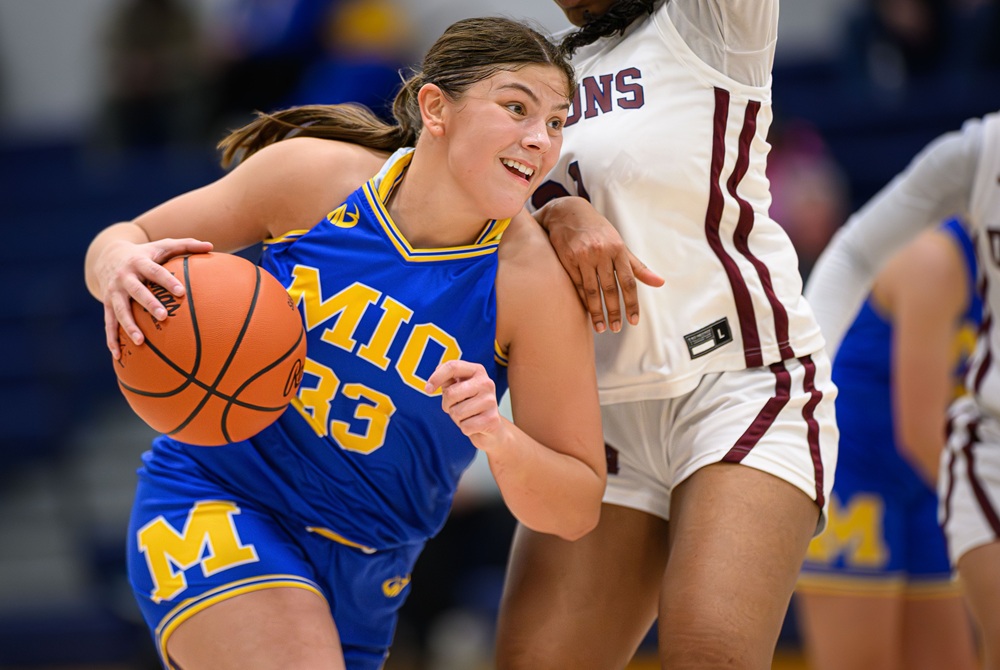
Mio (16-4) The Thunderbolts will seek to add to two straight trips to the Regional Semifinals when they begin their postseason march next week, and they’ll hope to secure a third-straight league title tonight when they play Hillman with a share of the North Star League Little Dipper championship on the line. Mio split back-to-back games with Au Gres-Sims, which has clinched a share of the title. Mia McGregor has passed 2,000 points this season as a junior and is in line to pursue the all-time MHSAA career scoring record next winter.
Portland St. Patrick (16-4) The Shamrocks have been championship contenders – and won their share – over the last several decades, but this season is a little different as past championship player and assistant coach Michelle Smith has taken over the program from longtime leader Al Schrauben. The success continues. While St. Patrick is fourth in the Central Michigan Athletic Conference – which features four teams with at least 16 wins – all of its losses have come to those other three teams, which all play in Division 3.
Can’t-Miss Contests
Be on the lookout for results of these games coming up:
Tuesday – Kingston (21-0) at Deckerville (17-3) – This will finish determining one of the final league races still outstanding, as Kingston has clinched a share of the Big Thumb Conference Blue title but Deckerville can do the same by avenging an earlier 53-34 loss to the Cardinals.
Tuesday – Beaverton (17-2) at Standish-Sterling (17-3) – These two will face off for the overall Jack Pine Conference championship after also facing each other Friday, with Beaverton winning the first round 58-47.
Thursday – Belleville (21-0) vs. Howell (20-1) at Northville – This has been one of the most anticipated matchups in the state for weeks as the reigning Division 1 champion Tigers seek to finish as repeat overall Kensington Lakes Activities Association champs.
Thursday – Rockford (19-1) at Grand Rapids South Christian (20-0) – Both are strong candidates to finish at Breslin Center next month, the Rams in Division 1 and the Sailors in Division 2.
Thursday – Negaunee (19-1) at Gladstone (17-3) – Gladstone will be seeking to avenge a 30-19 loss to the Miners from Jan. 27, and they’re lined up to potentially see each other in a Division 2 District Final next week as well.
MHSAA.com's weekly “Breslin Bound” reports are powered by MI Student Aid, a division within the Department of Lifelong Education, Advancement, and Potential (MiLEAP). MI Student Aid encourages students to pursue postsecondary education by providing access to student financial resources and information. MI Student Aid administers the state’s scholarship and grant programs that help make college Accessible, Affordable and Attainable for you. Click to connect with MI Student Aid and find more information on Facebook and X @mistudentaid.
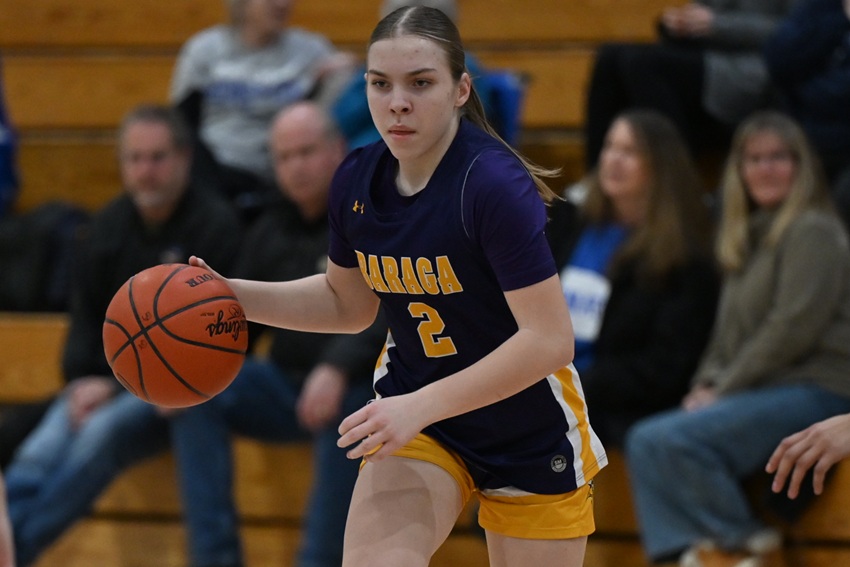
PHOTOS (Top) Mio’s Mia McGregor (33) handles the ball during a game against Saginaw Arts & Sciences earlier this month. (Middle) Baraga's Danica Jahfetson directs the offense against Ishpeming. (Mio/SASA photo by Kolleth Photo. Baraga/Ishpeming photo by Cara Kamps.)