


New Math: Division & Multiplication Problems
July 25, 2017
By Jack Roberts
MHSAA Executive Director
This is the second part in a series on MHSAA tournament classification, past and present, that will be published over the next two weeks. This series originally ran in this spring's edition of MHSAA benchmarks.
High school tournament classifications went viral before there was social media and most of us knew what “viral” meant.
Much as a virus infects computers today or has created epidemics of disease around the world for centuries, high school tournament classification – once introduced – tends to spread uncontrollably. Once started, it tends to keep expanding and rarely contracts.
While we are still some distance from providing every team a trophy as a result of expanding high school tournament classification across the country, there is criticism nevertheless that we are headed in that direction – a philosophy which is supposed to exist only in local youth sports for our youngest children.
Michigan could be blamed for all this. Michigan is generally accepted as the first state to provide different classifications for season-ending tournaments for different sized schools. It started a century ago. Today, every state has various classifications for its tournaments in most if not all sports. And it is a bit ironic that Michigan – creator of the classification chaos – more than most other states has kept the number of tournament classes or divisions under control.
Yes, there is evidence that tournament classifications have expanded over the years in Michigan, especially with the relatively recent introduction of tournaments in football and the late 1990s’ move from classes to divisions in most MHSAA tournaments. But the MHSAA Representative Council has held true to its word when it expanded the playoffs for football from four classes to eight divisions: this is needed because of unique factors of football, factors that exist in no other sport; and all other sports should be capped at a maximum of four classes or divisions.
Kentucky is the preeminent defender of single-class basketball. All of its 276 high schools compete for the single state championship for each gender. In Indiana, there are still open wounds from its move in 1998 from one to four classes for its 400 schools in basketball.
Multi-class tournaments have tended to increase the number of non-public school champions, which some states are trying to lower through enrollment “multipliers,” and also tend to increase the number of repeat champions, which some states are trying to affect with “success factors” which lift smaller schools into classifications for larger schools if they take home too many trophies.
While there is considerable evidence that state tournaments do as much bad as good for educational athletics, state associations persist in providing postseason tournaments because, on balance, the experiences are supposed to be good for student-athletes. And once we reach that conclusion it is just a small leap to believe that if the tournaments are good for a few, they must be better for more – which leads to creating more and more tournament classifications. One becomes two classes, then three, then four and so forth.
While the argument is that more classifications or divisions provides more students with opportunities to compete and win, it is undeniable that the experience changes as the number of tournament classifications expands. It is not possible for state associations to provide the same level of support when tournament classifications expand to multiple venues playing simultaneously. For example, there is less audio and video broadcast potential at each venue, and less media coverage to each venue. Focus is diluted and fans diminished at each championship.
No one can argue reasonably that today's two-day MHSAA Football Finals of eight championship games has the same pizazz as the one-day, four-games event conducted prior to 1990.
In some states the number of divisions has grown so much that it is difficult to see much difference between the many season-ending state championship games and a regular-season event in the same sport.
It is a balancing act. And Michigan has been studying that balance longer than any other state, and charting a steadier course than most.
Addition by Division
The shift to Divisions for MHSAA Tournament play in numerous sports has added up to a greater number of champions for teams and individuals across the state. Following are the sports currently employing a divisional format, and the procedures for determining enrollment and classification.
In 23 statewide or Lower Peninsula tournaments, schools which sponsor the sport are currently divided into nearly equal divisions. They are:
- Baseball - 4 Divisions
- Boys Bowling - 4 Divisions
- Girls Bowling - 4 Divisions
- Girls Competitive Cheer - 4 Divisions
- LP Boys Cross Country - 4 Divisions
- LP Girls Cross Country - 4 Divisions
- LP Boys Golf - 4 Divisions
- LP Girls Golf - 4 Divisions
- Ice Hockey - 3 Divisions
- Boys Lacrosse - 2 Divisions
- Girls Lacrosse - 2 Divisions
- Boys Skiing - 2 Divisions
- Girls Skiing - 2 Divisions
- LP Boys Soccer - 4 Divisions LP
- Girls Soccer - 4 Divisions
- Girls Softball - 4 Divisions
- LP Boys Swimming & Diving - 3 Divisions
- LP Girls Swimming & Diving - 3 Divisions
- LP Boys Tennis - 4 Divisions
- LP Girls Tennis - 4 Divisions
- LP Boys Track & Field - 4 Divisions
- LP Girls Track & Field - 4 Divisions
- Wrestling - 4 Divisions
Lists of schools for each division of these 23 tournaments are posted on MHSAA.com approximately April 1. Listings of schools in Upper Peninsula tournaments for their sports are also posted on MHSAA.com. The lists are based on school memberships and sports sponsorships in effect or anticipated for the following school year, as known to the MHSAA office as of a date in early March.
In football, the 256 schools which qualify for MHSAA 11-player playoffs are placed in eight equal divisions annually on Selection Sunday. Beginning in 2017, the 8-player divisions will be determined in a like manner on Selection Sunday as well, with 32 qualifying schools placed in two divisions.
Schools have the option to play in any higher division in one or more sports for a minimum of two years.
The deadlines for "opt-ups" are as follows:
- Applications for fall sports must be submitted by April 15
- Applications for winter sports must be submitted by Aug. 15
- Applications for spring sports must be submitted by Oct. 15
Subsequent to the date of these postings for these tournaments, no school will have its division raised or lowered by schools opening or closing, schools adding or dropping sports, schools exercising the option to play in a higher division, or approval or dissolution of cooperative programs.
When the same sport is conducted for boys and girls in the same season (e.g., track & field and cross country), the gender that has the most sponsoring schools controls the division breaks for both genders.
Whiteford's Mensing Bringing Successful System to Westland John Glenn
By
Doug Donnelly
Special for MHSAA.com
April 26, 2022
Jason Mensing insists that when he showed up at Ottawa Lake Whiteford a decade ago he had thoughts of a state championship on his mind.
 It seemed a tall task. The Bobcats had enjoyed pockets of success throughout school history but had just won just five playoff games and one conference football championship over the previous 45 years.
Still, the Tecumseh native and former Adrian College football player was determined.
“We believed if we could imprint our system and develop a strength program and teach the fundamentals and continue to grow, we’d have success,” Mensing said.
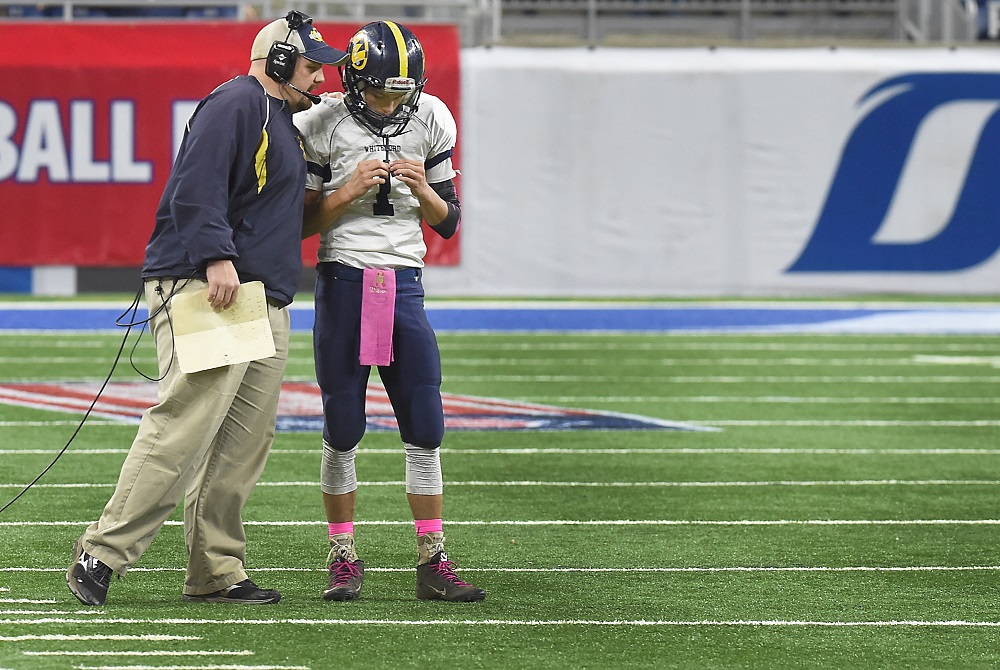
The formula was magic. Whiteford went 8-2 that first season under Mensing and tied a school record with nine wins in Year 2. By 2015, the Bobcats were in the MHSAA Semifinals for the first time. In 2016, Whiteford played at Ford Field for the first time. In 2017, Whiteford won a Division 8 championship. The Bobcats were a combined 93-24 during his decade running the program, including 11-2 this past fall.
“The reality is we do believe in our system,” Mensing said.
After 10 years, Mensing announced this week that he would be taking his system elsewhere. He will become the next head football coach at Westland John Glenn, a Class A school west of Detroit. The Rockets haven’t had much success in recent years, but school officials are excited to have Mensing on board.
“I’m excited to see what Jason can bring to our school and our program,” said John Glenn Principal Eric McCalla. “He is a culture builder. That’s one of the things we need here.”
McCalla is very familiar with Mensing. McCalla coached football for 16 years at Grass Lake and Manchester. At Grass Lake, McCalla’s team scrimmaged against Mensing’s for several years.
“It was definitely a great hire for us,” McCalla said. “We needed a different direction, and we feel confident that he is the right person for the job.”
Mensing, who will step down as athletic director and director of student advancement at Whiteford at the end of the school year, planned on meeting the John Glenn football players and parents this week. He will start immediately to build a coaching staff and relationships.
“They’ve struggled the last couple of years, but there is a solid history there,” Mensing said. “The first thing is I want is to bring stability and consistency to the program. They’ve had three football coaches in four years. We have to create an atmosphere where playing football is fun, create a culture where kids are excited about being part of the program.”
John Glenn has known football success. During the 1990s, John Glenn made several deep runs in the playoffs, reaching the Finals in 1993 and the Semifinals two more times.
The Rockets open the season Aug. 25 against Hartland in a nonleague game and play a challenging schedule in the always-tough Kensington Lakes Activities Association. They finished 2-7 last season and are seeking their first winning finish since 2014.
 “There’s no doubt that we play a tough schedule,” McCalla said. “In any given year we play one if not two or even three teams ranked in the top five or top 10. It’s a tough football conference.
“I think the first thing he can do is instill confidence in our kids. That is an important first step – and not just the kids, but the parents and the community. Having confidence in our program.”
Mensing was an academic All-American at Adrian College, where his father Henry Mensing coached and served as athletic director. Jason Mensing has made four other coaching stops during his 19-year career and picked up a lot of playoff appearances and coach of the year awards, and a built a lot of relationships.
He led Addison to the playoffs in his first season as varsity coach. He spent one year at Grayling, and won an Associated Press Class B Coach of the Year award during his three years at Owosso. He returned to Lenawee County to coach Tecumseh during the mid-2000s. In his one year away from high school football, he coached at Siena Heights University.
Whiteford lured him from the college level in 2012.
It wasn’t long before the milestone games and victories began piling up. Ironically, two Bobcats playoff losses were important steps in the team’s ascension. The first was a 2013 loss to New Lothrop in the Division 8 Regional Final. The Bobcats had beaten Sterling Heights Parkway Christian 59-6 and Detroit Allen Academy 61-20 in two home District games, then went on the road to face the Hornets, a powerhouse program.
“That loss was really big,” he said. “It showed us how far away we were but showed us what we needed to do to get there.”
Whiteford won seven games the following year, and in 2015 the Bobcats won three playoff games for the first time in school history, including a victory over a strong Climax-Scotts team. They lost the following week to Waterford Our Lady of the Lakes, but again, Mensing said, it was a loss that showed them the way.
“It was the moment we knew we belonged,” he said.
The Bobcats have ‘belonged’ ever since, proving not to be a one-and-done type program.
The 2017 team scored an incredible 737 points and punted just twice all season. The closest any opponent came was 16 points. Whiteford defeated Mendon in the Semifinals and Saginaw Nouvel in the Division 8 championship game.
Even in 2019 when the Bobcats went just 5-5, they upset a powerful Sand Creek team. Last year Whiteford reached the Division 8 Semifinals and led Hudson 22-0 at halftime before losing to the eventual champion, 28-22.
“There were some ups and downs,” Mensing said. “There were times we implemented things that didn’t necessarily work. Overall, though, we kept growing.
“When I look back at those years, the focus we started on growth and getting better year after year worked. We had 10 years of consistent growth. I do feel we are significantly more mature and better of a program than we were when I got here in 2012.”
Now, Mensing turns his attention to John Glenn, a school six times the size of Whiteford. He believes in the system he’s bringing with him and in the students at John Glenn.
“He’s a kid guy,” McCalla said. “We need people who are going to be there for our kids, not just football players, but all of our students. It’s not just about football, but life lessons.”
 Doug Donnelly has served as a sports and news reporter and city editor over 25 years, writing for the Daily Chief-Union in Upper Sandusky, Ohio from 1992-1995, the Monroe Evening News from 1995-2012 and the Adrian Daily Telegram since 2013. He's also written a book on high school basketball in Monroe County and compiles record books for various schools in southeast Michigan. E-mail him at [email protected] with story ideas for Jackson, Washtenaw, Hillsdale, Lenawee and Monroe counties.
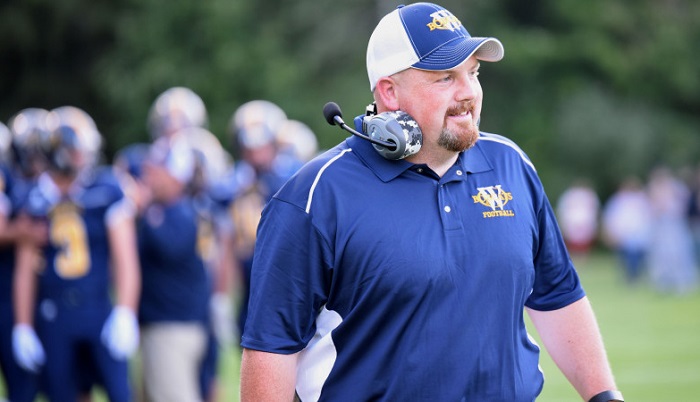
PHOTOS (Top) Coach Jason Mensing confers with a Whiteford player during one of the team’s two runs to Ford Field. (Middle) Mensing will be leaving the program after 10 seasons with the Bobcats. (Top photo by Tom Hawley/Monroe News; middle by Cari Hayes.)