

New Math: Division & Multiplication Problems
July 25, 2017
By Jack Roberts
MHSAA Executive Director
This is the second part in a series on MHSAA tournament classification, past and present, that will be published over the next two weeks. This series originally ran in this spring's edition of MHSAA benchmarks.
High school tournament classifications went viral before there was social media and most of us knew what “viral” meant.
Much as a virus infects computers today or has created epidemics of disease around the world for centuries, high school tournament classification – once introduced – tends to spread uncontrollably. Once started, it tends to keep expanding and rarely contracts.
While we are still some distance from providing every team a trophy as a result of expanding high school tournament classification across the country, there is criticism nevertheless that we are headed in that direction – a philosophy which is supposed to exist only in local youth sports for our youngest children.
Michigan could be blamed for all this. Michigan is generally accepted as the first state to provide different classifications for season-ending tournaments for different sized schools. It started a century ago. Today, every state has various classifications for its tournaments in most if not all sports. And it is a bit ironic that Michigan – creator of the classification chaos – more than most other states has kept the number of tournament classes or divisions under control.
Yes, there is evidence that tournament classifications have expanded over the years in Michigan, especially with the relatively recent introduction of tournaments in football and the late 1990s’ move from classes to divisions in most MHSAA tournaments. But the MHSAA Representative Council has held true to its word when it expanded the playoffs for football from four classes to eight divisions: this is needed because of unique factors of football, factors that exist in no other sport; and all other sports should be capped at a maximum of four classes or divisions.
Kentucky is the preeminent defender of single-class basketball. All of its 276 high schools compete for the single state championship for each gender. In Indiana, there are still open wounds from its move in 1998 from one to four classes for its 400 schools in basketball.
Multi-class tournaments have tended to increase the number of non-public school champions, which some states are trying to lower through enrollment “multipliers,” and also tend to increase the number of repeat champions, which some states are trying to affect with “success factors” which lift smaller schools into classifications for larger schools if they take home too many trophies.
While there is considerable evidence that state tournaments do as much bad as good for educational athletics, state associations persist in providing postseason tournaments because, on balance, the experiences are supposed to be good for student-athletes. And once we reach that conclusion it is just a small leap to believe that if the tournaments are good for a few, they must be better for more – which leads to creating more and more tournament classifications. One becomes two classes, then three, then four and so forth.
While the argument is that more classifications or divisions provides more students with opportunities to compete and win, it is undeniable that the experience changes as the number of tournament classifications expands. It is not possible for state associations to provide the same level of support when tournament classifications expand to multiple venues playing simultaneously. For example, there is less audio and video broadcast potential at each venue, and less media coverage to each venue. Focus is diluted and fans diminished at each championship.
No one can argue reasonably that today's two-day MHSAA Football Finals of eight championship games has the same pizazz as the one-day, four-games event conducted prior to 1990.
In some states the number of divisions has grown so much that it is difficult to see much difference between the many season-ending state championship games and a regular-season event in the same sport.
It is a balancing act. And Michigan has been studying that balance longer than any other state, and charting a steadier course than most.
Addition by Division
The shift to Divisions for MHSAA Tournament play in numerous sports has added up to a greater number of champions for teams and individuals across the state. Following are the sports currently employing a divisional format, and the procedures for determining enrollment and classification.
In 23 statewide or Lower Peninsula tournaments, schools which sponsor the sport are currently divided into nearly equal divisions. They are:
- Baseball - 4 Divisions
- Boys Bowling - 4 Divisions
- Girls Bowling - 4 Divisions
- Girls Competitive Cheer - 4 Divisions
- LP Boys Cross Country - 4 Divisions
- LP Girls Cross Country - 4 Divisions
- LP Boys Golf - 4 Divisions
- LP Girls Golf - 4 Divisions
- Ice Hockey - 3 Divisions
- Boys Lacrosse - 2 Divisions
- Girls Lacrosse - 2 Divisions
- Boys Skiing - 2 Divisions
- Girls Skiing - 2 Divisions
- LP Boys Soccer - 4 Divisions LP
- Girls Soccer - 4 Divisions
- Girls Softball - 4 Divisions
- LP Boys Swimming & Diving - 3 Divisions
- LP Girls Swimming & Diving - 3 Divisions
- LP Boys Tennis - 4 Divisions
- LP Girls Tennis - 4 Divisions
- LP Boys Track & Field - 4 Divisions
- LP Girls Track & Field - 4 Divisions
- Wrestling - 4 Divisions
Lists of schools for each division of these 23 tournaments are posted on MHSAA.com approximately April 1. Listings of schools in Upper Peninsula tournaments for their sports are also posted on MHSAA.com. The lists are based on school memberships and sports sponsorships in effect or anticipated for the following school year, as known to the MHSAA office as of a date in early March.
In football, the 256 schools which qualify for MHSAA 11-player playoffs are placed in eight equal divisions annually on Selection Sunday. Beginning in 2017, the 8-player divisions will be determined in a like manner on Selection Sunday as well, with 32 qualifying schools placed in two divisions.
Schools have the option to play in any higher division in one or more sports for a minimum of two years.
The deadlines for "opt-ups" are as follows:
- Applications for fall sports must be submitted by April 15
- Applications for winter sports must be submitted by Aug. 15
- Applications for spring sports must be submitted by Oct. 15
Subsequent to the date of these postings for these tournaments, no school will have its division raised or lowered by schools opening or closing, schools adding or dropping sports, schools exercising the option to play in a higher division, or approval or dissolution of cooperative programs.
When the same sport is conducted for boys and girls in the same season (e.g., track & field and cross country), the gender that has the most sponsoring schools controls the division breaks for both genders.
Breslin Bound: 2025-26 Boys District Preview
By
Geoff Kimmerly
MHSAA.com senior editor
February 23, 2026
The march to Breslin Center ramps up significantly this week as more than 700 boys basketball teams across Michigan begin a journey they hope will end in East Lansing.

We always switch up our “Breslin Bound” format once the MHSAA Tournament starts, as last week’s most intriguing results below are followed this time by glances at three District brackets of note in each division. Host sites are bolded, and teams playing in those brackets are listed by seed as determined by Michigan Power Ratings (MPR).
Everything you could want to know this week about tickets, brackets and more can be found on the Boys Basketball page. To watch any of several games online, visit the NFHS Network.
“Breslin Bound” is powered by MI Student Aid and based on results and schedules posted for each school at MHSAA.com.
Week in Review
The countdown of last week’s five most intriguing results:
1. Saginaw Heritage 73, Grand Blanc 60 The Hawks (18-4) avenged a 28-point loss to Grand Blanc (17-4) from December in this matchup of Saginaw Valley League division champions.
2. Detroit Catholic Central 64, Detroit Martin Luther King 54 The Shamrocks (15-6) won the annual Operation Friendship championship game matching the winners from the Catholic High School League and Detroit Public School League, and adding to a 54-46 overtime win over King (17-5) from December.
3. Gladwin 49, Beaverton 46 Gladwin (21-1) claimed the overall Jack Pine Conference championship with its second win this month over Beaverton (17-5).
4. Flushing 52, Goodrich 51 Flushing (18-4) held on for a second close win over Goodrich, this time in the Flint Metro League championship game, after winning their Jan. 27 meeting by four.
5. Wayne Memorial 61, Hartland 48 The Zebras (19-3) capped off their regular season by defeating the Eagles (18-4) in the Kensington Lakes Activities Association title game.
Districts at a Glance
These could be among our most competitive brackets. Host sites are in bold, and teams are listed by seed:
DIVISION 1
Detroit Cass Tech
1. Detroit Martin Luther King (17-5), 2. Detroit Cass Tech (16-6), 3. Detroit Western (19-2), 4. Grosse Pointe South (11-11), 5. Grosse Pointe North (10-12).
King and Cass Tech have met twice this season – King won the Jan. 21 matchup 60-53 that helped decide the PSL Blue title, and then 68-63 in the PSL Tournament city championship game Feb. 15. King also defeated Western, 56-36, in a league tournament semifinal, while Cass Tech and Western didn’t face each other during this regular season. Grosse Pointe North has won seven of its last nine games and defeated Cass Tech by a point in their District matchup last season, and South owns a big early win over North.
Flushing
1. Saginaw Heritage (18-4), 2. Flushing (18-4), 3. Saginaw United (13-8), 4. Flint Carman-Ainsworth (8-14), 5. Swartz Creek (11-11).
As noted by the results above, Heritage and Flushing emerged at the end of last week as the top teams from the Saginaw Valley League and Flint Metro League, respectively. Saginaw United finished second in the SVL South and split with SVL North runner-up Mount Pleasant this season, and despite losing to Heritage early should also be considered a contender. Flushing has only one loss this calendar year, to Pontiac Notre Dame Prep in overtime, and Heritage has lost only twice since Jan. 1 and defeated Mount Pleasant twice by 20 or more points to win the SVL North.
Muskegon
1. Rockford (18-3), 2. Muskegon (19-2), 3. Greenville (20-2), 4. Muskegon Mona Shores (10-10), 5. Muskegon Reeths-Puffer (6-16), 6. Cedar Springs (7-15).
Rockford and Muskegon are the anticipated matchup to decide this bracket, and they met in last season’s District Final with the Rams winning 64-62. Rockford has victories over Bloomfield Hills Brother Rice and East Kentwood but finished second to the latter in the O-K Red. Muskegon has downed Wayne Memorial and Lansing Waverly and won the O-K Green. And definitely don’t count out River Cities Alliance champion Greenville, which has two losses by a combined six points and introduced itself loudly with a December win over Grand Rapids Northview.
DIVISION 2
Comstock Park
1. Grand Rapids Catholic Central (16-6), 2. Grand Rapids Christian (16-5), 3. Grand Rapids NorthPointe Christian (17-5), 4. Wyoming Kelloggsville (14-7), 5. Comstock Park (5-17), 6. Ada Forest Hills Eastern (2-20).
Grand Rapids Christian claimed the O-K White title outright last week in part thanks to a 51-43 win over Grand Rapids Catholic Central, and they split their regular-season series as the Cougars won their Jan. 20 meeting by five. NorthPointe was second in the O-K Silver and Kelloggsville fourth, and on opposite sides of this bracket certainly could provide obstacles as the Cougars and Eagles pursue a third round.
Ludington
1. Ludington (20-2), 2. Hart (19-3), 3. Reed City (10-12), 4. Manistee (12-10), 5. Big Rapids (9-13).
Ludington finished undefeated in the West Michigan Conference Lakes and has reached Regional Finals the last two seasons. Hart was second in the WMC Rivers and is seeking a first District title since 2019. They have key mutual opponents; both lost to North Muskegon this winter, and Hart also took a loss from Fremont while Ludington swept the Packers. Manistee and Ludington played Thursday – Ludington winning 68-55 – and they could meet again in a District Semifinal if Manistee gets past Big Rapids tonight.
Yale
1. Yale (20-2), 2. Croswell-Lexington (17-5), 3. Imlay City (16-6), 4. Almont (10-10), 5. North Branch (7-15).
All five of these teams are from the Blue Water Area Conference and finished among the top six, with Yale and Croswell-Lexington sharing the championship and splitting their matchups – the Pioneers won Jan. 20 in overtime, 64-57, while Yale won the rematch Friday 60-41. Imlay City finished third in the BWAC and despite losing both games against both champs took Croswell-Lexington to overtime the second time they played.
DIVISION 3
Kent City
1. Blanchard Montabella (15-7), 2. Kent City (14-8), 3. Morley Stanwood (13-9), 4. Ravenna (13-9), 5. Lakeview (7-15), 6. White Cloud (3-19).
The top four seeds all finished second or third in their respective leagues and will look to add a trophy winning what could be one of the most tightly-contested brackets in any division. Montabella tied for second in the Mid-State Activities Conference West and has won six of its last seven games since falling to Ravenna 43-39 on Jan. 28. Ravenna, which tied for third in the WMC Rivers, has bounced back from a late rough stretch and opened this season with a win over Morley Stanwood – which finished second in the Central State Activities Association White while splitting with third-place Kent City, which won their Friday matchup by 20.
Mancelona
1. Mancelona (20-2), 2. East Jordan (20-2), 3. Indian River Inland Lakes (14-8), 4. Harbor Springs (11-11), 5. Boyne City (9-12), 6. Charlevoix (6-15).
By the numbers, Mancelona and East Jordan has been so close at the top of this District that East Jordan actually passed Mancelona in MPR during the week after seeding. East Jordan also won the Ski Valley Conference by game over Mancelona, claiming their matchups 48-38 and 45-36. Inland Lakes finished third in the Ski Valley, losing to both league title contenders twice, and Harbor Springs is coming over after finishing third in the Northern Shores Conference and losing to East Jordan by only six points, 45-39, on Thursday.
Unionville-Sebewaing
1. Harbor Beach (19-3), 2. Elkton-Pigeon-Bay Port Laker (18-3), 3. Cass City (16-6), 4. Unionville-Sebewaing (11-11), 5. Bad Axe (6-15).
There is a great deal of familiarity in this bracket as well, as Harbor Beach won the Big Thumb Conference Black and Laker and Cass City were first and second, respectively, in the BTC White. Harbor Beach saw both during the first half of the regular season, defeating Cass City by seven and Laker by three. Laker defeated Cass City by seven and nine to win their league. USA tied for fifth in the BTC White – with an eight-point win over Cass City and a four-point loss to Laker in February rematches.
DIVISION 4
Lake Linden-Hubbell
1. Dollar Bay (19-2), 2. L’Anse (15-6), 3. Baraga (15-6), 4. Lake-Linden-Hubbell (7-15), 5. Chassell (5-16).
Dollar Bay won the Copper Mountain Conference championship and L’Anse and Baraga both finished among the upper half among a strong group – in fact, Baraga defeated Dollar Bay by 11 just 10 days ago. Dollar Bay did defeat Baraga in last season’s District Final, and the Blue Bolts’ only other loss this season was to Division 1 Marquette. L’Anse is enjoying its first winning season since 2018-19 and swept Baraga during the regular season.
Rogers City
1. Hillman (19-2), 2. Posen (15-5), 3. Gaylord St. Mary (13-9), 4. Rogers City (12-9), 5. Onaway (5-17), 6. Atlanta (4-13).
Hillman and Posen shared the North Star League Little Dipper championship, splitting the regular-season series with Posen and winning their most recent matchup 57-50 on Jan. 27. They may meet again, but Hillman also took a loss from potential Wednesday opponent Rogers City before winning their rematch by 20. Rogers City also defeated Posen twice. Gaylord St. Mary is intriguing after finishing fourth in the Ski Valley Conference but, as noted above, defeating that league’s champion East Jordan earlier this month.
Three Oaks River Valley
1. St. Joseph Michigan Lutheran (17-4), 2. St. Joseph Our Lady of the Lake Catholic (13-7), 3. New Buffalo (14-8), 4. Eau Claire (11-11), 5. Three Oaks River Valley (3-17).
Michigan Lutheran finished first, Our Lady and New Buffalo tied for second, and Eau Claire finished fourth in the Berrien-Cass-St. Joseph League. New Buffalo handed Michigan Lutheran its only conference defeat in their second of two games – winning by a point – and New Buffalo and Our Lady split their two games, decided by five and two points. Michigan Lutheran also defeated New Buffalo to clinch a District championship a year ago.
MHSAA.com's weekly “Breslin Bound” reports are powered by MI Student Aid, a division within the Department of Lifelong Education, Advancement, and Potential (MiLEAP). MI Student Aid encourages students to pursue postsecondary education by providing access to student financial resources and information. MI Student Aid administers the state’s scholarship and grant programs that help make college Accessible, Affordable and Attainable for you. Click to connect with MI Student Aid and find more information on Facebook and X @mistudentaid.
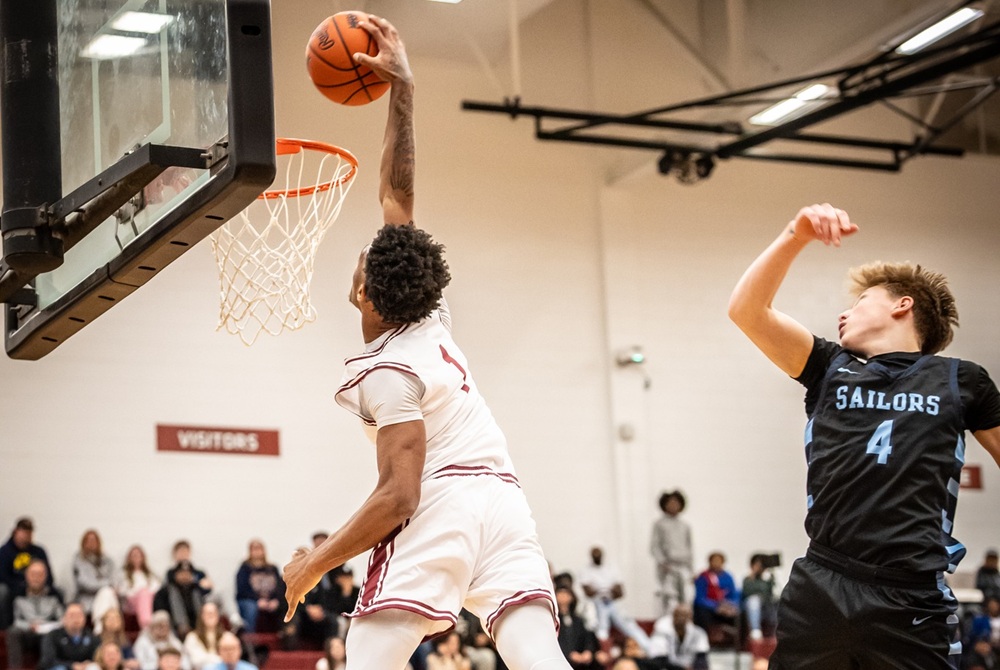
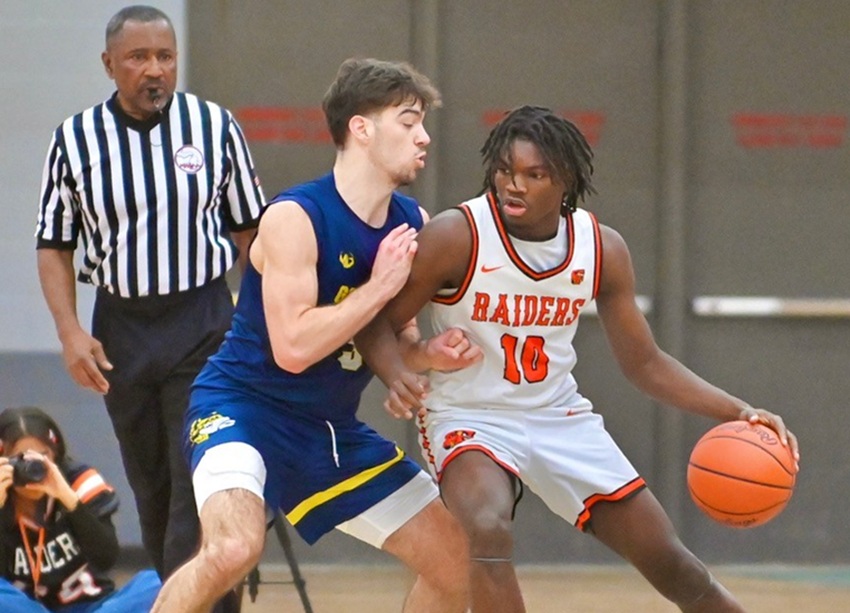
PHOTOS (Top) Muskegon’s James Martin throws down a dunk against Muskegon Mona Shores during a Jan. 30 win. (Middle) Flushing’s Raymond Neither (10) works for post position against Goodrich’s Jensen LePla during the Raiders’ 52-51 Metro League title clincher. (Muskegon/Mona Shores photo by Tim Reilly. Flushing/Goodrich photo by Terry Lyons.)