


New Math: Division & Multiplication Problems
July 25, 2017
By Jack Roberts
MHSAA Executive Director
This is the second part in a series on MHSAA tournament classification, past and present, that will be published over the next two weeks. This series originally ran in this spring's edition of MHSAA benchmarks.
High school tournament classifications went viral before there was social media and most of us knew what “viral” meant.
Much as a virus infects computers today or has created epidemics of disease around the world for centuries, high school tournament classification – once introduced – tends to spread uncontrollably. Once started, it tends to keep expanding and rarely contracts.
While we are still some distance from providing every team a trophy as a result of expanding high school tournament classification across the country, there is criticism nevertheless that we are headed in that direction – a philosophy which is supposed to exist only in local youth sports for our youngest children.
Michigan could be blamed for all this. Michigan is generally accepted as the first state to provide different classifications for season-ending tournaments for different sized schools. It started a century ago. Today, every state has various classifications for its tournaments in most if not all sports. And it is a bit ironic that Michigan – creator of the classification chaos – more than most other states has kept the number of tournament classes or divisions under control.
Yes, there is evidence that tournament classifications have expanded over the years in Michigan, especially with the relatively recent introduction of tournaments in football and the late 1990s’ move from classes to divisions in most MHSAA tournaments. But the MHSAA Representative Council has held true to its word when it expanded the playoffs for football from four classes to eight divisions: this is needed because of unique factors of football, factors that exist in no other sport; and all other sports should be capped at a maximum of four classes or divisions.
Kentucky is the preeminent defender of single-class basketball. All of its 276 high schools compete for the single state championship for each gender. In Indiana, there are still open wounds from its move in 1998 from one to four classes for its 400 schools in basketball.
Multi-class tournaments have tended to increase the number of non-public school champions, which some states are trying to lower through enrollment “multipliers,” and also tend to increase the number of repeat champions, which some states are trying to affect with “success factors” which lift smaller schools into classifications for larger schools if they take home too many trophies.
While there is considerable evidence that state tournaments do as much bad as good for educational athletics, state associations persist in providing postseason tournaments because, on balance, the experiences are supposed to be good for student-athletes. And once we reach that conclusion it is just a small leap to believe that if the tournaments are good for a few, they must be better for more – which leads to creating more and more tournament classifications. One becomes two classes, then three, then four and so forth.
While the argument is that more classifications or divisions provides more students with opportunities to compete and win, it is undeniable that the experience changes as the number of tournament classifications expands. It is not possible for state associations to provide the same level of support when tournament classifications expand to multiple venues playing simultaneously. For example, there is less audio and video broadcast potential at each venue, and less media coverage to each venue. Focus is diluted and fans diminished at each championship.
No one can argue reasonably that today's two-day MHSAA Football Finals of eight championship games has the same pizazz as the one-day, four-games event conducted prior to 1990.
In some states the number of divisions has grown so much that it is difficult to see much difference between the many season-ending state championship games and a regular-season event in the same sport.
It is a balancing act. And Michigan has been studying that balance longer than any other state, and charting a steadier course than most.
Addition by Division
The shift to Divisions for MHSAA Tournament play in numerous sports has added up to a greater number of champions for teams and individuals across the state. Following are the sports currently employing a divisional format, and the procedures for determining enrollment and classification.
In 23 statewide or Lower Peninsula tournaments, schools which sponsor the sport are currently divided into nearly equal divisions. They are:
- Baseball - 4 Divisions
- Boys Bowling - 4 Divisions
- Girls Bowling - 4 Divisions
- Girls Competitive Cheer - 4 Divisions
- LP Boys Cross Country - 4 Divisions
- LP Girls Cross Country - 4 Divisions
- LP Boys Golf - 4 Divisions
- LP Girls Golf - 4 Divisions
- Ice Hockey - 3 Divisions
- Boys Lacrosse - 2 Divisions
- Girls Lacrosse - 2 Divisions
- Boys Skiing - 2 Divisions
- Girls Skiing - 2 Divisions
- LP Boys Soccer - 4 Divisions LP
- Girls Soccer - 4 Divisions
- Girls Softball - 4 Divisions
- LP Boys Swimming & Diving - 3 Divisions
- LP Girls Swimming & Diving - 3 Divisions
- LP Boys Tennis - 4 Divisions
- LP Girls Tennis - 4 Divisions
- LP Boys Track & Field - 4 Divisions
- LP Girls Track & Field - 4 Divisions
- Wrestling - 4 Divisions
Lists of schools for each division of these 23 tournaments are posted on MHSAA.com approximately April 1. Listings of schools in Upper Peninsula tournaments for their sports are also posted on MHSAA.com. The lists are based on school memberships and sports sponsorships in effect or anticipated for the following school year, as known to the MHSAA office as of a date in early March.
In football, the 256 schools which qualify for MHSAA 11-player playoffs are placed in eight equal divisions annually on Selection Sunday. Beginning in 2017, the 8-player divisions will be determined in a like manner on Selection Sunday as well, with 32 qualifying schools placed in two divisions.
Schools have the option to play in any higher division in one or more sports for a minimum of two years.
The deadlines for "opt-ups" are as follows:
- Applications for fall sports must be submitted by April 15
- Applications for winter sports must be submitted by Aug. 15
- Applications for spring sports must be submitted by Oct. 15
Subsequent to the date of these postings for these tournaments, no school will have its division raised or lowered by schools opening or closing, schools adding or dropping sports, schools exercising the option to play in a higher division, or approval or dissolution of cooperative programs.
When the same sport is conducted for boys and girls in the same season (e.g., track & field and cross country), the gender that has the most sponsoring schools controls the division breaks for both genders.
Dundee's Swiderski Becomes 4th to Earn 4 Individual, 4 Team Finals Titles
By
Paul Costanzo
Special for MHSAA.com
March 5, 2022
DETROIT – Casey Swiderski took a moment Saturday for himself.
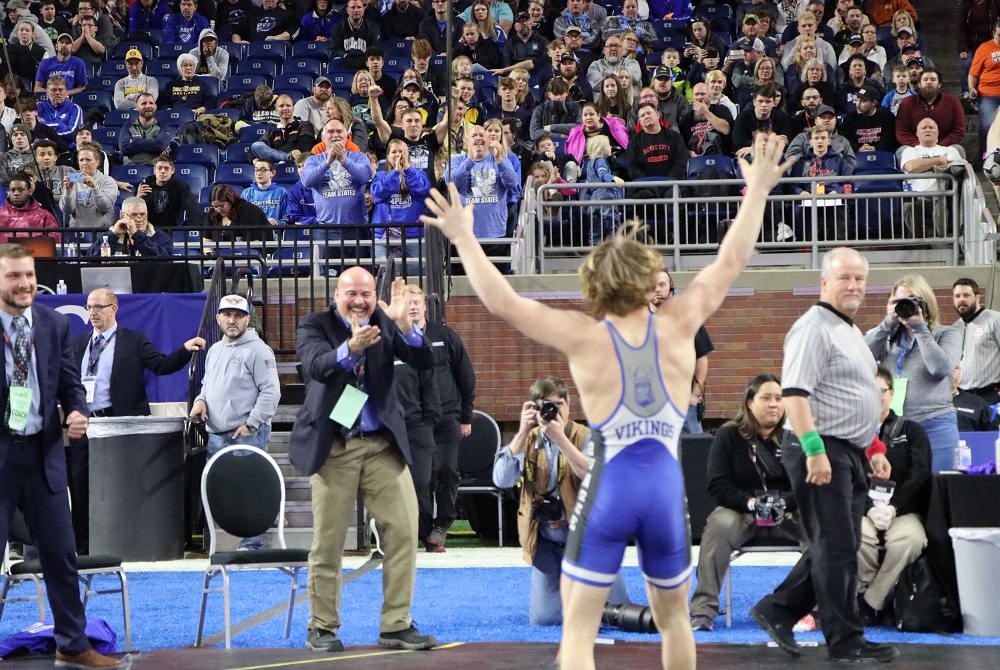
The Dundee senior and four-time Individual Wrestling Finals champion had already had his hand raised. He had already addressed the crowd and had a post-match celebration.
But as fans continued to rain applause down on him, Swiderski crouched off to the side of the mat and took it all in.
“It’s tough walking away from this,” Swiderski said following his pinfall victory against Kingsley’s Aiden Shier in the Division 3, 152-pound final. “That was it. That was my last high school match in the MHSAA season. It’s tough. It’s a lot of hard work and years. I’ve got college to go to, but that’s tough right there.”
Swiderski deserved the moment, as he finished off one of the most dominant and successful careers in MHSAA history.
With his victory, and Dundee’s team title win a week earlier, Swiderski became the fourth wrestler in state history to win four team titles and four individual titles. He joined Davison’s Brent Metcalf (who will be one of his coaches at Iowa State), Lowell’s Austin Boone and his former teammate, Stoney Buell.
“It’s amazing,” Swiderski said. “When you put in all the hard work and the belief, this is the bonus day right here. This comes with it. It’s an awesome thing.”
Swiderski (45-0) was leading comfortably in the second period of the final when Shier was able to get his first burst of offense on a deep shot. Rather than give up the takedown, however, Swiderski turned it into his own pinning combination.
He finished the tournament with three pins and one technical fall. None of his matches went beyond the second period.
103
Champion: Talan Parsons, Ovid-Elsie, Soph. (37-1)
Major Decision, 9-0, over Landon Sopha, Yale, Fr. (53-2)
A year after coming one match short of his ultimate goal, Parsons wasn’t going to be denied Saturday.
“This was my biggest goal,” Parsons said. “Last year I was so close, and it hurt a lot to make it all that way and not take first. So I put in all the work to make my way back and win it this year.”
Parsons jumped on Sopha early and controlled the match throughout, adding a takedown, nearfall and reversal as the match went on to win with a major decision.
112
Champion: Kade Kluce, Dundee, Soph. (41-6)
Decision, 5-4, over Easton Moran, Yale, Sr. (51-3)
Kluce was a returning Finals champion, having won at 103 a year ago. But he wasn’t happy with how things started this season, and the emotions were evident as he celebrated his second title.
“I just felt grateful I got the opportunity to come here and wrestle,” said Kluce, who suffered a knee injury in the summer that lingered into the beginning of the season. “I lost six matches this year, three times as much as I did last year. I don’t know, I just didn’t feel proud of myself until now.”
Kluce fell behind 2-0 as Moran picked up an early takedown, but he battled back and a takedown with 37 seconds remaining won him the match.
119
Champion: Braeden Davis, Dundee, Jr. (41-2)
Technical Fall, 3:32, over Connor Busz, Clinton, Jr. (48-3)
Davis has not wrestled into the third period at the Individual Finals.
He’s a three-time champion.
“I’ve just been able to bonus my way through states the past three years, and I’m really grateful,” Davis said. “I’m really happy that I’m able to do things like that.”
Davis, who has already committed to Penn State, won at 103 pounds in 2020 and 112 in 2021. Saturday’s match was his first final to make it out of the first period, but it came against an opponent in Busz who was a runner-up a year ago.
As a three-time individual and team champion, Davis has a chance to match Swiderski’s achievement next season.
125
Champion: Cameron Chinavare, Dundee, Soph. (39-2)
Fall, 3:14, over Fabian Facundo, Alma, Fr. (38-4)
After an early-season match between these two was airtight, Chinavare – who won that first match 4-3 – was expecting another battle.
“I know I had to go out there and keep my feet moving,” Chinavare said. “I knew he was going to come at me. I dragged him right there at the end and took him to his back. I wasn’t expecting a pin at all, but it fell right into place, I guess.”
Chinavare led the match 2-0 after the first period, and before he was able to get the takedown and pin.
130
Champion: Zachary Gibson, Lake Odessa Lakewood, Sr. (39-0)
Major decision, 11-0, over Caiden Pelc, Portland, Sr. (34-7)
Gibson and Pelc had met three times throughout the season, with Gibson winning each matchup.
He wasn’t worried about Pelc figuring him out, though.
“I had something new against him every time,” Gibson said.
The title was the second straight for Gibson, who won at 125 pounds a year ago. This was his first at Ford Field.
“It’s way different,” he said. “Way bigger, way more exciting.”
135
Champion: Aidan Bernard, Montrose, Sr. (46-1)
Decision, 8-1, over Logan Sander, Dundee, Sr. (35-7)
After winning his first Finals title, Bernard couldn’t contain his emotions.
“I’m so happy,” he said. “I’ve been wrestling since I was 9, and this is all I’ve wanted for the past nine years. I’ve been close – my sophomore year I took third. Last year I thought I was going to have it, but I was in really bad shape because of COVID. This year, I really (worked hard) and I had great coaching staff, great family, great friends who pushed me and supported me. I’m just really grateful for the moment.”
Twice during his Finals match, Bernard’s injured knee flared up. But he wasn’t going to let that stop him.
“I knew I was going to keep going,” he said. “I told my parents and my friends, even if I break something early in the match, I’m going to keep going.”
140
Champion: Ryker Johnecheck, Williamston, Sr. (38-2)
Decision, 5-1, over Peter Pena, Milan, Jr. (21-2)
Johnecheck never planned to be flashy in claiming his third-straight individual title. He just wanted to be efficient.
He was certainly that as he controlled his match with Pena throughout.
“I think it’s one of those matches where it’s the state finals, I’m not going to go take any unnecessary risks,” he said. “I just went out there, wrestled smart. He can catch people, so my big thing was be smart, get a comfortable score, and take what’s there, and I think that’s what I did.”
Johnecheck won at 125 in 2020 and 130 in 2021.
“It’s not what I expected coming in as a freshman,” Johnecheck said. “It hasn’t really sunk in yet, that I’m going to be one of those guys in 10 years that they’re looking up (in the gymnasium) and say, ‘Oh, I knew him.’”
145
Champion: Aiden Davis, Dundee, Jr. (43-0)
Decision, 11-5, over Mason Cantu, Hart, Sr. (48-2)
Despite being a returning champion, Davis said he felt the pressure was on Cantu coming into their Finals match. So the Dundee junior picked his spots to finish off his unbeaten season and come away with another title.
“I’ve been here before. I sort of know the environment,” Davis said. “And I had to stay cool, calm and collected throughout the whole match.”
Davis won at 135 pounds a year ago, and was runner-up at 125 in 2020. Cantu was a Division 4 runner-up at 135 pounds in 2020.
160
Champion: Connor Owens, Flint Powers Catholic, Jr. (18-0)
Decision, 5-2, over Nick Marienfeld, Napoleon, Sr. (54-1)
Owens didn’t like the feeling of not winning a Finals title a year ago, when he finished runner-up at this weight. So he decided this season to simply not lose.
“This is dreams coming to reality right here, man; this is nuts,” he said. “This is my biggest wrestling dream ever, and I’m just in shock right now. That feeling of losing, whether in the state finals or not, when you’re a true competitor, you have to hate losing more than you love winning, and you just have to refuse to lose.”
The match was tied heading into the third period, but an escape and a takedown gave Owens the victory.
171
Champion: Kevin McKiernan, Richmond, Sr. (40-9)
Decision, 4-3, over Jake Nelson, Howard City, Sr. (38-8)
McKiernan is the youngest of five brothers, and all made a Final for Richmond. He’s now the third McKiernan to win a title.
“It means a ton,” he said. “You can’t be the only brother to not make it to the Finals. Then you’re the end of every joke. But it means a ton.”
McKiernan took third in his region, but battled through this bracket to get his first title. He scored a late first-period takedown to take his first lead, and never relinquished it.
“It’s the coaches standing in the corner, the practice partners in the room, all of that adds up to state titles,” McKiernan said. “I think this is just proof of that again.”
189
Champion: Jacob Munger, Alma, Sr. (43-2)
Decision, 11-5, over Logan Badge, Clinton, Sr. (36-6)
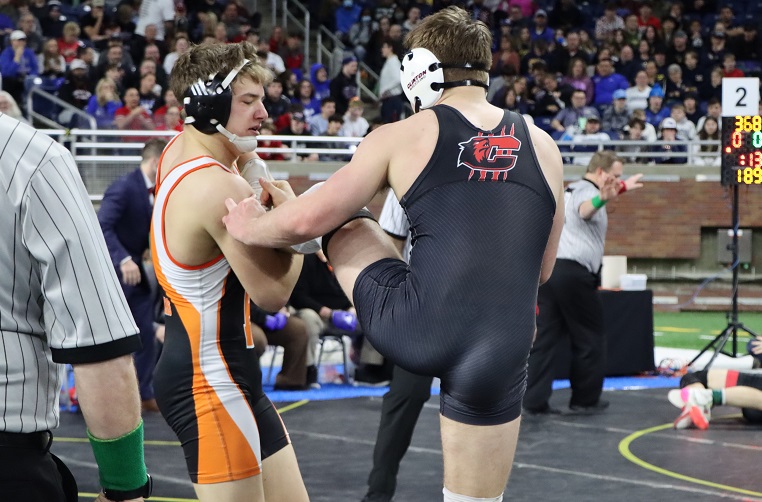
For the second time in as many weeks, Munger defeated Badge, this time claiming his first title, and denying Badge his fourth.
“All my coaches, they say to stay with the positive, remember what worked the last match and bring it to this match,” Munger said. “I stayed with the positive … I knew I had a great gas tank and brought that over. It’s just all positive.”
Munger led 6-3 heading into the third period, and added two more takedowns in the third to pad his lead.
Badge was a three-time champion in Division 4, winning at 189 in 2020 and 2021, and 215 in 2019.
215
Champion: Hunter Huguelet, Gladwin, Sr. (46-1)
Fall, 1:54, over Adam Garcia, Alma, Sr. (32-7)
Huguelet thought for a long time about what he could do to win his first individual title.
It didn’t take him that long to do it.
The Gladwin senior capped off his career with a first-period pin.
“That was great,” Huguelet said. “I just was focusing for the last two hours, all day today and last night, and I just came in ready to go. It feels amazing. It’s more than what I thought.”
285
Champion: Levi Harber, Montrose, (44-4)
Fall, 3:51, over Eli Marshall, Watervliet, Sr. (42-3)
Harber was dominant throughout the tournament, pinning each of his first three opponents in the opening minute.
His Finals match took a little longer, but ultimately had the same result.
Harber had Marshall on his back in the first period as well, but it didn’t result in a pin, and that wasn’t necessarily even the plan.
“I’m going to be honest, I threw that cradle to get some comfort points between me and him,” he said. “So, I wasn’t expecting a pin. He was getting pretty close, but I was not in the position that I felt I could pin him properly.”
PHOTOS (Top) Dundee’s Casey Swiderski is applauded after concluding his high school career with a fourth Division 3 individual championship. (Middle) Alma’s Jacob Munger, left, works toward a win at 189 pounds. (Click for more from HighSchoolSportsScene.com.)