


New Math: Division & Multiplication Problems
July 25, 2017
By Jack Roberts
MHSAA Executive Director
This is the second part in a series on MHSAA tournament classification, past and present, that will be published over the next two weeks. This series originally ran in this spring's edition of MHSAA benchmarks.
High school tournament classifications went viral before there was social media and most of us knew what “viral” meant.
Much as a virus infects computers today or has created epidemics of disease around the world for centuries, high school tournament classification – once introduced – tends to spread uncontrollably. Once started, it tends to keep expanding and rarely contracts.
While we are still some distance from providing every team a trophy as a result of expanding high school tournament classification across the country, there is criticism nevertheless that we are headed in that direction – a philosophy which is supposed to exist only in local youth sports for our youngest children.
Michigan could be blamed for all this. Michigan is generally accepted as the first state to provide different classifications for season-ending tournaments for different sized schools. It started a century ago. Today, every state has various classifications for its tournaments in most if not all sports. And it is a bit ironic that Michigan – creator of the classification chaos – more than most other states has kept the number of tournament classes or divisions under control.
Yes, there is evidence that tournament classifications have expanded over the years in Michigan, especially with the relatively recent introduction of tournaments in football and the late 1990s’ move from classes to divisions in most MHSAA tournaments. But the MHSAA Representative Council has held true to its word when it expanded the playoffs for football from four classes to eight divisions: this is needed because of unique factors of football, factors that exist in no other sport; and all other sports should be capped at a maximum of four classes or divisions.
Kentucky is the preeminent defender of single-class basketball. All of its 276 high schools compete for the single state championship for each gender. In Indiana, there are still open wounds from its move in 1998 from one to four classes for its 400 schools in basketball.
Multi-class tournaments have tended to increase the number of non-public school champions, which some states are trying to lower through enrollment “multipliers,” and also tend to increase the number of repeat champions, which some states are trying to affect with “success factors” which lift smaller schools into classifications for larger schools if they take home too many trophies.
While there is considerable evidence that state tournaments do as much bad as good for educational athletics, state associations persist in providing postseason tournaments because, on balance, the experiences are supposed to be good for student-athletes. And once we reach that conclusion it is just a small leap to believe that if the tournaments are good for a few, they must be better for more – which leads to creating more and more tournament classifications. One becomes two classes, then three, then four and so forth.
While the argument is that more classifications or divisions provides more students with opportunities to compete and win, it is undeniable that the experience changes as the number of tournament classifications expands. It is not possible for state associations to provide the same level of support when tournament classifications expand to multiple venues playing simultaneously. For example, there is less audio and video broadcast potential at each venue, and less media coverage to each venue. Focus is diluted and fans diminished at each championship.
No one can argue reasonably that today's two-day MHSAA Football Finals of eight championship games has the same pizazz as the one-day, four-games event conducted prior to 1990.
In some states the number of divisions has grown so much that it is difficult to see much difference between the many season-ending state championship games and a regular-season event in the same sport.
It is a balancing act. And Michigan has been studying that balance longer than any other state, and charting a steadier course than most.
Addition by Division
The shift to Divisions for MHSAA Tournament play in numerous sports has added up to a greater number of champions for teams and individuals across the state. Following are the sports currently employing a divisional format, and the procedures for determining enrollment and classification.
In 23 statewide or Lower Peninsula tournaments, schools which sponsor the sport are currently divided into nearly equal divisions. They are:
- Baseball - 4 Divisions
- Boys Bowling - 4 Divisions
- Girls Bowling - 4 Divisions
- Girls Competitive Cheer - 4 Divisions
- LP Boys Cross Country - 4 Divisions
- LP Girls Cross Country - 4 Divisions
- LP Boys Golf - 4 Divisions
- LP Girls Golf - 4 Divisions
- Ice Hockey - 3 Divisions
- Boys Lacrosse - 2 Divisions
- Girls Lacrosse - 2 Divisions
- Boys Skiing - 2 Divisions
- Girls Skiing - 2 Divisions
- LP Boys Soccer - 4 Divisions LP
- Girls Soccer - 4 Divisions
- Girls Softball - 4 Divisions
- LP Boys Swimming & Diving - 3 Divisions
- LP Girls Swimming & Diving - 3 Divisions
- LP Boys Tennis - 4 Divisions
- LP Girls Tennis - 4 Divisions
- LP Boys Track & Field - 4 Divisions
- LP Girls Track & Field - 4 Divisions
- Wrestling - 4 Divisions
Lists of schools for each division of these 23 tournaments are posted on MHSAA.com approximately April 1. Listings of schools in Upper Peninsula tournaments for their sports are also posted on MHSAA.com. The lists are based on school memberships and sports sponsorships in effect or anticipated for the following school year, as known to the MHSAA office as of a date in early March.
In football, the 256 schools which qualify for MHSAA 11-player playoffs are placed in eight equal divisions annually on Selection Sunday. Beginning in 2017, the 8-player divisions will be determined in a like manner on Selection Sunday as well, with 32 qualifying schools placed in two divisions.
Schools have the option to play in any higher division in one or more sports for a minimum of two years.
The deadlines for "opt-ups" are as follows:
- Applications for fall sports must be submitted by April 15
- Applications for winter sports must be submitted by Aug. 15
- Applications for spring sports must be submitted by Oct. 15
Subsequent to the date of these postings for these tournaments, no school will have its division raised or lowered by schools opening or closing, schools adding or dropping sports, schools exercising the option to play in a higher division, or approval or dissolution of cooperative programs.
When the same sport is conducted for boys and girls in the same season (e.g., track & field and cross country), the gender that has the most sponsoring schools controls the division breaks for both genders.
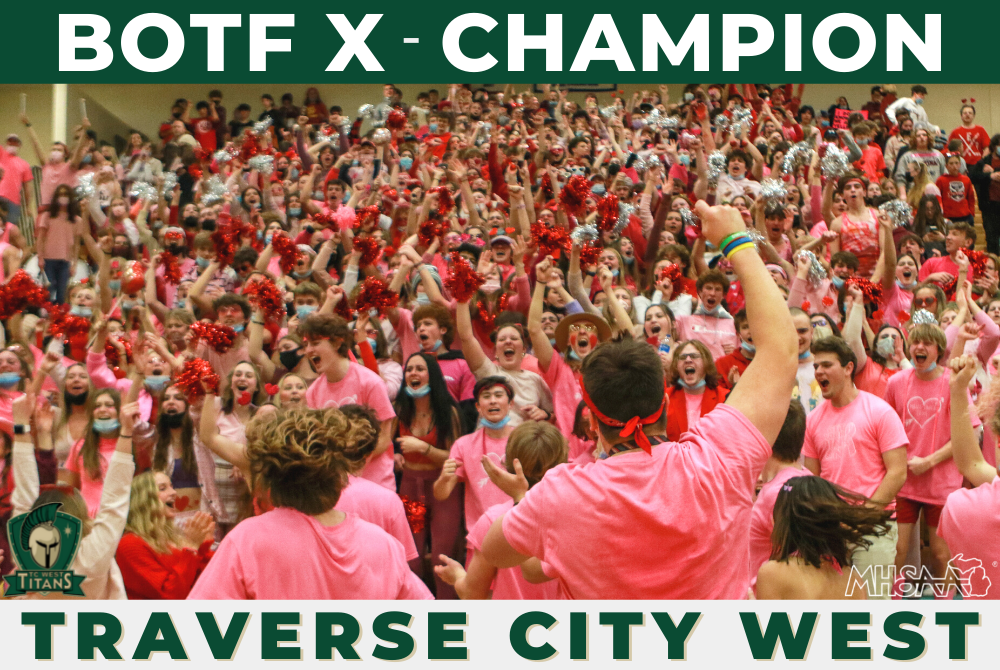
And the 2022 BOTF Winner is ...
By
Geoff Kimmerly
MHSAA.com senior editor
February 17, 2022
Few have studied up for the MHSAA’s Battle of the Fans as much as Traverse City West senior Patrick Guiney did before the start of this year’s BOTF X competition.
He watched all of the finalists’ videos from the first nine years, and many of the semifinalists’ as well, diving in to uncover the best strategies to help he and his classmates deliver the Bleacher Creatures their second BOTF championship.
Of course, he watched all of Traverse City West’s past videos too, trying to see if those past sections had done something well that the current Creatures should incorporate this year, and to figure out where those past sections may have fallen short.
But watching all of those schools, his and others, also left a pretty significant impression about what BOTF, and more generally student sections, should be about.
“I think it’s really about bringing people together, leaving whatever is going on just letting go of it for a while and enjoying a big game with your friends,” Guiney said. “Maybe meeting some new people, and knowing that no matter what you’ll be welcomed with open arms. It’s just a really positive environment that I feel everybody should be part of because (student sections) are just so much fun.”
The Bleacher Creatures have had a ton of fun this school year. And they’ve earned statewide fame to add to their memories of the experience.
Traverse City West will accept its Battle of the Fans X championship banner during halftime of the first Division 2 Boys Basketball Semifinal on March 25 at Michigan State University’s Breslin Center. Finalists Buchanan and Midland Dow also have been invited to Breslin to be honored for this season’s achievement.
 Traverse City West was chosen based on a vote by the MHSAA’s 16-member Student Advisory Council influenced by public vote on the MHSAA’s Facebook, Twitter, Instagram and TikTok sites. A total of 8,964 social media votes was received. The addition of TikTok this year added to the engagement substantially, as TikToks using the hashtag #MHSAABOTF2022 were viewed more than 700,000 times.
The Student Advisory Council based its vote on the following criteria: positive sportsmanship, student body participation, school spirit, originality of cheers, organization of the group, section leadership and overall fun. Nine semifinalists were selected from the original application group before Buchanan, Midland Dow and Traverse City West were chosen for MHSAA visits. Howell, Imlay City, North Muskegon, Petersburg Summerfield, Spring Lake and Yale also were semifinalists.
In addition to their other championship year, the Bleacher Creatures also were finalists in 2014 and 2017. Buchanan was a finalist for the seventh time this winter and has won championships in 2013, 2018 and 2020. Midland Dow entered the competition this year for the first time.
Below are our final takeaways from this year’s finalist visits:
Community Doesn’t Graduate: Buchanan
What we saw: At a game otherwise moderately attended by adults and opposing students, The Herd was out in force – as usual. After 10 years of Battle of the Fans, Buchanan students have reached a point in history where cheering on their teams and showing tons of spirit is all they’ve known – and especially as high school leaders have traveled to the middle and elementary schools every year to cultivate that culture. Herd leaders make games into gatherings, and this was just another during a year full of them as COVID-19 has eased. We watched this year’s Herd cheer the boys basketball team to a big win, but also sing and dance and just enjoy being back with each other in the stands, with plenty of representation from throughout the school as nearly half the student body showed.
Why we’re fans: A question we discuss after every BOTF visit is if we would’ve wanted to be part of the cheering section we just watched – and we’ve always left Buchanan with a resounding “Yes.” We’ve said this before, but every school would be served to replicate or at least borrow some of what Buchanan has created over the last decade. The relationships between high school leaders and the younger students who are following them, the ties between the athletes and their classmates cheering for them, and the connections between current Herd members and the people who came before them defines community.
Accept the Challenge Award: Midland Dow
What we saw: First-time BOTF applicant Dow will always have our respect for becoming the first to invite the MHSAA to an away game. The schedule caused them to bring us instead to Midland High, but the Chargers really impressed us with their organization, positivity and engagement throughout the game despite the rival Chemics’ win on the court. We dug the Doctors & Nurses theme and especially the fundraiser (again, at a road game) to buy snacks for local emergency room workers. Also notable – Dow has state-ranked girls basketball and hockey teams this winter, and the Chargers’ leadership includes members of both who put in additional time to make this section spark on top of commitments to those title-chasing sports teams.
Why we’re fans: The road game wasn’t the only challenge Dow accepted this school year. Of course, all of our finalists were left to restart their sections after COVID-19 spectator limits over the last 18 months, and Dow did so in a way others should copy – notably, stepping up their social media game and becoming a force not just at football and basketball but volleyball, soccer and hockey as well. Dow has had a section in years past but raised its game this fall and winter. We’re looking forward to seeing more – and next time at “Herb’s House” for a Dow home game.
Battle of the Fans champion: Traverse City West
What we saw: First off, possibly more fans than we’ve seen before, and stacked from the first row to the top of the high-rising bleachers. After past visits with the Bleacher Creatures, we were plenty familiar with the section’s organizational structure and leadership by its student senate, but we really admire how this year’s senators have embraced a fresh look to attract students from all grades and all activities to be part of the fun. Frankly, the Men’s Dance Team performance at halftime was pretty impressive – especially the aerials – and we can’t say enough about how much the drumline brings to the overall atmosphere of the game, especially working with the student section to rally the home team. Guiney regularly conducts interviews with fans in the stands and athletes from the various teams (and previously actors from the theater cast too) that are some parts serious but most parts silly, and getting all of those voices involved adds to the feeling of togetherness.
Why we’re fans: We’ve seen big crowds before. We’ve seen fans get crazy and sing and dance. We’ve seen fun halftime shows and entertaining quarter-break antics. All make student sections awesome.
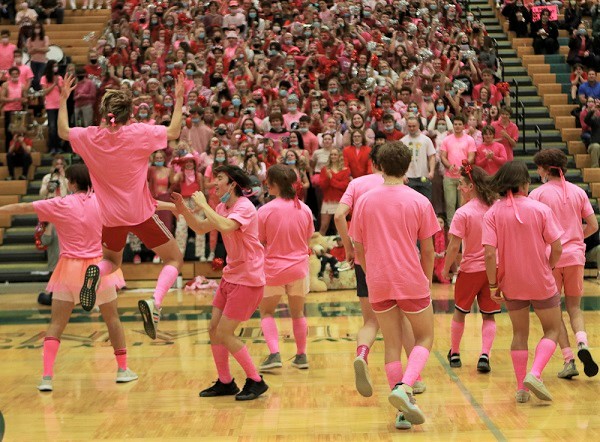
But what really stuck out about this year’s Bleacher Creatures is the lengths they undertake to make a 1,600-student school feel much smaller. Leaders told us stories about how in past years, the school’s senate and by extension the Bleacher Creatures were thought to be just for the “cool kids” or certain social groups, and busting that reputation was a goal as the section reunited in the fall.
What they’ve achieved that way is a much more meaningful legacy that will be passed on by this year’s seniors, along with a revived championship student section.
Guiney and his classmates may be living it right now, but the significance isn't lost on them.
"I remember talking with some of my close friends who also (are involved) with the student section, during the early stages of this," he recalled. "(Saying) if we can win this and make our impact, that will last for a long time, and that will definitely fuel students of the future.
"I know that inspiring those kids and showing them how awesome a student section can be will definitely have a positive impact on the future of TC West and ensure that kids will be able to go to student sections with the same energy and have the same amount of fun. Because everybody deserves to have that experience."
The Battle of the Fans is sponsored in part by the United Dairy Industry of Michigan.
Check out below our stories and videos behind the finalists. (Photos by Alan Newton/Newton Photography; click for more from this BOTF visit.)
Buchanan
Read all about it: Buchanan's 'Herd' Begins New Era with Same Bucks Energy
Midland Dow
Read all about it: Dow Aims to Give Teams Advantage with Charger Spirit
Traverse City West
Read all about it: West's Creatures Filling Bleachers with Support for Titans Teams