

New Math: Division & Multiplication Problems
July 25, 2017
By Jack Roberts
MHSAA Executive Director
This is the second part in a series on MHSAA tournament classification, past and present, that will be published over the next two weeks. This series originally ran in this spring's edition of MHSAA benchmarks.
High school tournament classifications went viral before there was social media and most of us knew what “viral” meant.
Much as a virus infects computers today or has created epidemics of disease around the world for centuries, high school tournament classification – once introduced – tends to spread uncontrollably. Once started, it tends to keep expanding and rarely contracts.
While we are still some distance from providing every team a trophy as a result of expanding high school tournament classification across the country, there is criticism nevertheless that we are headed in that direction – a philosophy which is supposed to exist only in local youth sports for our youngest children.
Michigan could be blamed for all this. Michigan is generally accepted as the first state to provide different classifications for season-ending tournaments for different sized schools. It started a century ago. Today, every state has various classifications for its tournaments in most if not all sports. And it is a bit ironic that Michigan – creator of the classification chaos – more than most other states has kept the number of tournament classes or divisions under control.
Yes, there is evidence that tournament classifications have expanded over the years in Michigan, especially with the relatively recent introduction of tournaments in football and the late 1990s’ move from classes to divisions in most MHSAA tournaments. But the MHSAA Representative Council has held true to its word when it expanded the playoffs for football from four classes to eight divisions: this is needed because of unique factors of football, factors that exist in no other sport; and all other sports should be capped at a maximum of four classes or divisions.
Kentucky is the preeminent defender of single-class basketball. All of its 276 high schools compete for the single state championship for each gender. In Indiana, there are still open wounds from its move in 1998 from one to four classes for its 400 schools in basketball.
Multi-class tournaments have tended to increase the number of non-public school champions, which some states are trying to lower through enrollment “multipliers,” and also tend to increase the number of repeat champions, which some states are trying to affect with “success factors” which lift smaller schools into classifications for larger schools if they take home too many trophies.
While there is considerable evidence that state tournaments do as much bad as good for educational athletics, state associations persist in providing postseason tournaments because, on balance, the experiences are supposed to be good for student-athletes. And once we reach that conclusion it is just a small leap to believe that if the tournaments are good for a few, they must be better for more – which leads to creating more and more tournament classifications. One becomes two classes, then three, then four and so forth.
While the argument is that more classifications or divisions provides more students with opportunities to compete and win, it is undeniable that the experience changes as the number of tournament classifications expands. It is not possible for state associations to provide the same level of support when tournament classifications expand to multiple venues playing simultaneously. For example, there is less audio and video broadcast potential at each venue, and less media coverage to each venue. Focus is diluted and fans diminished at each championship.
No one can argue reasonably that today's two-day MHSAA Football Finals of eight championship games has the same pizazz as the one-day, four-games event conducted prior to 1990.
In some states the number of divisions has grown so much that it is difficult to see much difference between the many season-ending state championship games and a regular-season event in the same sport.
It is a balancing act. And Michigan has been studying that balance longer than any other state, and charting a steadier course than most.
Addition by Division
The shift to Divisions for MHSAA Tournament play in numerous sports has added up to a greater number of champions for teams and individuals across the state. Following are the sports currently employing a divisional format, and the procedures for determining enrollment and classification.
In 23 statewide or Lower Peninsula tournaments, schools which sponsor the sport are currently divided into nearly equal divisions. They are:
- Baseball - 4 Divisions
- Boys Bowling - 4 Divisions
- Girls Bowling - 4 Divisions
- Girls Competitive Cheer - 4 Divisions
- LP Boys Cross Country - 4 Divisions
- LP Girls Cross Country - 4 Divisions
- LP Boys Golf - 4 Divisions
- LP Girls Golf - 4 Divisions
- Ice Hockey - 3 Divisions
- Boys Lacrosse - 2 Divisions
- Girls Lacrosse - 2 Divisions
- Boys Skiing - 2 Divisions
- Girls Skiing - 2 Divisions
- LP Boys Soccer - 4 Divisions LP
- Girls Soccer - 4 Divisions
- Girls Softball - 4 Divisions
- LP Boys Swimming & Diving - 3 Divisions
- LP Girls Swimming & Diving - 3 Divisions
- LP Boys Tennis - 4 Divisions
- LP Girls Tennis - 4 Divisions
- LP Boys Track & Field - 4 Divisions
- LP Girls Track & Field - 4 Divisions
- Wrestling - 4 Divisions
Lists of schools for each division of these 23 tournaments are posted on MHSAA.com approximately April 1. Listings of schools in Upper Peninsula tournaments for their sports are also posted on MHSAA.com. The lists are based on school memberships and sports sponsorships in effect or anticipated for the following school year, as known to the MHSAA office as of a date in early March.
In football, the 256 schools which qualify for MHSAA 11-player playoffs are placed in eight equal divisions annually on Selection Sunday. Beginning in 2017, the 8-player divisions will be determined in a like manner on Selection Sunday as well, with 32 qualifying schools placed in two divisions.
Schools have the option to play in any higher division in one or more sports for a minimum of two years.
The deadlines for "opt-ups" are as follows:
- Applications for fall sports must be submitted by April 15
- Applications for winter sports must be submitted by Aug. 15
- Applications for spring sports must be submitted by Oct. 15
Subsequent to the date of these postings for these tournaments, no school will have its division raised or lowered by schools opening or closing, schools adding or dropping sports, schools exercising the option to play in a higher division, or approval or dissolution of cooperative programs.
When the same sport is conducted for boys and girls in the same season (e.g., track & field and cross country), the gender that has the most sponsoring schools controls the division breaks for both genders.
Preview: Past Champs Back in Running
November 5, 2020
By Geoff Kimmerly
Second Half editor
The first runners down the home stretch at Michigan International Speedway this weekend could look familiar for at least three divisions of the MHSAA Lower Peninsula Girls Cross Country Finals.
The fourth? That’s guaranteed to finish much differently than a year ago.
Reigning champions are expected to set the pace again in Divisions 1, 2 and 3. But Division 4 will be another story entirely, as the reigning team and individual champions are running in Division 3 this time.
A change in format also will switch things up a bit. To limit the number of participants in each race, the four divisions will be run over two days – Friday and Saturday – with each gender in each division spread over two races. Third-place teams and individual qualifiers from Regionals will run first, and first and second-place Regional finishers will run second.
Watching this year’s Finals at MIS also will be different. Attendance is limited due to COVID-19 precautions, but opportunities to watch off-site are available again via MHSAA.tv. Coverage will be enhanced this year with an additional camera on the back of the course to better capture the first 800 meters, 1.5-mile and 2.25-mile marks of the race. The traditional Finish Line camera also will cover the action, with commentary from a crew of announcers.
Here’s the schedule, with links to broadcasts of each race:
Friday – Nov. 6
Division 1 Finals - Boys at 9:30 and 10 a.m. - Girls at 11 and 11:30 a.m.
Division 2 Finals - Boys at 1:30 and 2 p.m. - Girls at 3 and 3:30 p.m.
Saturday – Nov. 7
Division 3 Finals - Boys at 9:30 and 10 a.m. - Girls at 11 and 11:30 a.m.
Division 4 Finals - Boys at 1:30 and 2 p.m. - Girls at 3 and 3:30 p.m.
Come back both Friday and Saturday for coverage of all four meets on Second Half, and see below for teams and individuals who should be in the running. References to a list of fastest times per division this fall includes only the top time for each runner and can be found with the Finals program and much more information on or linked to MHSAA.com.
Division 1
Reigning champion: Ann Arbor Pioneer
2019 runner-up: Traverse City Central
2020 top-ranked: 1. Traverse City Central, 2. Ann Arbor Pioneer, 3. Holland West Ottawa
This could come down to Pioneer and Central again after the Pioneers edged the Trojans 80-113 at the top of the standings of last year’s Final. Pioneer graduated last season’s individual champion Zofia Dudek and total two of its top five but is keyed by a Regional champion freshman in Rachel Forsyth, while Central brings back five of last season’s top six who are joined by a pair of standout freshmen. Trojans junior Julia Flynn didn’t run at her team’s Regional but has the fastest time in Division 1 this fall at 16:51.27 and finished third at the Final a year ago. Pioneer junior Sarah Forsyth was ninth at the Final in 2019, and Central senior Avery McLean was 17th. West Ottawa is expected to move up from seventh last season as it pursues its first Finals championship, anchored by Arianne Olson – the individual runner-up last season as a freshman.
Individuals: Although Dudek graduated, 14 of last season’s top 20 finishers will reload the field. Following Olson and Flynn last year was Saline now-junior Madi Wood in fourth and Birmingham Seaholm now-senior Audrey DaDamio in fifth, with Novi now-senior Elizabeth Babcock in seventh. Those five finished within 17 seconds of each other, and DaDamio’s season-best 17:16.40 is the second-fastest time in Division 1 this fall. Also back from last season’s top 20 are Forsyth, Plymouth junior Lauren Kiley (11th), Grand Rapids Ottawa Hills senior Madison Ebright (12th), Lake Orion senior Sophie Novak (13th), East Lansing senior Abbie Draheim (14th), McLean, Plymouth senior Londyn Swenson (18th), Northville senior Yasmine Mansi (19th) and Ottawa Hills’ junior Adit Dau (20th). Two more freshmen – Grand Rapids Forest Hills Central’s Clara James-Heer and Macomb Dakota’s Jayden Harberts – have posted times among the 10 fastest in Division 1 this fall.
Division 2
Reigning champion: East Grand Rapids
2019 runner-up: Petoskey
2020 top-ranked: 1. East Grand Rapids, 2. Petoskey, 3. Grand Rapids Christian
Like in Division 1, last season’s top finishers are expected to push for the championship again – East Grand Rapids for the third straight season and Petoskey attempting to win for the first time. The Pioneers won the race at the top in 2019 36-92, placing five of the top 14 individuals but graduating two last spring including champion Anna Petr. At the same time, freshman Drew Muller, junior Ainsley Workman and senior Hannah Bodine have posted times among the 11 fastest in Division 2; Bodine was seventh and Workman 10th at the Final last season. Petoskey senior Emma Squires has the fastest time in Division 2 (17:26.70), with senior Cambrie Smith fifth (18:07,60), senior Sarah Liederbach 12th and junior Noel Vanderwall 13th – Squires was fifth at the 2019 Final, Liederbach was 20th and Vanderwall was 27th. Grand Rapids Christian finished 12th last season but has three titles and a runner-up finish over the last decade and one of the fastest individuals in junior Madelyn Frens, who edged Muller by just more than a second at their league’s championship race and was sixth at her most recent Finals in 2018.
Individuals: Squires, Bodine and Workman are the only top-10 finishers from 2019 back in the field, but six more return who came in 13-20th – Plainwell sophomore Grace Pettit (13th), Whitehall junior Ryann Jibson (15th), Lansing Catholic sophomore Hannah Pricco (16th), Freeland junior Kiera Hansen (17th), Otsego junior Joy Wolfe (18th) and Liederbach, with two more currently scratched for this weekend's race. Cadillac junior Kendall Schopieray was 47th last year but has the sixth-fastest time in Division 2 this fall. A trio of freshmen as well should make a massive impact on the individual standings: Muller, along with Mason’s Meghan Ford and Frankenmuth’s Mary Richmond. Ford’s best of 17:36.40 ranks second in Division 2 this season, and Richmond’s best is seventh on the list. Shepherd senior Madde Skeel, who ran 20th in Division 3 last season, also is in this field.
Division 3
Reigning champion: Hart
2019 runner-up: Shepherd
2020 top-ranked: 1. Hart, 2. Grandville Calvin Christian, 3. Benzie Central
Hart is hoping to become the fourth Lower Peninsula girls cross country program to win four consecutive Finals, and the Pirates remain formidable coming off a Regional where they took the top four places. Freshman Alyson Enns (17:46.75) ranks fifth on the list of fastest Division 3 times this fall, with senior Savannah Ackley (4th), junior Audrienna Enns (5th) and senior Lynae Ackley (14th) the team’s top three finishers from last season’s impressive win. Calvin Christian is looking to make a jump from third last season, when now-junior Leanne Krombeen led the way with a 19th-place individual finish. Senior teammate Catherine Kortman also has been among Division 3’s fastest this fall. Benzie Central was seventh last season and is led by standout freshman Mylie Kelly joining four of the team’s top five Finals finishers from 2019.
Individuals: A fast returning field will be bolstered even more by another two-time champion. Stockbridge junior Rylee Tolson won Division 3 last season and is back, and Muskegon Western Michigan Christian junior Abby VanderKooi is in Division 3 this weekend after winning Division 4 the last two years. She has the fastest Division 3 time this fall at 16:48.71. Ithaca junior Lani Bloom, Roscommon junior Allison Chmielewski and Jackson Lumen Christi junior Faith Smith have the next three fastest times, respectively, and the finished 18th, third and 22nd in 2019. Other top-20 finishers from last season running again are Boyne City sophomore Ava Maginity (7th), Harbor Springs junior Maye Burns (8th), St. Louis junior Libby Munderloh (10th), New Lothrop junior Clara Krupp (11th), Reed City senior Abbigail Kiaunis (13th) and Kent City senior Layla Martini (16th). Bridgman senior Karsyn Stewart, who set the pace for her team's Division 4 championship last fall by coming in sixth, is running in Division 3 as well.
Division 4
Reigning champion: Bridgman
2019 runner-up: Mount Pleasant Sacred Heart
2020 top-ranked: 1. Lansing Christian, 2. Hillsdale Academy, 3. Beal City
Lansing Christian and Hillsdale Academy are running for what would be a first championship, while Beal City is hoping to add a third after topping Division 4 back-to-back in 2013 and 2014. The Pilgrims didn’t qualify for the Finals as a team last season, but did enjoy a third-place individual finish from now-senior Madison Volz, a 20th by now-sophomore Ashlyn Kephart and a 35th place by now-senior Natalie Tebben. Those three rank among the top 19 in Division 4 this fall. Hillsdale Academy is looking to move up from fourth in 2019 with sophomore Megan Roberts again among the division’s fastest after placing 22nd individually a year ago. The Aggies will follow a speedy 1-2 punch of sophomore Kaylee Locke and junior Rachal Weber, who crossed eighth and 10th, respectively, last season as the team finished 17th. Sophomore Tailor Onstott also has run among the leaders this season.
Individuals: This field opens up with VanderKooi running in Division 3. Volz is the highest-placing returnee and also finished second in Division 4 as a sophomore and fifth as a freshman. Maple City Glen Lake junior Makenna Scott (18:42.84) has the fastest time in Division 4 this fall and finished fourth at the 2019 Final, and Buckley freshman Aiden Harrand (18:43.07) surely will be in the mix with the second-fastest time in Division 4, just ahead of the best by Volz (18:47.37). Concord senior Skylar Thompson was fifth last season and ranks fifth on this year’s fastest times list, with Westland Huron Valley sophomore Erika Van Loton fourth this season and coming off a seventh-place 2019 finish. Also back from last season’s top 20 are Mayville senior Haley Rowbotham (9th), Sacred Heart sophomore Olivia Ervin (12th), Gaylord St. Mary freshman Miriam Murrell (14th), Brethren senior Alexis Tracy (15th) and Harbor Beach senior Makara Kramer (19th).
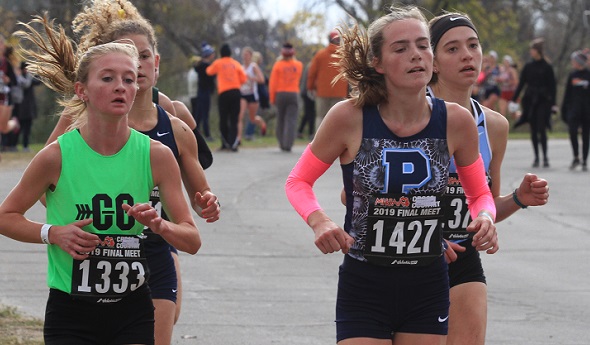
PHOTO: Petoskey's Emma Squires (1427) leads a pack through the middle of last season's Division 2 championship race at Michigan International Speedway. (Click for more from RunMichigan.com.)