

New Math: Division & Multiplication Problems
July 25, 2017
By Jack Roberts
MHSAA Executive Director
This is the second part in a series on MHSAA tournament classification, past and present, that will be published over the next two weeks. This series originally ran in this spring's edition of MHSAA benchmarks.
High school tournament classifications went viral before there was social media and most of us knew what “viral” meant.
Much as a virus infects computers today or has created epidemics of disease around the world for centuries, high school tournament classification – once introduced – tends to spread uncontrollably. Once started, it tends to keep expanding and rarely contracts.
While we are still some distance from providing every team a trophy as a result of expanding high school tournament classification across the country, there is criticism nevertheless that we are headed in that direction – a philosophy which is supposed to exist only in local youth sports for our youngest children.
Michigan could be blamed for all this. Michigan is generally accepted as the first state to provide different classifications for season-ending tournaments for different sized schools. It started a century ago. Today, every state has various classifications for its tournaments in most if not all sports. And it is a bit ironic that Michigan – creator of the classification chaos – more than most other states has kept the number of tournament classes or divisions under control.
Yes, there is evidence that tournament classifications have expanded over the years in Michigan, especially with the relatively recent introduction of tournaments in football and the late 1990s’ move from classes to divisions in most MHSAA tournaments. But the MHSAA Representative Council has held true to its word when it expanded the playoffs for football from four classes to eight divisions: this is needed because of unique factors of football, factors that exist in no other sport; and all other sports should be capped at a maximum of four classes or divisions.
Kentucky is the preeminent defender of single-class basketball. All of its 276 high schools compete for the single state championship for each gender. In Indiana, there are still open wounds from its move in 1998 from one to four classes for its 400 schools in basketball.
Multi-class tournaments have tended to increase the number of non-public school champions, which some states are trying to lower through enrollment “multipliers,” and also tend to increase the number of repeat champions, which some states are trying to affect with “success factors” which lift smaller schools into classifications for larger schools if they take home too many trophies.
While there is considerable evidence that state tournaments do as much bad as good for educational athletics, state associations persist in providing postseason tournaments because, on balance, the experiences are supposed to be good for student-athletes. And once we reach that conclusion it is just a small leap to believe that if the tournaments are good for a few, they must be better for more – which leads to creating more and more tournament classifications. One becomes two classes, then three, then four and so forth.
While the argument is that more classifications or divisions provides more students with opportunities to compete and win, it is undeniable that the experience changes as the number of tournament classifications expands. It is not possible for state associations to provide the same level of support when tournament classifications expand to multiple venues playing simultaneously. For example, there is less audio and video broadcast potential at each venue, and less media coverage to each venue. Focus is diluted and fans diminished at each championship.
No one can argue reasonably that today's two-day MHSAA Football Finals of eight championship games has the same pizazz as the one-day, four-games event conducted prior to 1990.
In some states the number of divisions has grown so much that it is difficult to see much difference between the many season-ending state championship games and a regular-season event in the same sport.
It is a balancing act. And Michigan has been studying that balance longer than any other state, and charting a steadier course than most.
Addition by Division
The shift to Divisions for MHSAA Tournament play in numerous sports has added up to a greater number of champions for teams and individuals across the state. Following are the sports currently employing a divisional format, and the procedures for determining enrollment and classification.
In 23 statewide or Lower Peninsula tournaments, schools which sponsor the sport are currently divided into nearly equal divisions. They are:
- Baseball - 4 Divisions
- Boys Bowling - 4 Divisions
- Girls Bowling - 4 Divisions
- Girls Competitive Cheer - 4 Divisions
- LP Boys Cross Country - 4 Divisions
- LP Girls Cross Country - 4 Divisions
- LP Boys Golf - 4 Divisions
- LP Girls Golf - 4 Divisions
- Ice Hockey - 3 Divisions
- Boys Lacrosse - 2 Divisions
- Girls Lacrosse - 2 Divisions
- Boys Skiing - 2 Divisions
- Girls Skiing - 2 Divisions
- LP Boys Soccer - 4 Divisions LP
- Girls Soccer - 4 Divisions
- Girls Softball - 4 Divisions
- LP Boys Swimming & Diving - 3 Divisions
- LP Girls Swimming & Diving - 3 Divisions
- LP Boys Tennis - 4 Divisions
- LP Girls Tennis - 4 Divisions
- LP Boys Track & Field - 4 Divisions
- LP Girls Track & Field - 4 Divisions
- Wrestling - 4 Divisions
Lists of schools for each division of these 23 tournaments are posted on MHSAA.com approximately April 1. Listings of schools in Upper Peninsula tournaments for their sports are also posted on MHSAA.com. The lists are based on school memberships and sports sponsorships in effect or anticipated for the following school year, as known to the MHSAA office as of a date in early March.
In football, the 256 schools which qualify for MHSAA 11-player playoffs are placed in eight equal divisions annually on Selection Sunday. Beginning in 2017, the 8-player divisions will be determined in a like manner on Selection Sunday as well, with 32 qualifying schools placed in two divisions.
Schools have the option to play in any higher division in one or more sports for a minimum of two years.
The deadlines for "opt-ups" are as follows:
- Applications for fall sports must be submitted by April 15
- Applications for winter sports must be submitted by Aug. 15
- Applications for spring sports must be submitted by Oct. 15
Subsequent to the date of these postings for these tournaments, no school will have its division raised or lowered by schools opening or closing, schools adding or dropping sports, schools exercising the option to play in a higher division, or approval or dissolution of cooperative programs.
When the same sport is conducted for boys and girls in the same season (e.g., track & field and cross country), the gender that has the most sponsoring schools controls the division breaks for both genders.
Mason Girls, Jackson NW Boys Earn 1st Titles
By
Keith Dunlap
Special for MHSAA.com
March 6, 2020
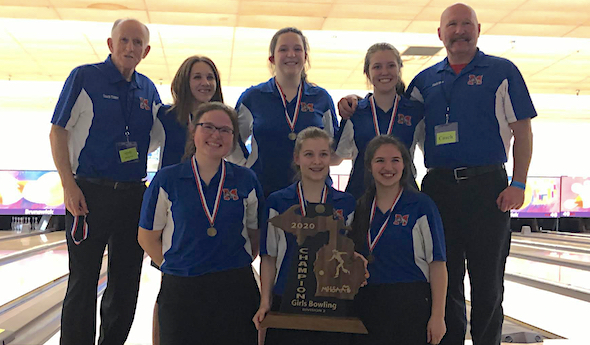
WATERFORD – The Mason girls bowling team probably felt like it won two championships at Friday’s Division 2 Finals at Century Bowl.
First, the Bulldogs had to have felt like they won a championship after the semifinal round, when they did something no team had done during the previous six Division 2 Tournaments – beat Flint Kearsley.
Not deterred by the six-time reigning champion, Mason recorded a 1,245-1,157 win over Kearsley in one semifinal to earn a major boost of adrenaline.
“It really did,” Mason coach Terry Dormer said. “It gave us a big lift. It showed us that we could compete.”
But as significant as the win was over Kearsley, there was still a big obstacle to conquer for the Bulldogs.
Waiting in the final was Tecumseh, the Division 2 runner-up the last two years, champing at the bit to take home the championship trophy.
But Mason overcame that challenge in the closest possible manner.
By just one pin, Mason won its first MHSAA Finals girls bowling title, outlasting Tecumseh 1,185-1,184.
Trailing by three pins after the two Baker games, Mason earned an 849-845 win in the regular game to claim the title.
“We had to adjust a bit on the lanes,” said Dormer, who concluded his 15th year as coach at Mason. “But they came back and did it.”
There was also a first-time champion on the boys side of the tournament.
Jackson Northwest claimed its first title in another close title match, toppling Cadillac 1,320-1,300 in the final.
Cadillac held a 23-pin edge after the first Baker game and a nine-pin lead going into the regular game, but Jackson Northwest hit bigger shots to prevail.
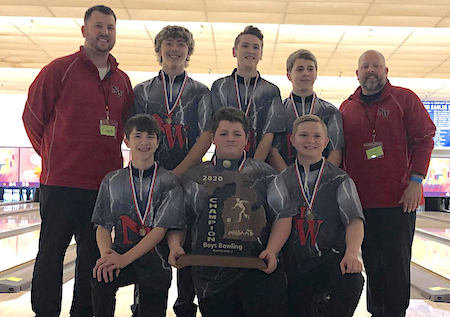 Northwest lost in the round of eight to eventual champion New Boston Huron last year, and coach Gerry Lobdell said that loss and experience served as motivation throughout the entire tournament – even when falling behind early.
“We were just trying to keep them calm,” Lobdell said. “Just one frame at a time for them. Just fill frames. That’s what we talk about all the time.”
Both the Mason girls and the Jackson Northwest boys excelled from the start, as Mason finished first out of the qualifying block with 3,063 pins, while Jackson Northwest was second out of its qualifying block with 3,514.
Before beating Kearsley in the semifinals, Mason knocked off Muskegon Mona Shores in the quarterfinals by a score of 1,214-1,096.
Jackson Northwest earned a three-pin win over Grand Rapids Northview in the quarterfinals (1,333-1,330) before knocking off Iron Mountain in a semifinal, 1,309-1,242.
Cadillac finished first out of the qualifying block with 3,532 pins before beating Ferndale in the quarterfinals, 1,284-1,163, and Huron in the semifinals, 1,313-1,287.
Cadillac appeared in good shape with a lead going into the regular game against Jackson Northwest, but saw Jackson Northwest deliver a few more strikes to win.
The Vikings reached the semifinals last season.
“It’s been an up-and-down season for us,” Cadillac coach Jeremy Moore said. “It just wasn’t our day, I guess. That team we bowled against, they threw good shots when they needed to. That’s really what it came down to.”
Visibly heartbroken afterward over falling short of a title for the third straight year and in such close fashion, the Tecumseh girls had finished third out of the qualifying block before beating Cedar Springs in the quarterfinals, 1,348-1,181.
Tecumseh then knocked off Carleton Airport in the semifinals, 1,188-1,073 to earn a spot in the final once again.
Click for full girls results and boys results.