

New Math: Division & Multiplication Problems
July 25, 2017
By Jack Roberts
MHSAA Executive Director
This is the second part in a series on MHSAA tournament classification, past and present, that will be published over the next two weeks. This series originally ran in this spring's edition of MHSAA benchmarks.
High school tournament classifications went viral before there was social media and most of us knew what “viral” meant.
Much as a virus infects computers today or has created epidemics of disease around the world for centuries, high school tournament classification – once introduced – tends to spread uncontrollably. Once started, it tends to keep expanding and rarely contracts.
While we are still some distance from providing every team a trophy as a result of expanding high school tournament classification across the country, there is criticism nevertheless that we are headed in that direction – a philosophy which is supposed to exist only in local youth sports for our youngest children.
Michigan could be blamed for all this. Michigan is generally accepted as the first state to provide different classifications for season-ending tournaments for different sized schools. It started a century ago. Today, every state has various classifications for its tournaments in most if not all sports. And it is a bit ironic that Michigan – creator of the classification chaos – more than most other states has kept the number of tournament classes or divisions under control.
Yes, there is evidence that tournament classifications have expanded over the years in Michigan, especially with the relatively recent introduction of tournaments in football and the late 1990s’ move from classes to divisions in most MHSAA tournaments. But the MHSAA Representative Council has held true to its word when it expanded the playoffs for football from four classes to eight divisions: this is needed because of unique factors of football, factors that exist in no other sport; and all other sports should be capped at a maximum of four classes or divisions.
Kentucky is the preeminent defender of single-class basketball. All of its 276 high schools compete for the single state championship for each gender. In Indiana, there are still open wounds from its move in 1998 from one to four classes for its 400 schools in basketball.
Multi-class tournaments have tended to increase the number of non-public school champions, which some states are trying to lower through enrollment “multipliers,” and also tend to increase the number of repeat champions, which some states are trying to affect with “success factors” which lift smaller schools into classifications for larger schools if they take home too many trophies.
While there is considerable evidence that state tournaments do as much bad as good for educational athletics, state associations persist in providing postseason tournaments because, on balance, the experiences are supposed to be good for student-athletes. And once we reach that conclusion it is just a small leap to believe that if the tournaments are good for a few, they must be better for more – which leads to creating more and more tournament classifications. One becomes two classes, then three, then four and so forth.
While the argument is that more classifications or divisions provides more students with opportunities to compete and win, it is undeniable that the experience changes as the number of tournament classifications expands. It is not possible for state associations to provide the same level of support when tournament classifications expand to multiple venues playing simultaneously. For example, there is less audio and video broadcast potential at each venue, and less media coverage to each venue. Focus is diluted and fans diminished at each championship.
No one can argue reasonably that today's two-day MHSAA Football Finals of eight championship games has the same pizazz as the one-day, four-games event conducted prior to 1990.
In some states the number of divisions has grown so much that it is difficult to see much difference between the many season-ending state championship games and a regular-season event in the same sport.
It is a balancing act. And Michigan has been studying that balance longer than any other state, and charting a steadier course than most.
Addition by Division
The shift to Divisions for MHSAA Tournament play in numerous sports has added up to a greater number of champions for teams and individuals across the state. Following are the sports currently employing a divisional format, and the procedures for determining enrollment and classification.
In 23 statewide or Lower Peninsula tournaments, schools which sponsor the sport are currently divided into nearly equal divisions. They are:
- Baseball - 4 Divisions
- Boys Bowling - 4 Divisions
- Girls Bowling - 4 Divisions
- Girls Competitive Cheer - 4 Divisions
- LP Boys Cross Country - 4 Divisions
- LP Girls Cross Country - 4 Divisions
- LP Boys Golf - 4 Divisions
- LP Girls Golf - 4 Divisions
- Ice Hockey - 3 Divisions
- Boys Lacrosse - 2 Divisions
- Girls Lacrosse - 2 Divisions
- Boys Skiing - 2 Divisions
- Girls Skiing - 2 Divisions
- LP Boys Soccer - 4 Divisions LP
- Girls Soccer - 4 Divisions
- Girls Softball - 4 Divisions
- LP Boys Swimming & Diving - 3 Divisions
- LP Girls Swimming & Diving - 3 Divisions
- LP Boys Tennis - 4 Divisions
- LP Girls Tennis - 4 Divisions
- LP Boys Track & Field - 4 Divisions
- LP Girls Track & Field - 4 Divisions
- Wrestling - 4 Divisions
Lists of schools for each division of these 23 tournaments are posted on MHSAA.com approximately April 1. Listings of schools in Upper Peninsula tournaments for their sports are also posted on MHSAA.com. The lists are based on school memberships and sports sponsorships in effect or anticipated for the following school year, as known to the MHSAA office as of a date in early March.
In football, the 256 schools which qualify for MHSAA 11-player playoffs are placed in eight equal divisions annually on Selection Sunday. Beginning in 2017, the 8-player divisions will be determined in a like manner on Selection Sunday as well, with 32 qualifying schools placed in two divisions.
Schools have the option to play in any higher division in one or more sports for a minimum of two years.
The deadlines for "opt-ups" are as follows:
- Applications for fall sports must be submitted by April 15
- Applications for winter sports must be submitted by Aug. 15
- Applications for spring sports must be submitted by Oct. 15
Subsequent to the date of these postings for these tournaments, no school will have its division raised or lowered by schools opening or closing, schools adding or dropping sports, schools exercising the option to play in a higher division, or approval or dissolution of cooperative programs.
When the same sport is conducted for boys and girls in the same season (e.g., track & field and cross country), the gender that has the most sponsoring schools controls the division breaks for both genders.
And the 2020 BOTF Winner is ...
By
Geoff Kimmerly
MHSAA.com senior editor
February 20, 2020
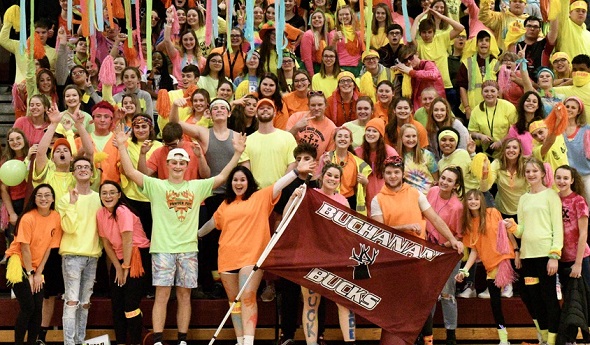
A standard for Michigan’s high school student cheering sections has been set over nine years of Battle of the Fans.
Carter Aalfs has been part of it almost from the start.
 He caught the fever as a fifth grader in 2013, watching an older cousin lead Buchanan’s newly-organized “Herd” to the BOTF II championship. Two years later, now in seventh grade, he stopped into the MHSAA’s finalists interview session with high school leaders to tell us how he already was becoming part of the growing tradition as a member of the younger students’ “Junior Herd.”
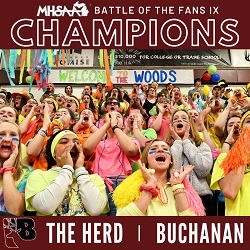
He was in the stands for Buchanan’s second BOTF championship in 2018. And this year, as a senior, he was one of the leaders directing from up front, showing his classmates the way to the Battle of the Fans IX championship – a victory that made Buchanan the first three-time winner in BOTF history.
"We've established a place where you can be yourself. You can be outgoing. You can have fun. And you don't have to worry about anybody judging you," Aalfs said. "Many people don't get to have an experience like this where you get to be with all your friends, all having a good time, while also supporting your school.
"Everybody is going to go crazy. Everybody is going to be so excited about it. Just because of all the hard work we put in during the whole season, all the way back into football season. All the preparation it took, the long meetings, and just making it all come together."
Buchanan will accept its Battle of the Fans IX championship banner during halftime of the first Division 2 Boys Basketball Semifinal on March 27 at Michigan State University’s Breslin Center. Finalists Saginaw Heritage and Zeeland East also have been invited to Breslin to be honored for this season’s achievement.
Buchanan was chosen based on a vote by the MHSAA’s 16-member Student Advisory Council influenced by public vote on the MHSAA’s Facebook, Twitter and Instagram sites. A total of 10,086 social media votes were received – the first time the total has reached 10,000 – with those results then equated against a school’s enrollment. This year’s results came out to 3.5 votes cast for every student attending one of our finalist schools.
Buchanan totaled the most public social media support. Combined, the three finalists received more than 10,000 RTs, Shares and Likes on social media since Tuesday, including 6,500 on Instagram.
Other numbers to consider from this season's contest: The application videos have been watched nearly 13,000 times, and the MHSAA-produced videos from our finalist tour stops have almost 2,000 views. The stories detailing the three tour stops plus Tuesday’s explanation of how to vote and the announcements of semifinalists and finalists had been viewed more than 6,000 times as of 8:30 this morning. The three Instagram stories covering our visits were viewed nearly 6,400 times combined.
 The Student Advisory Council based its vote on the following criteria: positive sportsmanship, student body participation, school spirit, originality of cheers, organization of the group, section leadership and overall fun. Nine semifinalists were selected from the original application group before Buchanan, Saginaw Heritage and Zeeland East were chosen for MHSAA visits. Caro, Frankenmuth, Hart, Petersburg Summerfield, Reese and Traverse City West also were semifinalists.
In addition to its three championship years, The Herd was a BOTF finalist in 2014, 2015 and 2018. Heritage was a finalist for the second straight year, and Zeeland East was a finalist in 2013.
Below are our final takeaways from this year’s finalist trips:
Power of Ownership Award: Saginaw Heritage
What we saw: The Hawk Nest has come so far so fast over the last two years, from pretty much nothing to two-time BOTF finalist. Visiting for the second year in a row, we were surprised at first to learn the foundation of the section had changed from being rooted in the school’s Leadership class to being completely student organized and directed. At the same time, students taking the reins is a section evolution we’ve heard about or seen for ourselves over the last decade of BOTF, and there was little doubt the Nest this year was taking its cues from student leaders including representatives from three grades. The Nest showed off another nice turnout for our basketball game visit considering the highly-ranked hockey team also was playing on the same night. Students who did attend this boys basketball game were invested in the action and cheered throughout. We also enjoyed how a wide variety seemed to have roles during our visit, from conducting the “light show” during pregame warmups to taking part in various cheers and a halftime relay competition.
Why we’re fans: We have a lot of respect for student initiative, and we appreciate the Nest owning not only the opportunities to have fun but also the importance of self-policing to make sure everyone is enjoying themselves in appropriate and sportsmanlike ways. They showed us some fun ideas and were up to try new things, and there was a strong feeling from that multi-class leadership that this section won’t drift away any time soon. We also appreciated how they take the show to the football field and ice rink, and do so in force. The enthusiasm was overflowing, and we could feel it.
Be the Change Award: Zeeland East
What we saw: Two hours of creativity and originality poured into genuine support for the players on the floor. The Valentine’s Day theme was pulled off to a T, and we’re sure all involved on this Senior Night felt the love – including mothers in the crowd supporting both the Chix and opponent Hamilton who received roses during halftime. The involvement of the school’s Ottawa County Sheriff’s deputy in leading a wild cruiser ride was memorable, and the middle school breakdancer unforgettable. We like to dissuade sections from playing with potentially messy confetti or glitter, but the blast of pink and silver into the air over The Coop looked pretty awesome. Coop Crazies say it’s all about the party – and we felt like they were throwing the biggest bash in town.
Why we’re fans: A lot of student sections say, “This is our year. We’re going to change some things.” Coop leaders actually had the courage and put in the work to do it. Underwhelmed by their student section experience the last three years, a group of seniors took over and quickly rewrote the script. The question moving forward is how the next group of leaders will mold the section – but if they can keep the creativity and party atmosphere going, this will be a section to contend with for years to come.
Battle of the Fans champion: Buchanan
What we saw: There’s a line here between not saying enough about this year’s Herd and having already said it all, and we’re straddling it because we’ve had an opportunity to see Buchanan in action a number of times over the years. But as we stated in our original report last week, something did catch our attention – from the front row to the back and across the section through the Junior Herd youngsters who joined in, everyone was all in all the time during our Tuesday night visit, and without special rallying cries needed to keep it up. The Herd, standing together, was naturally cohesive and fun, which comes with really wanting to be there and be a part. The section was loud from start to finish, every possession and every break, and always engaged in the action. But there’s more to it.
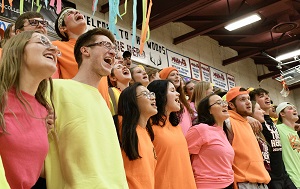 Why we’re fans: The first time we visited Buchanan, in 2013, the takeaway was a new student cheering section had changed school culture dramatically over just a few short months. Now that culture is ingrained in every grade from elementary school up. People have asked over the years if this Herd lifestyle is real or just a show – and we’re here to tell you, it’s absolutely authentic.
The Herd experience sends outgoing seniors into tears and brings past leaders back to watch those who have followed them. It has now linked nearly a decade’s worth of students – and continues to set an example any school would be wise to follow.
And Buchanan is glad to be that example. Over the years, Herd leaders have been sought out by other student sections across the state, and even some from other states, asking for advice on how to do something similar at their schools.
Aalfs and his classmates are glad to show anyone the ropes, that those schools too might enjoy some of what he and his friends have grown up with and grown to love about their high school experience.
"It's going to leave me with such great memories that I'm going to remember for the rest of my life," Aalfs said. "Just being around everybody, everybody being so positive. It's crazy."
The Battle of the Fans is sponsored in part by the United Dairy Industry of Michigan.
Check out below our stories and videos behind the finalists. Also, click to see student-produced videos from all sections that entered the contest. (Photos courtesy of Buchanan High School.)
Buchanan
Read all about it: Have You Herd? Buchanan Tradition Lives On
Saginaw Heritage
Read all about it: Heritage's Hawk Nest Taking Charge
Zeeland East
Read all about it: Zeeland East's Coop Crazies Share the Love