

New Math: Division & Multiplication Problems
July 25, 2017
By Jack Roberts
MHSAA Executive Director
This is the second part in a series on MHSAA tournament classification, past and present, that will be published over the next two weeks. This series originally ran in this spring's edition of MHSAA benchmarks.
High school tournament classifications went viral before there was social media and most of us knew what “viral” meant.
Much as a virus infects computers today or has created epidemics of disease around the world for centuries, high school tournament classification – once introduced – tends to spread uncontrollably. Once started, it tends to keep expanding and rarely contracts.
While we are still some distance from providing every team a trophy as a result of expanding high school tournament classification across the country, there is criticism nevertheless that we are headed in that direction – a philosophy which is supposed to exist only in local youth sports for our youngest children.
Michigan could be blamed for all this. Michigan is generally accepted as the first state to provide different classifications for season-ending tournaments for different sized schools. It started a century ago. Today, every state has various classifications for its tournaments in most if not all sports. And it is a bit ironic that Michigan – creator of the classification chaos – more than most other states has kept the number of tournament classes or divisions under control.
Yes, there is evidence that tournament classifications have expanded over the years in Michigan, especially with the relatively recent introduction of tournaments in football and the late 1990s’ move from classes to divisions in most MHSAA tournaments. But the MHSAA Representative Council has held true to its word when it expanded the playoffs for football from four classes to eight divisions: this is needed because of unique factors of football, factors that exist in no other sport; and all other sports should be capped at a maximum of four classes or divisions.
Kentucky is the preeminent defender of single-class basketball. All of its 276 high schools compete for the single state championship for each gender. In Indiana, there are still open wounds from its move in 1998 from one to four classes for its 400 schools in basketball.
Multi-class tournaments have tended to increase the number of non-public school champions, which some states are trying to lower through enrollment “multipliers,” and also tend to increase the number of repeat champions, which some states are trying to affect with “success factors” which lift smaller schools into classifications for larger schools if they take home too many trophies.
While there is considerable evidence that state tournaments do as much bad as good for educational athletics, state associations persist in providing postseason tournaments because, on balance, the experiences are supposed to be good for student-athletes. And once we reach that conclusion it is just a small leap to believe that if the tournaments are good for a few, they must be better for more – which leads to creating more and more tournament classifications. One becomes two classes, then three, then four and so forth.
While the argument is that more classifications or divisions provides more students with opportunities to compete and win, it is undeniable that the experience changes as the number of tournament classifications expands. It is not possible for state associations to provide the same level of support when tournament classifications expand to multiple venues playing simultaneously. For example, there is less audio and video broadcast potential at each venue, and less media coverage to each venue. Focus is diluted and fans diminished at each championship.
No one can argue reasonably that today's two-day MHSAA Football Finals of eight championship games has the same pizazz as the one-day, four-games event conducted prior to 1990.
In some states the number of divisions has grown so much that it is difficult to see much difference between the many season-ending state championship games and a regular-season event in the same sport.
It is a balancing act. And Michigan has been studying that balance longer than any other state, and charting a steadier course than most.
Addition by Division
The shift to Divisions for MHSAA Tournament play in numerous sports has added up to a greater number of champions for teams and individuals across the state. Following are the sports currently employing a divisional format, and the procedures for determining enrollment and classification.
In 23 statewide or Lower Peninsula tournaments, schools which sponsor the sport are currently divided into nearly equal divisions. They are:
- Baseball - 4 Divisions
- Boys Bowling - 4 Divisions
- Girls Bowling - 4 Divisions
- Girls Competitive Cheer - 4 Divisions
- LP Boys Cross Country - 4 Divisions
- LP Girls Cross Country - 4 Divisions
- LP Boys Golf - 4 Divisions
- LP Girls Golf - 4 Divisions
- Ice Hockey - 3 Divisions
- Boys Lacrosse - 2 Divisions
- Girls Lacrosse - 2 Divisions
- Boys Skiing - 2 Divisions
- Girls Skiing - 2 Divisions
- LP Boys Soccer - 4 Divisions LP
- Girls Soccer - 4 Divisions
- Girls Softball - 4 Divisions
- LP Boys Swimming & Diving - 3 Divisions
- LP Girls Swimming & Diving - 3 Divisions
- LP Boys Tennis - 4 Divisions
- LP Girls Tennis - 4 Divisions
- LP Boys Track & Field - 4 Divisions
- LP Girls Track & Field - 4 Divisions
- Wrestling - 4 Divisions
Lists of schools for each division of these 23 tournaments are posted on MHSAA.com approximately April 1. Listings of schools in Upper Peninsula tournaments for their sports are also posted on MHSAA.com. The lists are based on school memberships and sports sponsorships in effect or anticipated for the following school year, as known to the MHSAA office as of a date in early March.
In football, the 256 schools which qualify for MHSAA 11-player playoffs are placed in eight equal divisions annually on Selection Sunday. Beginning in 2017, the 8-player divisions will be determined in a like manner on Selection Sunday as well, with 32 qualifying schools placed in two divisions.
Schools have the option to play in any higher division in one or more sports for a minimum of two years.
The deadlines for "opt-ups" are as follows:
- Applications for fall sports must be submitted by April 15
- Applications for winter sports must be submitted by Aug. 15
- Applications for spring sports must be submitted by Oct. 15
Subsequent to the date of these postings for these tournaments, no school will have its division raised or lowered by schools opening or closing, schools adding or dropping sports, schools exercising the option to play in a higher division, or approval or dissolution of cooperative programs.
When the same sport is conducted for boys and girls in the same season (e.g., track & field and cross country), the gender that has the most sponsoring schools controls the division breaks for both genders.
Have you Herd? Buchanan Tradition Lives On
By
Geoff Kimmerly
MHSAA.com senior editor
February 14, 2020
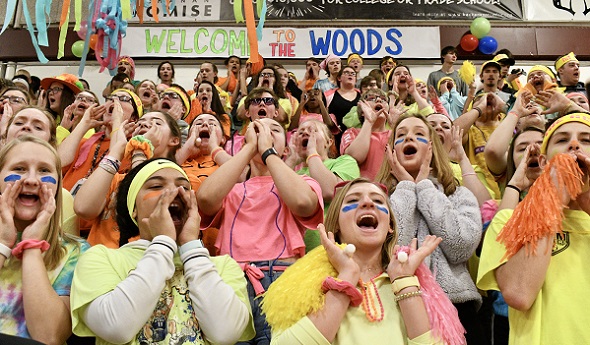
BUCHANAN – Every year cheering in Buchanan High School’s student section is different – a different mix of students guarantees a different leadership style, different ideas and different levels of creativity.
But let’s not confuse different with new. Buchanan has built one of the state’s richest student section traditions, and with the accolades to back it up – Battle of the Fans championships in 2013 and 2018 and four other finals finishes.
There’s no forgetting The Herd’s past. And why would anyone want to try?
Section leaders going back nearly a decade are recalled as famously as any recent star athlete. Current section leaders readily recall when they, as elementary students, learned Herd staple cheers like “Geronimo” from those past all-stars during visits – traveling pep rallies – to their elementary and middle schools.
Photos from years past adorn classroom walls, stoking memories and new ideas. And past Herd campaigns like “Mean Stinks” and “Don’t be a Bully” provide memories of growing up in a school and community that has become known as a standard-setter for student section support – and added to the legacy with another BOTF finalist tour visit Tuesday for its boys basketball game against Watervliet.
“We've been doing this for so long. It's just like an expectation,” Buchanan junior Mia Struss said. “It's what we do. It's what Buchanan does. Everybody comes together on Friday nights. Or like this (visit) happened on a Tuesday – we know we're going to have fun, so we're just like ‘Come out’ or ‘Are you guys going to the game? Oh yeah! Absolutely, we're going to the game.’ Everybody just comes together and has a fun time because it's what we do. It's what we're used to doing.”
There’s a well-worn path from the MHSAA’s East Lansing office to Buchanan during Battle of the Fans season.
As noted above, this was our sixth visit in nine years of BOTF, and current seniors were in fifth grade the first time we made the trip. We know how the section got started, we readily can recall leaders we’ve met in the past and cheers that pop immediately into our heads when we even think about coming back to see The Herd.
But instead of relying on that knowledge, we approached Tuesday like we’d never been to Buchanan before. We asked the assembled leaders – seniors Carter Aalfs, Nora Kaltenbach, Jade Smith, Rose Johnson and Bobby Ruth and juniors Ty Scurlock and Mia and her twin sister Morgan Struss – the questions we always ask. How did this get started? What has this meant to your school? Why did you get involved?
Their answers could’ve been word for word what Herd leaders told us in 2013 or 2018 or during any other trip. The conversation just reinforced how ingrained the cheering section has all the way down to the elementary students dreaming of joining in when they are older.
As they joked – but maybe not? – The Herd is a lifestyle.
This is how they live.
Game Time
Buchanan had to deal with a bit of a curveball this BOTF season. Originally, the Herd was going to host the MHSAA on Friday, Jan. 31. But a school-wide illness knocked out the Bucks’ opponent for that night, and the only feasible make-up for the BOTF visit was a Tuesday – generally the lesser-anticipated night for a big crowd compared to a Friday anywhere in the state.
But the move to a Tuesday only seemed to psych The Herd up more.
“It’s a challenge. But we’ve taken it and made it into something that’s normal,” Morgan Struss said.
“We can totally do this,” sister Mia figured. “Yes, it’s a Tuesday. But we’re The Herd. We got it.”
Leaders have an eight-year library of cheers, chants, dances and more to draw from, to go with ideas they’ve cooked up for this school year.
Leaders made sure to tell us this year they have added four new dances to the repertoire. And those were folded nicely into a night of what we’ve come to expect from near-annual trips to “The Woods.”
“We love to keep stuff, but we always like to think outside the box, get new things in and keep some of the old things,” Aalfs said. “And sometimes we'll bring back other things that we've taken out. It’s kinda like a cycle.”
Considering again this was a Tuesday night, the stands were filled – not just the student section, but both sides of the court – which makes sense with the perspective that a school with just more than 400 9th-12th grade students sold 1,200 Herd T-shirts this year to fund the section, provide for local families in need and fund scholarships.
“Neon Night” predictably was a hit, not just with the nearly 200 high schoolers filling their set of bleachers, but also the 30 or more middle school and younger students who formed a “Junior Herd” next to them.
Following a lights-out introduction of the home team, there were cheers for individual players and some kind of activity during every timeout and quarter break until the end of a 22-point win. Halftime included a senior class dance and a five-minute mashup of signing and grooving. Another new addition came at the end of the game, when students formed a long tunnel for the team to leave the court – and then joined together at midcourt one more time for The Herd’s signature “B-U-C-K-S Bucks!” chant.
Back to every year being “different.” Leaders had a tough time putting it into words at first before settling on “effortless” to describe the enthusiasm and cohesiveness of this year’s Herd. And frankly, we could tell the difference too as every student in the stands from front to top seemed engaged and having fun from warmups through the final buzzer.
“(This year) it's truly a feeling of unity,” Ruth added. “You don't understand how amazing it feels just looking up into those stands and just seeing everybody. I'm down on the floor, I'm saying my cheers, I'm leading everybody, and it's so great just seeing everybody all stacked up.”
Be like Buchanan
Take some of these tips from The Herd:
Find a teacher, find a friend: The Herd absolutely benefits from that trio of teachers – “shepherds” – who are dedicated to giving their time and whatever else the section needs. That, and administrative support, go a long way in helping a section get started and need to be cultivated. At the same time, it doesn’t take a lot of student power to get something going. Find a friend, or a few, tell other students you have a plan for the game coming up and just show up and do your thing. Do that once or a few times, and something is bound to take root and grow.
Open the gates: Herd leaders want anyone and everyone from all grades, friend groups, teams and clubs, etc., to be involved – and that’s part of its allure. Tuesday’s visit included something of a welcome with “MHSAA” painted on students’ backs, and one of the students had been at the school all of a week – but already had been pulled into a section meeting and Herd Snapchat. “Everybody's accepted at Buchanan, and we don't exclude anybody,” Ruth said. “It feels so nice to have everybody around. The more people, the more energy and spirit that I feel when we're having meetings and games and everything.”
Embrace trial and error. Because it’s fun: Not every chant or cheer or song is going to work. And that’s fine. Most great discoveries come after the first try. As long as ideas are reasonable, try them out. It’s a great way to find a section identity, and also to keep people engaged in coming up with ideas to help build it.
Make a plan: Once you’ve got a few ideas for theme nights, or a few cheers that have worked and taken hold, make a plan for game night – especially big ones where you’re hoping to get a lot of students to join in. That way you’re not left trying to figure out what’s next on the fly, and your classmates will get hooked on being part of something organized and well-led.
They said it best
Embrace the opportunity: “Come in with an open mind,” Smith said. “Don't be like, ‘That's lame. I'm too cool for that.’ What's the worst that will happen? People will laugh. Laugh with them. In the end you're actually enjoying yourself – you're having more fun than those people judging you.”
 Trust me: “I always viewed (The Herd) as an icon, like what people go to see, and I never viewed it as something to do,” Scurlock said. “I always went there to watch them, or I was playing basketball. This year it was different. Last year I was behind them in the stands, going with them, but I wasn't consistent with it. Now that I’m in it, I wish I did it before. I regret it a lot. … I’ll ask my friends if they want to do this or that (with The Herd), and they’ll say they, ‘Nah, I don’t want to do that.’ I say, ‘Trust me, you do. You just don’t realize it.’”
Great expectations: “I started two years ago, and just looking at the class that had graduated that year (in 2018), that had started everything, that class was full of a lot of my friends and I felt very inspired looking at them,” Ruth said. “So I felt like this year, I really had to own up to that and say, ‘Hey, listen.’ I need to do what they did.”
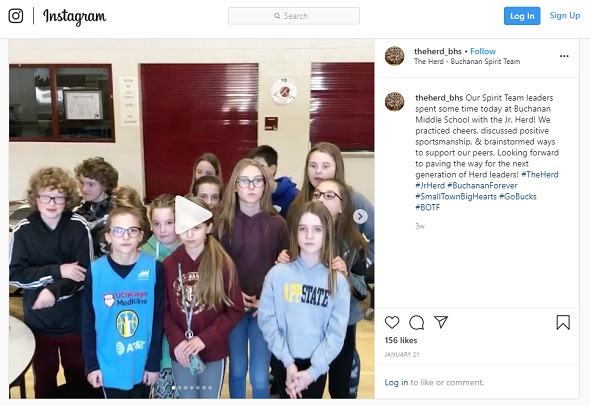
They’ve got next: “When we go into traveling pep rallies, we're like, ‘Hey, this is going to be you someday. You're going to have to fill our shoes eventually.’ We're just trying to prepare them as much as possible so it will be a fun time for them.” Johnson said of the younger students coming up. “Whenever we say a chant, like ‘Do you know this chant?’ They're like yeah, and they start doing it. So it's just exciting. They just know us and know all the chants and what we do.”
Next stop on BOTF: We will finish the 2020 BOTF tour at Zeeland East with tonight’s boys basketball game against Hamilton. Our coverage of that trip will be posted to Second Half on Monday, and social media voting will begin Tuesday and continue through Thursday. The Battle of the Fans IX champion will be announced Feb. 21.
The Battle of the Fans is sponsored in part by the United Dairy Industry of Michigan.
PHOTOS: (Top) Buchanan students cheer on their classmates during Tuesday’s boys basketball game against Watervliet. (Middle) Senior Carter Aalfs gets plenty of air while leading the section’s roller coaster. (Photos by Jessica Elliott.)