

New Math: Division & Multiplication Problems
July 25, 2017
By Jack Roberts
MHSAA Executive Director
This is the second part in a series on MHSAA tournament classification, past and present, that will be published over the next two weeks. This series originally ran in this spring's edition of MHSAA benchmarks.
High school tournament classifications went viral before there was social media and most of us knew what “viral” meant.
Much as a virus infects computers today or has created epidemics of disease around the world for centuries, high school tournament classification – once introduced – tends to spread uncontrollably. Once started, it tends to keep expanding and rarely contracts.
While we are still some distance from providing every team a trophy as a result of expanding high school tournament classification across the country, there is criticism nevertheless that we are headed in that direction – a philosophy which is supposed to exist only in local youth sports for our youngest children.
Michigan could be blamed for all this. Michigan is generally accepted as the first state to provide different classifications for season-ending tournaments for different sized schools. It started a century ago. Today, every state has various classifications for its tournaments in most if not all sports. And it is a bit ironic that Michigan – creator of the classification chaos – more than most other states has kept the number of tournament classes or divisions under control.
Yes, there is evidence that tournament classifications have expanded over the years in Michigan, especially with the relatively recent introduction of tournaments in football and the late 1990s’ move from classes to divisions in most MHSAA tournaments. But the MHSAA Representative Council has held true to its word when it expanded the playoffs for football from four classes to eight divisions: this is needed because of unique factors of football, factors that exist in no other sport; and all other sports should be capped at a maximum of four classes or divisions.
Kentucky is the preeminent defender of single-class basketball. All of its 276 high schools compete for the single state championship for each gender. In Indiana, there are still open wounds from its move in 1998 from one to four classes for its 400 schools in basketball.
Multi-class tournaments have tended to increase the number of non-public school champions, which some states are trying to lower through enrollment “multipliers,” and also tend to increase the number of repeat champions, which some states are trying to affect with “success factors” which lift smaller schools into classifications for larger schools if they take home too many trophies.
While there is considerable evidence that state tournaments do as much bad as good for educational athletics, state associations persist in providing postseason tournaments because, on balance, the experiences are supposed to be good for student-athletes. And once we reach that conclusion it is just a small leap to believe that if the tournaments are good for a few, they must be better for more – which leads to creating more and more tournament classifications. One becomes two classes, then three, then four and so forth.
While the argument is that more classifications or divisions provides more students with opportunities to compete and win, it is undeniable that the experience changes as the number of tournament classifications expands. It is not possible for state associations to provide the same level of support when tournament classifications expand to multiple venues playing simultaneously. For example, there is less audio and video broadcast potential at each venue, and less media coverage to each venue. Focus is diluted and fans diminished at each championship.
No one can argue reasonably that today's two-day MHSAA Football Finals of eight championship games has the same pizazz as the one-day, four-games event conducted prior to 1990.
In some states the number of divisions has grown so much that it is difficult to see much difference between the many season-ending state championship games and a regular-season event in the same sport.
It is a balancing act. And Michigan has been studying that balance longer than any other state, and charting a steadier course than most.
Addition by Division
The shift to Divisions for MHSAA Tournament play in numerous sports has added up to a greater number of champions for teams and individuals across the state. Following are the sports currently employing a divisional format, and the procedures for determining enrollment and classification.
In 23 statewide or Lower Peninsula tournaments, schools which sponsor the sport are currently divided into nearly equal divisions. They are:
- Baseball - 4 Divisions
- Boys Bowling - 4 Divisions
- Girls Bowling - 4 Divisions
- Girls Competitive Cheer - 4 Divisions
- LP Boys Cross Country - 4 Divisions
- LP Girls Cross Country - 4 Divisions
- LP Boys Golf - 4 Divisions
- LP Girls Golf - 4 Divisions
- Ice Hockey - 3 Divisions
- Boys Lacrosse - 2 Divisions
- Girls Lacrosse - 2 Divisions
- Boys Skiing - 2 Divisions
- Girls Skiing - 2 Divisions
- LP Boys Soccer - 4 Divisions LP
- Girls Soccer - 4 Divisions
- Girls Softball - 4 Divisions
- LP Boys Swimming & Diving - 3 Divisions
- LP Girls Swimming & Diving - 3 Divisions
- LP Boys Tennis - 4 Divisions
- LP Girls Tennis - 4 Divisions
- LP Boys Track & Field - 4 Divisions
- LP Girls Track & Field - 4 Divisions
- Wrestling - 4 Divisions
Lists of schools for each division of these 23 tournaments are posted on MHSAA.com approximately April 1. Listings of schools in Upper Peninsula tournaments for their sports are also posted on MHSAA.com. The lists are based on school memberships and sports sponsorships in effect or anticipated for the following school year, as known to the MHSAA office as of a date in early March.
In football, the 256 schools which qualify for MHSAA 11-player playoffs are placed in eight equal divisions annually on Selection Sunday. Beginning in 2017, the 8-player divisions will be determined in a like manner on Selection Sunday as well, with 32 qualifying schools placed in two divisions.
Schools have the option to play in any higher division in one or more sports for a minimum of two years.
The deadlines for "opt-ups" are as follows:
- Applications for fall sports must be submitted by April 15
- Applications for winter sports must be submitted by Aug. 15
- Applications for spring sports must be submitted by Oct. 15
Subsequent to the date of these postings for these tournaments, no school will have its division raised or lowered by schools opening or closing, schools adding or dropping sports, schools exercising the option to play in a higher division, or approval or dissolution of cooperative programs.
When the same sport is conducted for boys and girls in the same season (e.g., track & field and cross country), the gender that has the most sponsoring schools controls the division breaks for both genders.
Country Day Rises with Super Saturday
June 1, 2019
By Keith Dunlap
Special for Second Half
NOVI – For a squad that had won the previous three championships and was ranked No. 1 in the state, there was still understandably a lot of nervousness within the Detroit Country Day girls tennis team going into the final day of the MHSAA Lower Peninsula Division 3 Finals.
Country Day entered the day trailing rival Bloomfield Hills Cranbrook Kingwood by a point, and that actually was a deficit that provided a bit of relief among the Yellowjackets.
“Before Cranbrook’s No. 4 doubles team lost, we were down four points to them and they weren’t supposed to lose that quarterfinal match,” said assistant coach Jane Ziecik, the acting head coach for the second day of competition. “Being down four points to Cranbrook is way different than down one.”
But while there were feelings of nervousness for Country Day, it didn’t translate into its play on the last day.
Country Day showed its championship mettle, rising up by winning six of the eight flights and claiming its fourth straight Finals title with 33 points, good enough to outlast runner-up Cranbrook’s total of 26.
“It was definitely more nerve-wracking than what our girls are used to,” Ziecik said. “They are used to not having to worry as hard.”
Leading the way was senior Monique Karoub, who ended her high school career by winning her fourth individual Finals title to complement being part of four team champions.
Karoub beat Nina Govila of Cranbrook in the No. 1 singles final 6-0, 6-1.
“I definitely was confident, but every year I get super nervous,” Karoub said. “It’s never a guarantee at all. It’s just the best feeling to be able to come out on top like this. Especially as a team, too. That’s the best.”
 This was a season of transition once again for Karoub, who won last season at No. 2 singles when Country Day had a highly-touted then-freshman, Julia Fleigner, win at No. 1.
Fleigner decided not to play high school this year, and Karoub returned to No. 1 singles, a flight she won as a sophomore in 2017.
Karoub also won the title at No. 2 singles as a freshman.
“It was a difficult transition,” Karoub said. “But I was able to be successful with it. We had a quad in Allegan, and it was our first quad of the season. I had a really close three-set match, and it just emphasized how difficult No. 1 can be and how good the girls are.”
Karoub is moving on to attend college at Michigan State. She said she is undecided on whether she will play tennis.
“I just tried to be consistent because I was really nervous,” Karoub said. “I just tried to focus on footwork and try and control the things I could control.”
Other flight champions for Country Day were Elle Hartje at No. 2 singles, Alexis Nardicchio at No. 3 singles, the team of Tara Rahmani and Nina Khaghany at No. 1 doubles, the tandem of Ruhe Wayak and Lana Haddad at No. 2 doubles and the team of Maria Sicilia and Rachel Jeong at No. 3 doubles.
Cranbrook, which won five team Division 3 championships in a row from 2011-15, finished runner-up for the second straight year.
Charlotte Brown won the title at No. 4 singles for Cranbrook.
“Country Day is a really strong team, and we’ve been chasing them all year,” Cranbrook head coach Grant Asher said. “We feel like we have been getting closer and closer, and I think that was evident after day one. But they’re a really strong and deep team. I was really proud of our girls in a sense that they put themselves in a position to put some pressure on them. Unfortunately, Country Day elevated their game at the end.”
The only flight that didn’t have a champion from Country Day or Cranbrook was No. 4 doubles, where Grand Rapids Christian’s team of Grace Maurer and Calista Bremer, seeded sixth, won the title.
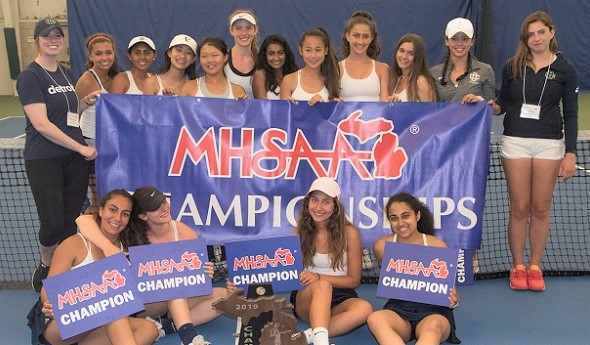
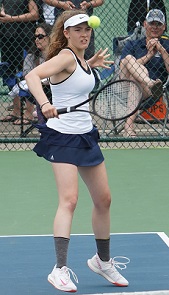
PHOTOS: (Top) Detroit Country Day celebrates its fourth straight LP Division 3 title Saturday. (Middle) Country Day's Maria Sicilia returns a volley during a match at No. 3 doubles. (Click for more from HighSchoolSportsScene.com.)