

New Math: Division & Multiplication Problems
July 25, 2017
By Jack Roberts
MHSAA Executive Director
This is the second part in a series on MHSAA tournament classification, past and present, that will be published over the next two weeks. This series originally ran in this spring's edition of MHSAA benchmarks.
High school tournament classifications went viral before there was social media and most of us knew what “viral” meant.
Much as a virus infects computers today or has created epidemics of disease around the world for centuries, high school tournament classification – once introduced – tends to spread uncontrollably. Once started, it tends to keep expanding and rarely contracts.
While we are still some distance from providing every team a trophy as a result of expanding high school tournament classification across the country, there is criticism nevertheless that we are headed in that direction – a philosophy which is supposed to exist only in local youth sports for our youngest children.
Michigan could be blamed for all this. Michigan is generally accepted as the first state to provide different classifications for season-ending tournaments for different sized schools. It started a century ago. Today, every state has various classifications for its tournaments in most if not all sports. And it is a bit ironic that Michigan – creator of the classification chaos – more than most other states has kept the number of tournament classes or divisions under control.
Yes, there is evidence that tournament classifications have expanded over the years in Michigan, especially with the relatively recent introduction of tournaments in football and the late 1990s’ move from classes to divisions in most MHSAA tournaments. But the MHSAA Representative Council has held true to its word when it expanded the playoffs for football from four classes to eight divisions: this is needed because of unique factors of football, factors that exist in no other sport; and all other sports should be capped at a maximum of four classes or divisions.
Kentucky is the preeminent defender of single-class basketball. All of its 276 high schools compete for the single state championship for each gender. In Indiana, there are still open wounds from its move in 1998 from one to four classes for its 400 schools in basketball.
Multi-class tournaments have tended to increase the number of non-public school champions, which some states are trying to lower through enrollment “multipliers,” and also tend to increase the number of repeat champions, which some states are trying to affect with “success factors” which lift smaller schools into classifications for larger schools if they take home too many trophies.
While there is considerable evidence that state tournaments do as much bad as good for educational athletics, state associations persist in providing postseason tournaments because, on balance, the experiences are supposed to be good for student-athletes. And once we reach that conclusion it is just a small leap to believe that if the tournaments are good for a few, they must be better for more – which leads to creating more and more tournament classifications. One becomes two classes, then three, then four and so forth.
While the argument is that more classifications or divisions provides more students with opportunities to compete and win, it is undeniable that the experience changes as the number of tournament classifications expands. It is not possible for state associations to provide the same level of support when tournament classifications expand to multiple venues playing simultaneously. For example, there is less audio and video broadcast potential at each venue, and less media coverage to each venue. Focus is diluted and fans diminished at each championship.
No one can argue reasonably that today's two-day MHSAA Football Finals of eight championship games has the same pizazz as the one-day, four-games event conducted prior to 1990.
In some states the number of divisions has grown so much that it is difficult to see much difference between the many season-ending state championship games and a regular-season event in the same sport.
It is a balancing act. And Michigan has been studying that balance longer than any other state, and charting a steadier course than most.
Addition by Division
The shift to Divisions for MHSAA Tournament play in numerous sports has added up to a greater number of champions for teams and individuals across the state. Following are the sports currently employing a divisional format, and the procedures for determining enrollment and classification.
In 23 statewide or Lower Peninsula tournaments, schools which sponsor the sport are currently divided into nearly equal divisions. They are:
- Baseball - 4 Divisions
- Boys Bowling - 4 Divisions
- Girls Bowling - 4 Divisions
- Girls Competitive Cheer - 4 Divisions
- LP Boys Cross Country - 4 Divisions
- LP Girls Cross Country - 4 Divisions
- LP Boys Golf - 4 Divisions
- LP Girls Golf - 4 Divisions
- Ice Hockey - 3 Divisions
- Boys Lacrosse - 2 Divisions
- Girls Lacrosse - 2 Divisions
- Boys Skiing - 2 Divisions
- Girls Skiing - 2 Divisions
- LP Boys Soccer - 4 Divisions LP
- Girls Soccer - 4 Divisions
- Girls Softball - 4 Divisions
- LP Boys Swimming & Diving - 3 Divisions
- LP Girls Swimming & Diving - 3 Divisions
- LP Boys Tennis - 4 Divisions
- LP Girls Tennis - 4 Divisions
- LP Boys Track & Field - 4 Divisions
- LP Girls Track & Field - 4 Divisions
- Wrestling - 4 Divisions
Lists of schools for each division of these 23 tournaments are posted on MHSAA.com approximately April 1. Listings of schools in Upper Peninsula tournaments for their sports are also posted on MHSAA.com. The lists are based on school memberships and sports sponsorships in effect or anticipated for the following school year, as known to the MHSAA office as of a date in early March.
In football, the 256 schools which qualify for MHSAA 11-player playoffs are placed in eight equal divisions annually on Selection Sunday. Beginning in 2017, the 8-player divisions will be determined in a like manner on Selection Sunday as well, with 32 qualifying schools placed in two divisions.
Schools have the option to play in any higher division in one or more sports for a minimum of two years.
The deadlines for "opt-ups" are as follows:
- Applications for fall sports must be submitted by April 15
- Applications for winter sports must be submitted by Aug. 15
- Applications for spring sports must be submitted by Oct. 15
Subsequent to the date of these postings for these tournaments, no school will have its division raised or lowered by schools opening or closing, schools adding or dropping sports, schools exercising the option to play in a higher division, or approval or dissolution of cooperative programs.
When the same sport is conducted for boys and girls in the same season (e.g., track & field and cross country), the gender that has the most sponsoring schools controls the division breaks for both genders.
Union City to Omaha: Skirka Takes Murray State Baseball to 1st College World Series
By
Scott Hassinger
Special for MHSAA.com
July 28, 2025
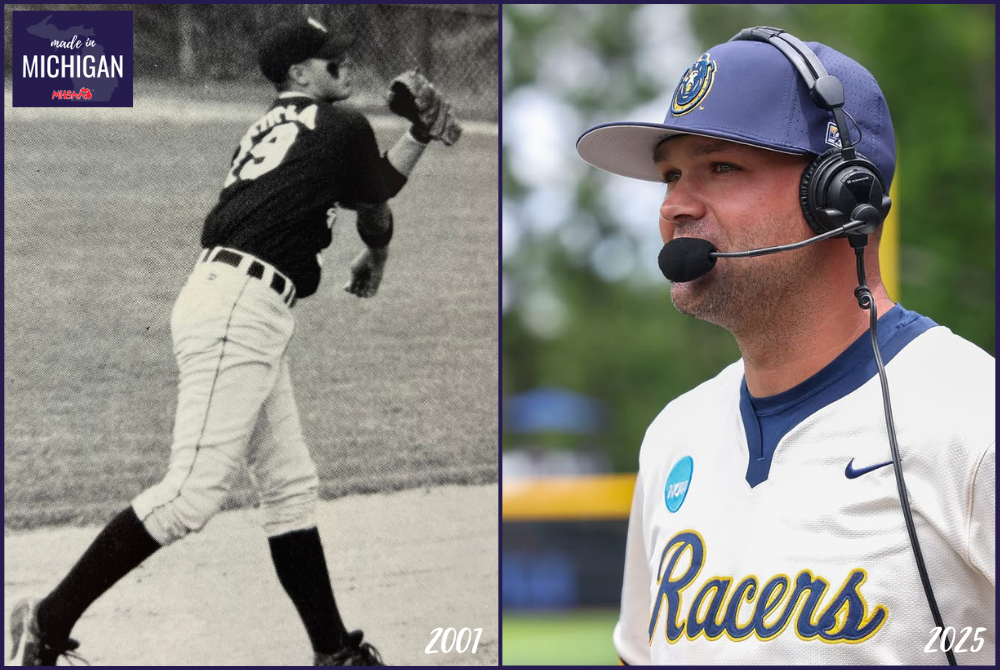
UNION CITY – From his days fielding ground balls at Alumni Field in Union City to coaching the Murray State Racers at the 2025 College World Series in Omaha, Neb., Dan Skirka has never taken the game of baseball for granted.
 A 2003 Union City graduate, Skirka credits his experience of growing up with three older brothers as playing a major impact in his athletic development.
"I played all three sports – football, basketball and baseball – when I was younger while growing up. After my freshman year, I began to concentrate solely on basketball and baseball," he said.
Inspired by watching his older siblings Darren (graduated 1995), Justin (1999) and Brian (2001) compete for the Chargers, Dan couldn't wait to be just like them when he reached the high school level.
"I would attend my brothers' games and I was always trying to emulate them and their teammates,” Dan Skirka said. “The desire to compete for my school when I got the chance helped turn me into the person I am today. It was just really special being on that field, and I never take the game for granted."
While his older brothers played multiple positions, Dan began his career as a pitcher, but an arm injury his freshman year convinced him to switch to shortstop, where he started his last three years for the Chargers.
Skirka was brought up to varsity his freshman year in both baseball and basketball. He played baseball under Joe Tinervia, earning all-conference at shortstop his sophomore, junior and senior seasons. As a senior, Skirka batted .520 in earning all-region as well.
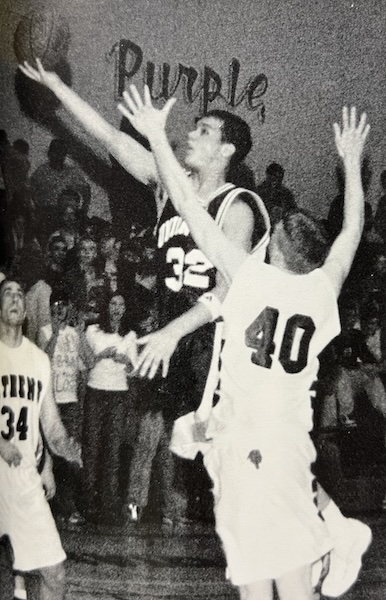
He also was selected all-conference in basketball his sophomore, junior and senior years. A small forward, Skirka remembers well the thrill of winning a District championship his junior year before losing in the Regional Final. Being able to share that experience with guys he grew up with was priceless.
"I learned a lot about leadership skills and how necessary they were in my growth and maturity as a player in high school and college. I learned a great deal from the example the older guys set," Skirka said.
After graduating from Union City, Skirka became a two-year starter at shortstop at Kellogg Community College for head coach Russ Bortell. The Bruins captured a Michigan Community College Baseball Association title during Skirka's sophomore season. The Bruins also reached the regional semifinals that spring after falling in the regional final his freshman year.
"We had a great program at Kellogg, and I learned a ton about baseball from the coaching staff there.” Skirka said. “Grand Rapids Junior College won the regional both years I was at Kellogg. They had a tremendous team and were tough to beat."
Skirka received a Division II baseball scholarship to Grand Valley State University, where he played under Steve Lyon and helped the Lakers win two Great Lakes Intercollegiate Athletic Conference titles. As a senior, Skirka was selected GVSU's Scholar-Athlete of the Year and named to the Division II all-region team, one step away from All-America honors, after hitting .400. He graduated from GVSU majoring in social studies with future plans to become a high school teacher and coach.
Skirka helped his teams at Kellogg and GVSU win a combined 173 games. He credits then-assistant coaches Eric Laskovy (Kellogg) and Jamie Detillion (GVSU) as being heavy influences in his decision to pursue a career in coaching college baseball.
 "Laskovy and Detillion were both great assistant coaches who later became head coaches at those schools, and they served as great mentors to me. They both felt that I'd make a good college coach,” Skirka said. “I had always had good relationships with my college coaches, and I served as a team captain at each school. I learned a lot of lessons about toughness and loving the game. Sometimes we played in front of no spectators, and there were a lot of long bus rides."
Laskovy, now a highly-successful head coach himself at Kellogg, describes Skirka as the same genuine and humble person that he was during his playing career.
"Dan was quiet, but real confident and he handled himself well on the field. His strong work ethic as a player made him a coach's dream. He had good leadership skills and he always led by example,” Laskovy said. “That shows up now in his personality as a head coach. He knows the game well and won't get outworked by anyone, and he's seen every situation there is to see in baseball. He knows his stuff, and he's earned the respect of every one of his players and they love him. I couldn't be any prouder of him and the success he's went on to enjoy."
Detillion, who served as GVSU's head coach for 12 seasons before joining Henry-Scheim as a dental sales rep, described Skirka as being another coach on the field during his playing career.
"Dan went from being a good contact hitter to being a power hitter his senior season at GVSU. He was another coach on the field and he outplayed others by how well he prepared," Detillion said. “He always does the right thing, and his mannerisms and the way he goes about his business reveal his high character.”
While student-teaching before graduating from GVSU, Skirka served as an assistant coach in 2008 at GRJC before becoming an assistant coach in 2009 for Ouachita Baptist University in Arkansas. He joined Murray State's coaching staff as an assistant from 2010-2015 before leaving to become the recruiting coordinator at Walters State Community College (Tenn.), which finished as national runner-up in 2018.
Skirka accepted the position of head baseball coach back at Murray State on July 2, 2018. He’s only a few weeks removed from leading the Racers to a historic season.
Murray State, which is 206-151 under Sirka, finished with a school-record 44 wins this spring, winning the Missouri Valley Conference regular-season and tournament championships. The Racers earned their first NCAA Tournament appearance since 2003 and fourth in program history. Murray State then upset host Ole Miss to claim the school's first NCAAA Regional crown, followed by a Super Regional victory over Duke that earned the Racers' their first trip to the College World Series. Murray State ended the season 44-17 after CWS losses to UCLA and Arkansas.
Skirka, who received Missouri Valley Conference Coach of the Year and the National Collegiate Baseball Writers Association Mike Martin National Coach of the Year awards, turned down several coaching offers at other schools to remain at Murray State. He recently received a four-year contract extension that came with a substantial pay raise to become reportedly the highest paid coach in the MVC.
 Skirka stated that his decision to stay on at Murray State was a simple one.
"Murray State is a real special place. I love the guys and people in this community, and it just feels like home,” Skirka said. “College baseball presents a lot of challenges. The game is difficult sometimes, and guys need to remember to be patient. It takes weeks, months and sometimes years to earn your time and develop a winning program."
Skirka pointed out clutch performances this season from his senior duo of outfielder and lead-off hitter Jonathan Hogart and third baseman and No. 3 hitter Carson Garner. Hogart hit a school-record 22 home runs, and Garner had 17.
"We have tough kids who grinded out and won 14 games by one run. We were never out of any game with a good mixture of veterans and underclassmen,” Skirka said. “It was a group of guys that loved one another and went out every day and had fun. This group worked hard and competed like crazy. They play the game the right way, and do it with a smile on their face. Our coaching staff is great as well. We meshed pretty well together."
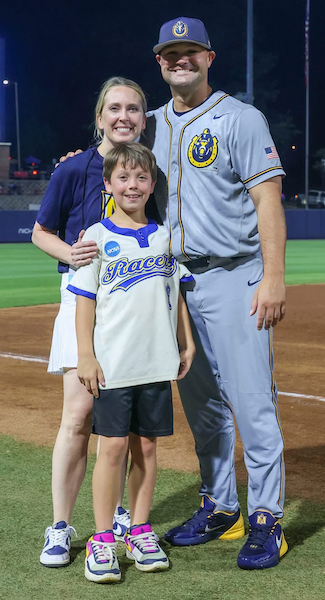
Skirka and his wife Kelsey (Hanson) – also a 2003 Union City grad and a standout in volleyball, basketball and softball – have a 9-year old son, Keagan.
2025 Made In Michigan
July 22: TC West's Wheelock Still 'Living My Dreams' as CMU Assistant Soccer Coach - Report
July 17: Stevenson's Travels Following Lake Orion Success Include Space Force, Penn, NYC - Report
July 15: 'Who Will Cheer for the Nimrods?' Peterson IV, Watersmeet Found Fans Worldwide - Report
July 10: Feeding 'Drive to Win,' Loy Norrix Grad Morgan Impresses with Strong USBC Showing - Report
July 9: After Blazing Multiple Volleyball Trails, Bastianelli Charting Next Career Path - Report
PHOTOS (Top) At left, Union City sophomore shortstop Dan Skirka makes a throw to first base after fielding a grounder in 2001. At right, Skirka dons headphones for a postgame interview this past season. (Middle) Skirka (32) lays the ball up for two points while playing for Union City against Athens. (Below) Skirka is pictured with wife Kelsey and son Keegan before a game this spring. (Union City photos courtesy of Union City High School. Murray State photos courtesy of ProfEatonPhoto/Murray State athletics.)