

Always Aiming to Provide a 'Fair Start'
June 6, 2013
By Geoff Kimmerly
Second Half editor
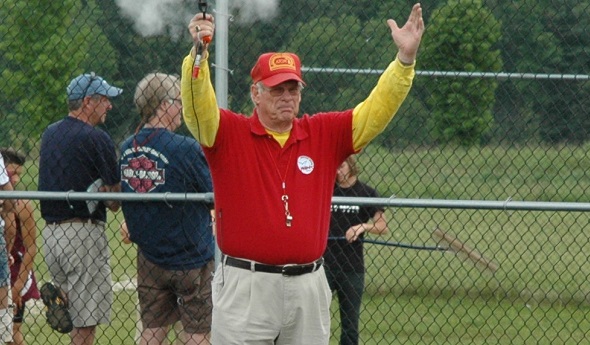
Tom Truscott was glad where he stood as he raised his hands to start the 100-meter boys Regional race at Lansing Sexton in 1987 that featured Corey Pryor of Jackson, Tico Duckett of Kalamazoo Loy Norrix and the host Big Reds’ Alan Haller.
They’d go on a few weeks later to finish first, third and fourth, respectively, in arguably the fastest MHSAA Finals race of all time. And on this afternoon, Truscott was glad he didn’t have to referee at the finish and figure out who crossed the line first.
To be honest, he’s never paid much attention to finishes during 42 years as an MHSAA track and field and cross country official who has launched a few generations of athletes in the classroom, on various playing fields and as one of the best-recognized race starters in the Lansing area.
His philosophy is simple – and surely has stretched across an educational career that began with his first MHSAA officials registration for the 1959-60 school year.
“I start,” Truscott said, “because I want to give the kids a fair start.”
Truscott has officiated for 42 years in addition to the nearly four decades he spent as a coach and athletic director. In keeping with that desire to give a “fair start,” Truscott quietly told organizers of the longtime Lansing Area Honor Roll Track and Field Meet that last Wednesday’s would be his 32nd and last as starter – not because he doesn’t love it still, but because it’s time to give younger officials the opportunity to run the prestigious show.
It’s a decision consistent with a career of creating opportunities – in track speak, starts – through sports.
“That’s typical Tom. He’s a gracious, humble man,” said retired longtime Grand Ledge and Fowler coach Kim Spalsbury, who now serves as director of the Honor Roll Meet. “That’s what Tom’s all about.”
Standing tall
There’s no way Truscott is 75 years old, one might conclude as he stands tall and instructs runners at the start of a race in a smooth baritone voice.
But he’s been involved as a high school athlete, coach, director or official for more than 60 years – and has officiating dates already stamped on his 2013-14 calendar.
 Truscott remains best known in school circles for his more than three decades as a coach and administrator at Potterville High School. A three-sport standout at Lansing Everett from 1953-56 and then two-sport athlete at Hillsdale College, Truscott joined Potterville schools in 1961. He went on to coach Vikings boys basketball teams to more than 300 wins and four District titles during 35 seasons, and he also led the football program for 24 seasons over two tenures – five of his teams won league championships, and he joined the Michigan High School Football Coaches Association Hall of Fame in 1986.
He also served as Potterville High School’s athletic director from 1963-96, even during a brief time when he also coached football as an assistant at Lansing Sexton. Potterville was one of few small schools in the mid-Michigan area with full track and field facilities, so Truscott hosted just about every significant event. He served as meet manager for 16 Regionals and also the 1977 and 1978 Lower Peninsula Class D Wrestling Finals.
Truscott also was a strong advocate as girls sports began to grow after Title IX. Among his best coaching hires was Sheryl Mox – who ended up leading both the girls basketball and volleyball teams to MHSAA championships and also became the athletic director.
“He’s a tall man in stature, and that’s a good way to list his long list of accomplishments,” said Spalsbury, who met Truscott in 1980 as their schools belonged to the same league, the Central Michigan Athletic Conference.
Truscott took an officiating course while at Hillsdale, and soon after debuted as an official for a few Thursday night football games. He was a third base umpire during the inaugural Capital Area Diamond Classic baseball tournament, which finished up its 52nd running this week. Cross country and track and field became his sports of choice for officiating because they best fit into his schedule as a coach and athletic director. He took a break from officiating for most of the 1970s, but has been a consistent presence again for the last three decades.
“You can stay associated with athletics by doing it. And you’re the person that’s going to influence the charisma of the game, how the game goes,” Truscott said, explaining how he'd sell the avocation to someone who might be considering it. “You don’t want to be noticed; you’re there to make a fair call and give kids a fair start.”
Seeing the big picture
That's another way Spalsbury described his longtime colleague.
Truscott continues to love the sports he played and coached. But running sports he officiates have earned a special place in his heart.
“You’re always going to the dugout or the locker room (with other sports). You never socialize with your competitors,” Truscott said. “With track and cross country, that’s the marvel of it; you talk to each other, know each other and then get into the blocks and try to beat each other. Then associate with each other again.”
 History is among Truscott’s favorite non-sports pastimes, although he certainly finds ways to tie the two; he emulated his Everett history teacher and coach Ted Bauer and so became a history teacher as well who often found a way to mix historical context into halftime speeches.
Truscott is an active member of the Michigan Historical Commission and has dedicated roughly 60 landmarks across the state. An officiating experience recently crept into one of those dedications – when placing a marker at Battle Creek’s Kellogg Community College last month, he likened the continuing education aspect of junior college to a Fulton-Middleton runner who despite trailing by laps continued until she had finished her race.
As word began to spread Wednesday that Truscott was retiring from the Honor Roll Meet, a few admirers made sure to pass on what he’d meant to them. Former Lansing Catholic standouts Zach Zingsheim and Jimmy Hicks – now running at Georgetown University and the University of Georgia, respectively – made sure to let Truscott know he was the best they’ve had start them, including those they’ve seen during their first seasons at the college level.
“They made a point to search him out and go and talk to him and tell him what they thought of him,” Lansing Catholic coach Tim Simpson said. “It is rare that kids would gain that much respect and like for an official.”
But Truscott has earned it by understanding how best to relate to high school athletes.
His son John Truscott, a former athlete at Sexton, remembered a situation concerning a championship-caliber competitor who was committing a minor violation that would've meant disqualification – but before taking that step, Tom Truscott gave the athlete a head's up instead. “He’s always looking out of kids,” John Truscott said.
Simpson recalled another occasion when one of his more “fiery” freshman girls threw a baton in the infield after a disappointing finish. Truscott called out “Ma’am” – which might’ve been a first for the stunned runner – and then explained why what she did was wrong. “Instead of just disqualifying her, he took the extra time. And that incident was never forgotten by that girl,” Simpson said. “It could have been a negative, and he turned it into a positive.
“He treats the kids with respect and in turn gets it back.”
Truscott started the Big Ten Cross Country Championships in 1991 at Michigan State University, and early in his career started meets at Olivet College and the University of Michigan.
But officiating at those levels never stacked up to the fun he’s had starting high school athletes.
John Truscott still hears from his dad after meets about the latest standout he saw or the one showing the potential to do great things. John knows better than most what the high school games mean to Tom – he often assisted his father during Saturday events – and why providing that "fair start" became a life's work.
“That really is his philosophy,” John Truscott said. “Over his career he coached great athletes, mediocre athletes and bad athletes. And he wanted them to all enjoy sports and learn from them, no matter what the future held for them.”
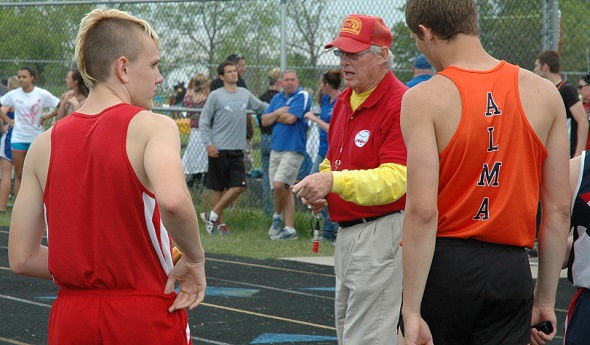
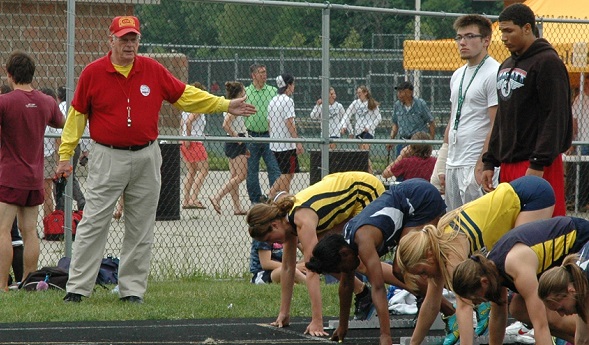
PHOTOS: (Top) Tom Truscott starts a race during last week's Lansing Area Honor Roll Track and Field Meet at Holt High School. (Middle) Truscott oganizes the 3,200 relay teams before their race. (Below) The 100-meter finalists await Truscott's start. (Photos by Geoff Kimmerly.)
Retired NHL-er Back on Ice to Answer Call - By Making Them
By
Rob Kaminski
MHSAA benchmarks editor
March 16, 2023
The most accomplished skater on the ice during Friday’s triple-overtime MHSAA Division 1 Semifinal hockey thriller between Hartland and Brighton was not wearing the school colors of either team.
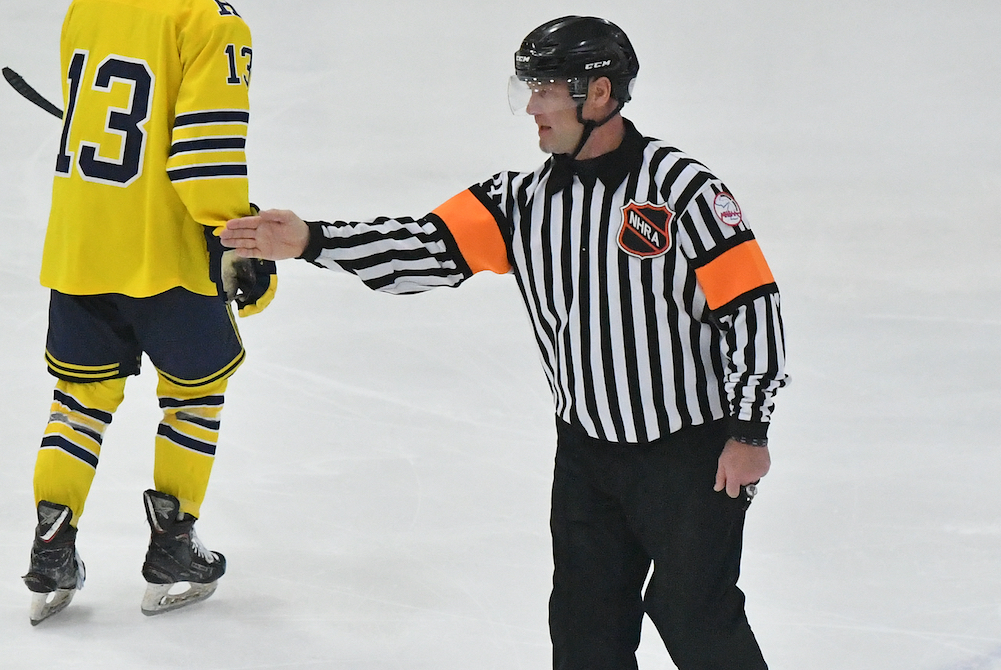
In front of a packed house at Plymouth’s USA Hockey Arena, referee Bryan Smolinski was in stripes, just like the rest of his officiating crew.
In his former life, he pulled on plenty of sweaters before lacing up the skates. That happens when one logs more than 1,000 games, tallies nearly 300 goals (274) and close to 400 assists (377) with eight teams spanning a 15-year playing career in the National Hockey League.
So, how did the 52-year-old former star player find himself on the ice last weekend as one of the referees for the pinnacle weekend of this high school season? Good question, even for the man known as “Smoke” during his playing days.
“I was working in youth development programs a few years back and reached out to some Michigan guys I had connections with about other ways to help the game,” Smolinski said. “I called Kevin May just to chat and asked, ‘Hey, how’s your reffing going?’ He said, ‘You know, we’re down a little bit,’ then said, ‘Why don’t you do it?’ I said, ‘Not a chance,’” Smolinski laughed.
Never Say Never
May persisted, imploring his friend to skate with him during a Fall league at Cranbrook in Bloomfield Hills. After eight weeks, once a week, Smolinski had a revelation.
“I’m like, ‘I’m kind of diggin’ this,’” Smolinski said “So, I did all the testing, and the educational part of it, and I really enjoyed it. I got with Danny (DiCristofaro) and his group, and he put me in as much as he could, and I really started to get my feet wet.”
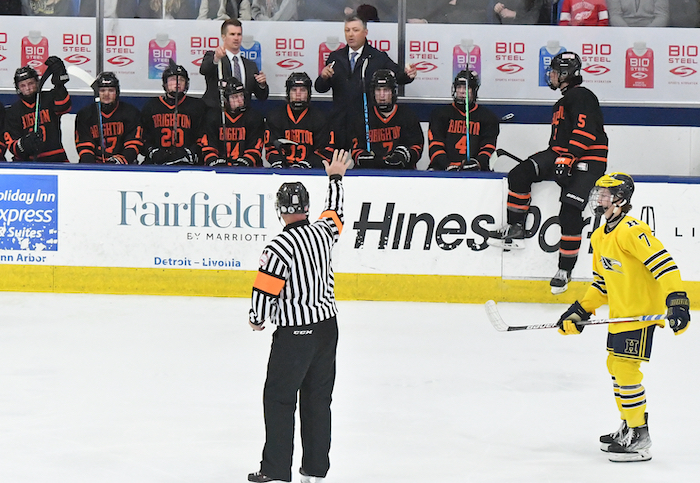 DiCristofaro is the assigner and referee-in-chief for the MHSAA’s Northeast Hockey Referees Association, and he has seen Smolinski’s growth first-hand.
“Obviously he’s got great instincts and a feel for the game, along with a wealth of experience, all of which has allowed him to climb the ladder quickly,” said DiCristofaro. “It’s been a joy to watch his growth as an official.”
Fast forward to last Friday, and there were Smolinski and May sharing duties as referees during the MHSAA Semifinal with linesmen Michael Andrews and Thomas Robbins.
In between, there has been a learning curve that still continues, but the jump to officiating was not quite as daunting as his introduction to the NHL.
“I was scared to death. My first game was against Mario Lemieux. I’m in the old Boston Garden and now I’m playing against these guys and it’s their job, and they’re out there trying to make a living,” Smolinski recalled.
The emotions were not running nearly as frenzied for his first game as an MHSAA official, obviously, yet respect came in a different form.
“I couldn’t pick the puck up, I was breathing heavily; it was Kevin and me doing a two-man game in Brighton,” Smolinski recalled. “There were a few high-end kids playing, and I’m thinking, ‘I’m dying here.’ You know, there’s no training for that first time.”
What that experience did, however, was revitalize Smolinski in a new way. His playing career is well documented, not only in the NHL, but around Michigan. He enjoyed an honor-laden career at Michigan State University from 1989-93 before joining the Boston Bruins (who had drafted him three years earlier) at the end of the ’93 NHL campaign. Even after his final season, with Montreal in 2007-08, he stayed in the game via men’s leagues, or coaching his son, Max.
Smolinski and his wife, Julie, have three daughters: Ashtyn (22), Jojo (16) and Rylen (12), along with Max, whom dad coached for seven years including during a national championship run with a Little Caesars U15 team in 2019. Max, 19, is now playing collegiately at Rensselaer Polytechnic Institute.
So, for Smolinski, officiating offers a new chapter.
“Reffing brought back ... I wouldn’t say love of the game, because that’s always been there; it’s a different side of enjoying the game now. I have no horse in the race, my son’s off to college, my daughters are doing their thing; I wanted to find something new in the game,” Smolinski said. “I’ve coached, and I don’t want to do that. I found this, and I’ve stuck with it.”
Old College Ties
One of the great benefits of athletics at any level are the friendships made. For two kids who met in their first years on the MSU campus and forged a bond that lasts to this day, it’s amazing how their careers reached the pinnacle and have now come full circle.
Wes McCauley, an MSU teammate, is one of Smolinski’s best friends. After numerous years in the minor leagues, McCauley, like his friend, made it to the NHL. But McCauley made it as an official, working his first NHL game in 2003, when Smolinski was nearing the end of his playing career.
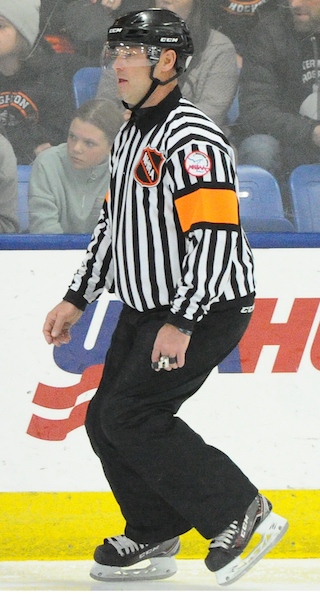 Their games lined up on just a few occasions in the NHL, and the two lobbied hard to have McCauley work Smolinski’s 1,000th career game in his final season with the Canadiens in 2007-08. The request, sadly, was denied by the league.
On the rare occasions when the friends did share the same ice, less than a handful by Smolinski’s count, it was McCauley who was forced to rebuff any attempts at fraternization. It’s just part of an official’s edict.
“For both of us, it was amazing; it was just great,” Smolinski said. “I’d say, ‘Hey man what’s up?’ and he says, ‘Can’t talk.’ I’m like, ‘What do you mean, we talk all the time.’ Again, he’s like, ‘Can’t talk, get away from me.’ You know, it was just business.”
McCauley then reached the 1,000-game plateau himself in 2018 and is still going strong as a regular selection for playoff duties with nine Stanley Cup Finals assignments, including last year.
So, it should have been natural for Smolinski to go to his old friend immediately for officiating pointers once he joined the ranks, right? Well, maybe not immediately.
“I talk to Wes all the time, but I actually hid it from him right out of the gate because I didn’t want to take his razzing. Eventually it got out, and he was loving it. He started sending me whistles and visors and pants,” Smolinski said, grinning. “And none of it fit, you know, because I’m older and fatter, and he’s so damn skinny. So, I still had to go out and get all new gear.”
Both Sides Now
Having been to the top of his profession, now moving to the other side of that same mountain that his friend McCauley scaled, the respect has grown for those blowing the whistle.
“The preparation for officiating is much more mental,” Smolinski said. “Way more rules oriented. You’re always trying to get away with things that you can as a player; now you have to police that.”
Smolinski has a distinct advantage.
“I know everything they’re trying to do because I’ve done it. I know where you’re going with the puck, I know what kind of breakout you’re trying to do,” Smolinski said. “I have all the instincts, now I just try to stay out of the way and not ruin their game. The most fun is watching the game develop and the ups and downs. For me to be out there and enjoy it with them, that’s the fun part.”
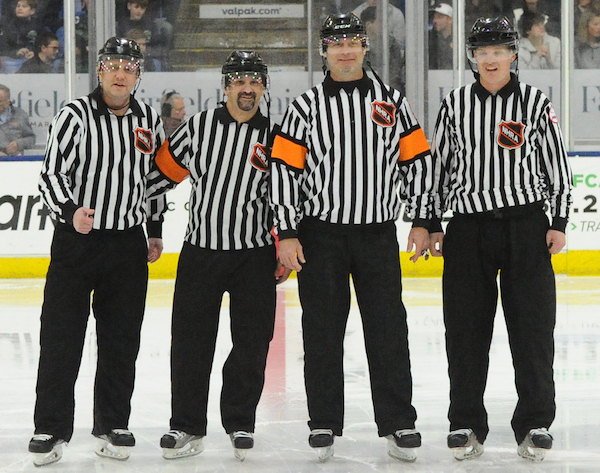 Those who have played hockey at any level have a built-in advantage should they consider the officiating avocation: the ability to skate. Unlike officiating in any other sport, skating is a prerequisite. This makes the pool limited, and almost solely composed of former players. Smolinski offers this advice.
“I prefer sticking with high school because I think there’s more decorum, more administrative structure. Kids are playing for their schools, there’s loyalty there,” said Smolinski. “And there is more accountability. People need report to athletic directors and supervisors. Other levels can be more loosely governed, or a bit more maverick in nature. Moms and dads get involved more, coaches maybe know a little less,” said Smolinski.
He has, in fact, worked a handful of non-school games, and there’s a stark difference.
“I wanted to see what was going on, and I see it first-hand,” Smolinski said. “There are some crazy people and parents out there, and these guys are getting absolutely tortured. I’ve been tortured. There has to be a level of respect for what officials do. I think schools can rein that in a little more. All the guys I’ve met give up a lot of time and work hard because they love to do it and love the game.”
All sports need an assist from school administration and from those who once played the games to keep the officials recruitment moving in the right direction. People like Smolinski can help.
“He clearly doesn’t need to do this, and that’s what makes it so fantastic,” DiCristofaro said. “We need more people who have played – at any level – to do what he’s done and stay in the game as officials.”
Smolinski continues to promote the game in other ways as well. Currently, he is involved in the NHL’s Learn To Play initiative, which aims to inspire youth and welcome more families into the hockey community.
“We work hand-in-hand with the NHL Players Association for player development and industry growth,” Smolinski said. “Ages 5 to 9 are introduced to hockey, get head-to-toe gear and instruction, and meet some former players.”
The idea is to have fun first, which can translate into years and maybe even a lifetime in the sport. It’s a lifetime that has given Smolinski so much and continues to do so as he watches it unfold for others from his new vantage point.
PHOTOS (Top) MHSAA official Bryan Smolinski signals during Friday's Division 1 Semifinal between Brighton and Hartland. (2) Smolinski, a retired NHL standout, communicates with the Bulldogs' bench. (3) Smolinski keeps watch during game play. (4) Smolinski, third from left, with his crew: Michael Andrews, Kevin May and Thomas Robbins.