

Always Aiming to Provide a 'Fair Start'
June 6, 2013
By Geoff Kimmerly
Second Half editor
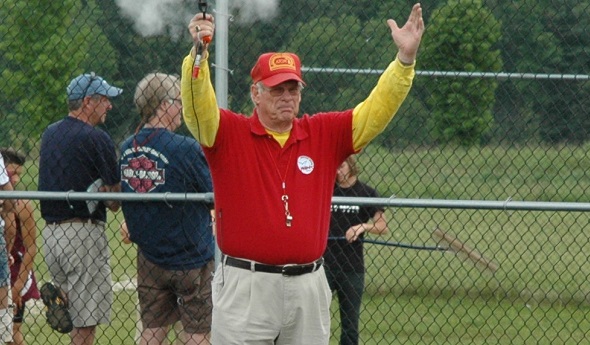
Tom Truscott was glad where he stood as he raised his hands to start the 100-meter boys Regional race at Lansing Sexton in 1987 that featured Corey Pryor of Jackson, Tico Duckett of Kalamazoo Loy Norrix and the host Big Reds’ Alan Haller.
They’d go on a few weeks later to finish first, third and fourth, respectively, in arguably the fastest MHSAA Finals race of all time. And on this afternoon, Truscott was glad he didn’t have to referee at the finish and figure out who crossed the line first.
To be honest, he’s never paid much attention to finishes during 42 years as an MHSAA track and field and cross country official who has launched a few generations of athletes in the classroom, on various playing fields and as one of the best-recognized race starters in the Lansing area.
His philosophy is simple – and surely has stretched across an educational career that began with his first MHSAA officials registration for the 1959-60 school year.
“I start,” Truscott said, “because I want to give the kids a fair start.”
Truscott has officiated for 42 years in addition to the nearly four decades he spent as a coach and athletic director. In keeping with that desire to give a “fair start,” Truscott quietly told organizers of the longtime Lansing Area Honor Roll Track and Field Meet that last Wednesday’s would be his 32nd and last as starter – not because he doesn’t love it still, but because it’s time to give younger officials the opportunity to run the prestigious show.
It’s a decision consistent with a career of creating opportunities – in track speak, starts – through sports.
“That’s typical Tom. He’s a gracious, humble man,” said retired longtime Grand Ledge and Fowler coach Kim Spalsbury, who now serves as director of the Honor Roll Meet. “That’s what Tom’s all about.”
Standing tall
There’s no way Truscott is 75 years old, one might conclude as he stands tall and instructs runners at the start of a race in a smooth baritone voice.
But he’s been involved as a high school athlete, coach, director or official for more than 60 years – and has officiating dates already stamped on his 2013-14 calendar.
 Truscott remains best known in school circles for his more than three decades as a coach and administrator at Potterville High School. A three-sport standout at Lansing Everett from 1953-56 and then two-sport athlete at Hillsdale College, Truscott joined Potterville schools in 1961. He went on to coach Vikings boys basketball teams to more than 300 wins and four District titles during 35 seasons, and he also led the football program for 24 seasons over two tenures – five of his teams won league championships, and he joined the Michigan High School Football Coaches Association Hall of Fame in 1986.
He also served as Potterville High School’s athletic director from 1963-96, even during a brief time when he also coached football as an assistant at Lansing Sexton. Potterville was one of few small schools in the mid-Michigan area with full track and field facilities, so Truscott hosted just about every significant event. He served as meet manager for 16 Regionals and also the 1977 and 1978 Lower Peninsula Class D Wrestling Finals.
Truscott also was a strong advocate as girls sports began to grow after Title IX. Among his best coaching hires was Sheryl Mox – who ended up leading both the girls basketball and volleyball teams to MHSAA championships and also became the athletic director.
“He’s a tall man in stature, and that’s a good way to list his long list of accomplishments,” said Spalsbury, who met Truscott in 1980 as their schools belonged to the same league, the Central Michigan Athletic Conference.
Truscott took an officiating course while at Hillsdale, and soon after debuted as an official for a few Thursday night football games. He was a third base umpire during the inaugural Capital Area Diamond Classic baseball tournament, which finished up its 52nd running this week. Cross country and track and field became his sports of choice for officiating because they best fit into his schedule as a coach and athletic director. He took a break from officiating for most of the 1970s, but has been a consistent presence again for the last three decades.
“You can stay associated with athletics by doing it. And you’re the person that’s going to influence the charisma of the game, how the game goes,” Truscott said, explaining how he'd sell the avocation to someone who might be considering it. “You don’t want to be noticed; you’re there to make a fair call and give kids a fair start.”
Seeing the big picture
That's another way Spalsbury described his longtime colleague.
Truscott continues to love the sports he played and coached. But running sports he officiates have earned a special place in his heart.
“You’re always going to the dugout or the locker room (with other sports). You never socialize with your competitors,” Truscott said. “With track and cross country, that’s the marvel of it; you talk to each other, know each other and then get into the blocks and try to beat each other. Then associate with each other again.”
 History is among Truscott’s favorite non-sports pastimes, although he certainly finds ways to tie the two; he emulated his Everett history teacher and coach Ted Bauer and so became a history teacher as well who often found a way to mix historical context into halftime speeches.
Truscott is an active member of the Michigan Historical Commission and has dedicated roughly 60 landmarks across the state. An officiating experience recently crept into one of those dedications – when placing a marker at Battle Creek’s Kellogg Community College last month, he likened the continuing education aspect of junior college to a Fulton-Middleton runner who despite trailing by laps continued until she had finished her race.
As word began to spread Wednesday that Truscott was retiring from the Honor Roll Meet, a few admirers made sure to pass on what he’d meant to them. Former Lansing Catholic standouts Zach Zingsheim and Jimmy Hicks – now running at Georgetown University and the University of Georgia, respectively – made sure to let Truscott know he was the best they’ve had start them, including those they’ve seen during their first seasons at the college level.
“They made a point to search him out and go and talk to him and tell him what they thought of him,” Lansing Catholic coach Tim Simpson said. “It is rare that kids would gain that much respect and like for an official.”
But Truscott has earned it by understanding how best to relate to high school athletes.
His son John Truscott, a former athlete at Sexton, remembered a situation concerning a championship-caliber competitor who was committing a minor violation that would've meant disqualification – but before taking that step, Tom Truscott gave the athlete a head's up instead. “He’s always looking out of kids,” John Truscott said.
Simpson recalled another occasion when one of his more “fiery” freshman girls threw a baton in the infield after a disappointing finish. Truscott called out “Ma’am” – which might’ve been a first for the stunned runner – and then explained why what she did was wrong. “Instead of just disqualifying her, he took the extra time. And that incident was never forgotten by that girl,” Simpson said. “It could have been a negative, and he turned it into a positive.
“He treats the kids with respect and in turn gets it back.”
Truscott started the Big Ten Cross Country Championships in 1991 at Michigan State University, and early in his career started meets at Olivet College and the University of Michigan.
But officiating at those levels never stacked up to the fun he’s had starting high school athletes.
John Truscott still hears from his dad after meets about the latest standout he saw or the one showing the potential to do great things. John knows better than most what the high school games mean to Tom – he often assisted his father during Saturday events – and why providing that "fair start" became a life's work.
“That really is his philosophy,” John Truscott said. “Over his career he coached great athletes, mediocre athletes and bad athletes. And he wanted them to all enjoy sports and learn from them, no matter what the future held for them.”
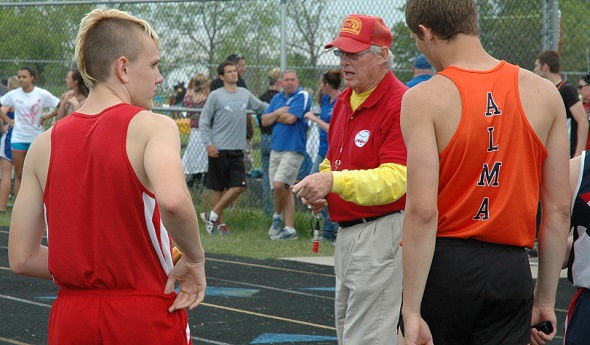
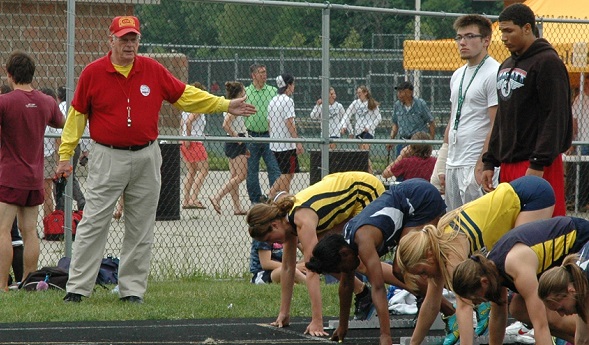
PHOTOS: (Top) Tom Truscott starts a race during last week's Lansing Area Honor Roll Track and Field Meet at Holt High School. (Middle) Truscott oganizes the 3,200 relay teams before their race. (Below) The 100-meter finalists await Truscott's start. (Photos by Geoff Kimmerly.)
Be the Referee: In or Out-of-Bounds in Wrestling
By
Sam Davis
MHSAA Director of Officials
February 7, 2023
Be The Referee is a series of short messages designed to help educate people on the rules of different sports, to help them better understand the art of officiating, and to recruit officials.
Below is this week's segment – In or Out-of-Bounds in Wrestling - Listen
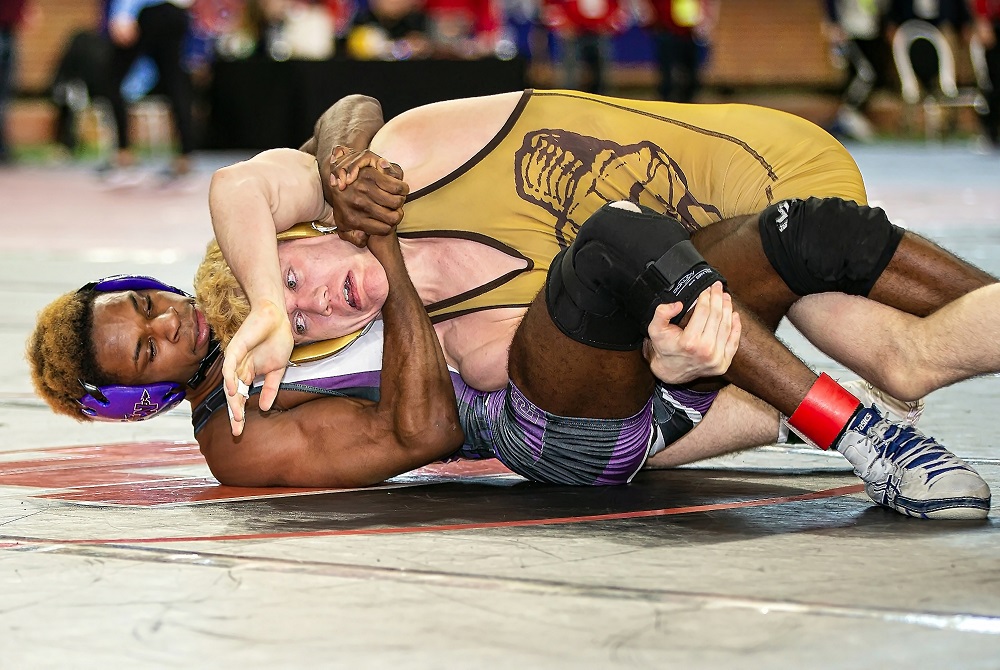
Two wrestlers are near the out-of-bounds line – the offensive wrestler is completely out of bounds, while holding the defensive wrestler on his back. Only the defensive wrestler’s shoulder is on the out-of-bounds line, and nothing else is touching in-bounds. What’s the call?
The official should continue to let them wrestle. Wrestlers are considered in bounds if a total of two supporting points of either wrestler are inside or on the boundary line. They are also in bounds if a shoulder of the defensive wrestler or hip of the offensive wrestler is inside or on the line – as both these situations count as two points of contact. With the shoulder, it’s also the scapula making contact – and with the hip, it’s also the thigh.
But if there are two contact points inside or on the line, wrestling can continue. And that includes the possibility of a pinfall.
Previous Editions:
Jan. 31: Over the Back - Listen
Jan. 24: Competitive Cheer Judges - Listen
Jan. 17: More Lines - Listen
Jan. 10: On the Line - Listen
Jan. 3: Basketball Measurements - Listen
Dec. 13: Pregame Dunks - Listen
Dec. 6: Gymnastics Judges - Listen
Nov. 22: Football Finals Replay - Listen
Nov. 15: Back Row Illegal Blocker - Listen
Nov. 8: Swim Turn Judges - Listen
Nov. 1: Soccer Referee Jersey Colors - Listen
Oct. 25: Cross Country Tie-Breaker - Listen
Oct. 18: Soccer Shootouts - Listen
Oct. 11: Safety in End Zone - Listen
Oct. 4: Football Overtime Penalty - Listen
Sept. 27: Kickoff Goal - Listen
Sept. 20: Soccer Timing - Listen
Sept. 13: Volleyball Replays - Listen
Sept. 6: Switching Sides - Listen
Aug. 30: Play Clock - Listen
Aug. 23: Intentional Grounding Change - Listen