

Always Aiming to Provide a 'Fair Start'
June 6, 2013
By Geoff Kimmerly
Second Half editor
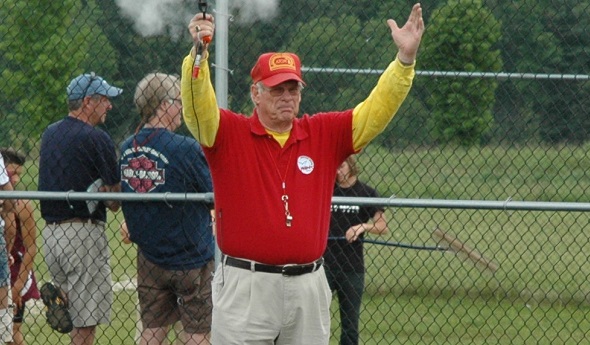
Tom Truscott was glad where he stood as he raised his hands to start the 100-meter boys Regional race at Lansing Sexton in 1987 that featured Corey Pryor of Jackson, Tico Duckett of Kalamazoo Loy Norrix and the host Big Reds’ Alan Haller.
They’d go on a few weeks later to finish first, third and fourth, respectively, in arguably the fastest MHSAA Finals race of all time. And on this afternoon, Truscott was glad he didn’t have to referee at the finish and figure out who crossed the line first.
To be honest, he’s never paid much attention to finishes during 42 years as an MHSAA track and field and cross country official who has launched a few generations of athletes in the classroom, on various playing fields and as one of the best-recognized race starters in the Lansing area.
His philosophy is simple – and surely has stretched across an educational career that began with his first MHSAA officials registration for the 1959-60 school year.
“I start,” Truscott said, “because I want to give the kids a fair start.”
Truscott has officiated for 42 years in addition to the nearly four decades he spent as a coach and athletic director. In keeping with that desire to give a “fair start,” Truscott quietly told organizers of the longtime Lansing Area Honor Roll Track and Field Meet that last Wednesday’s would be his 32nd and last as starter – not because he doesn’t love it still, but because it’s time to give younger officials the opportunity to run the prestigious show.
It’s a decision consistent with a career of creating opportunities – in track speak, starts – through sports.
“That’s typical Tom. He’s a gracious, humble man,” said retired longtime Grand Ledge and Fowler coach Kim Spalsbury, who now serves as director of the Honor Roll Meet. “That’s what Tom’s all about.”
Standing tall
There’s no way Truscott is 75 years old, one might conclude as he stands tall and instructs runners at the start of a race in a smooth baritone voice.
But he’s been involved as a high school athlete, coach, director or official for more than 60 years – and has officiating dates already stamped on his 2013-14 calendar.
 Truscott remains best known in school circles for his more than three decades as a coach and administrator at Potterville High School. A three-sport standout at Lansing Everett from 1953-56 and then two-sport athlete at Hillsdale College, Truscott joined Potterville schools in 1961. He went on to coach Vikings boys basketball teams to more than 300 wins and four District titles during 35 seasons, and he also led the football program for 24 seasons over two tenures – five of his teams won league championships, and he joined the Michigan High School Football Coaches Association Hall of Fame in 1986.
He also served as Potterville High School’s athletic director from 1963-96, even during a brief time when he also coached football as an assistant at Lansing Sexton. Potterville was one of few small schools in the mid-Michigan area with full track and field facilities, so Truscott hosted just about every significant event. He served as meet manager for 16 Regionals and also the 1977 and 1978 Lower Peninsula Class D Wrestling Finals.
Truscott also was a strong advocate as girls sports began to grow after Title IX. Among his best coaching hires was Sheryl Mox – who ended up leading both the girls basketball and volleyball teams to MHSAA championships and also became the athletic director.
“He’s a tall man in stature, and that’s a good way to list his long list of accomplishments,” said Spalsbury, who met Truscott in 1980 as their schools belonged to the same league, the Central Michigan Athletic Conference.
Truscott took an officiating course while at Hillsdale, and soon after debuted as an official for a few Thursday night football games. He was a third base umpire during the inaugural Capital Area Diamond Classic baseball tournament, which finished up its 52nd running this week. Cross country and track and field became his sports of choice for officiating because they best fit into his schedule as a coach and athletic director. He took a break from officiating for most of the 1970s, but has been a consistent presence again for the last three decades.
“You can stay associated with athletics by doing it. And you’re the person that’s going to influence the charisma of the game, how the game goes,” Truscott said, explaining how he'd sell the avocation to someone who might be considering it. “You don’t want to be noticed; you’re there to make a fair call and give kids a fair start.”
Seeing the big picture
That's another way Spalsbury described his longtime colleague.
Truscott continues to love the sports he played and coached. But running sports he officiates have earned a special place in his heart.
“You’re always going to the dugout or the locker room (with other sports). You never socialize with your competitors,” Truscott said. “With track and cross country, that’s the marvel of it; you talk to each other, know each other and then get into the blocks and try to beat each other. Then associate with each other again.”
 History is among Truscott’s favorite non-sports pastimes, although he certainly finds ways to tie the two; he emulated his Everett history teacher and coach Ted Bauer and so became a history teacher as well who often found a way to mix historical context into halftime speeches.
Truscott is an active member of the Michigan Historical Commission and has dedicated roughly 60 landmarks across the state. An officiating experience recently crept into one of those dedications – when placing a marker at Battle Creek’s Kellogg Community College last month, he likened the continuing education aspect of junior college to a Fulton-Middleton runner who despite trailing by laps continued until she had finished her race.
As word began to spread Wednesday that Truscott was retiring from the Honor Roll Meet, a few admirers made sure to pass on what he’d meant to them. Former Lansing Catholic standouts Zach Zingsheim and Jimmy Hicks – now running at Georgetown University and the University of Georgia, respectively – made sure to let Truscott know he was the best they’ve had start them, including those they’ve seen during their first seasons at the college level.
“They made a point to search him out and go and talk to him and tell him what they thought of him,” Lansing Catholic coach Tim Simpson said. “It is rare that kids would gain that much respect and like for an official.”
But Truscott has earned it by understanding how best to relate to high school athletes.
His son John Truscott, a former athlete at Sexton, remembered a situation concerning a championship-caliber competitor who was committing a minor violation that would've meant disqualification – but before taking that step, Tom Truscott gave the athlete a head's up instead. “He’s always looking out of kids,” John Truscott said.
Simpson recalled another occasion when one of his more “fiery” freshman girls threw a baton in the infield after a disappointing finish. Truscott called out “Ma’am” – which might’ve been a first for the stunned runner – and then explained why what she did was wrong. “Instead of just disqualifying her, he took the extra time. And that incident was never forgotten by that girl,” Simpson said. “It could have been a negative, and he turned it into a positive.
“He treats the kids with respect and in turn gets it back.”
Truscott started the Big Ten Cross Country Championships in 1991 at Michigan State University, and early in his career started meets at Olivet College and the University of Michigan.
But officiating at those levels never stacked up to the fun he’s had starting high school athletes.
John Truscott still hears from his dad after meets about the latest standout he saw or the one showing the potential to do great things. John knows better than most what the high school games mean to Tom – he often assisted his father during Saturday events – and why providing that "fair start" became a life's work.
“That really is his philosophy,” John Truscott said. “Over his career he coached great athletes, mediocre athletes and bad athletes. And he wanted them to all enjoy sports and learn from them, no matter what the future held for them.”
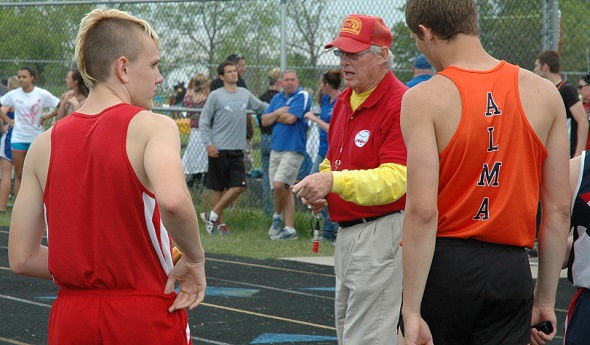
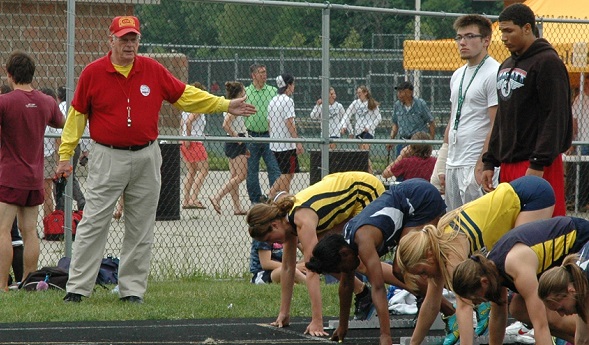
PHOTOS: (Top) Tom Truscott starts a race during last week's Lansing Area Honor Roll Track and Field Meet at Holt High School. (Middle) Truscott oganizes the 3,200 relay teams before their race. (Below) The 100-meter finalists await Truscott's start. (Photos by Geoff Kimmerly.)
Working Together to Give Teams Their Best, Dechow & Crew Win Every Time Out
By
Tom Spencer
Special for MHSAA.com
October 22, 2021
Football historians can debate this forever.
 Tonight at Rodes Field in Kingsley – perhaps for the first time in Michigan High School Athletic Association history – three teams with perfect records will meet each other on the same football field in the same game.
Two of them, Traverse City St. Francis, and Kingsley, are playing for the right to boast of an undefeated regular season and an outright conference championship. The third team and its captain — better known as the referee crew — has already been assigned a first-round playoff game by the MHSAA.
Where they will go hasn’t been determined, but Joe Dechow’s crew knows it will referee at least two rounds this postseason. The veteran crew already has assignments from MHSAA but just like the schools, the crew is waiting for the postseason pairings to be announced Sunday.
Dechow, the crew leader and an MHSAA 41-year veteran official, will put on his white cap and be ready for the 7 p.m. kickoff tonight knowing Kingsley/St. Francis is a big, big game. Dechow’s crew members will go into kickoff confident they know at least one team that will win, just like every game they’ve done together for about the last 20 years are so.
“We always win,” Dechow jested.
But how officials define their victories is different, Dechow explained.
Taking the field with Dechow tonight will be umpire Joe Johnson, back judge Roark Pargeon, line judge Brett Spalding, head linesman Jeff Bretzke, side judge Peter Moss, and field judge Rick Zych. All seven officials worked together in the Betsie Valley Officials Association for many years and have continued together as a crew with the Northern Sport Officials Association after the two combined a few years ago.
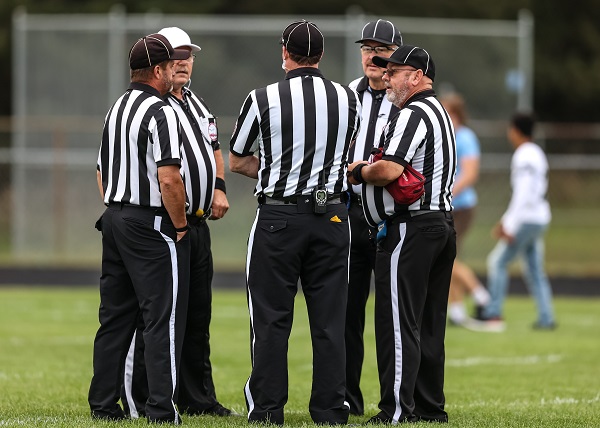 “We don’t win or lose, but we’re a still a team,” he said. “One of the great things about working with the same guys for years and years is you know where people are going to be, and you know how they’re going to take care of things.
“It is a trust factor, ‘cuz it’s a team.”
Dechow’s team has taken the field every week for decades for the benefit of student-athletes. Moss has been an MHSAA registered official for 44 years. Spalding and Zych have been registered 36 years. Bretzke, Johnson and Paragon follow with 22, 20 and 16 years of MHSAA service, respectively. All officiate at least two sports.
Dechow was on the wrestling and football teams at Maple City Glen Lake High School. Upon graduating, he started officiating wrestling — at the age of just 18.
“That got interesting, you know, because you go from a player to a ref all at once and all these old coaches are looking at you like ‘Who are you, kid?’” Dechow recalled.
Dechow has been officiating football for 36 years and was a registered wrestling official for 15. There have been a few times he’s considered giving up the white cap that signals he’s the game’s referee. (The white cap originated to benefit television viewers for college and the National Football League.)
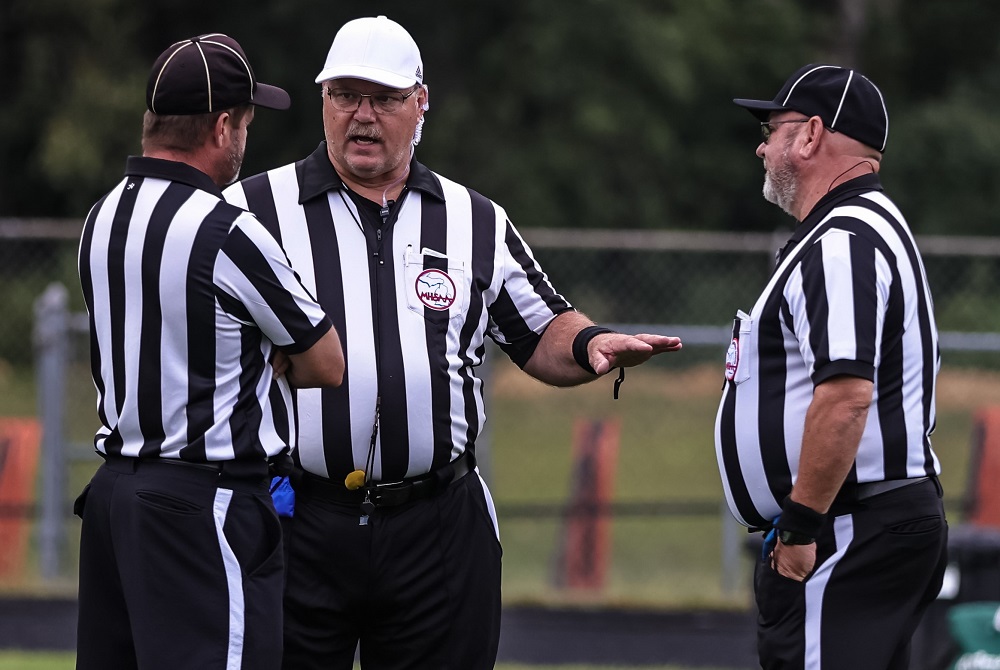
The referee has general oversight and control of the game. Dechow is the final authority for the score, the number of a down in case of a disagreement, and all rule interpretations when a debate arises among the other officials. He’s also the only official who wears a white hat; all the other officials wear black hats.
The “white hat” also announces all penalties and confers with the offending team’s captain, monitors the quarterback area during the game, requests the linesmen to bring the yardage chains in for first down measurements and notifies the head coach of player ejections.
Dechow was ready to put his white hat down for a while when he first attempted to give up refereeing due to family and career demands. He was planning to get out and was asked to help another crew for a “few” games.
“I was going to just do a couple of games, and then somebody else quit and I wound up getting back into it,” he said. “There was another white hat that had left just before the season started … so all of sudden I started hearing ‘Do you still have a white hat? Would you like to maybe …’
“So I did.”
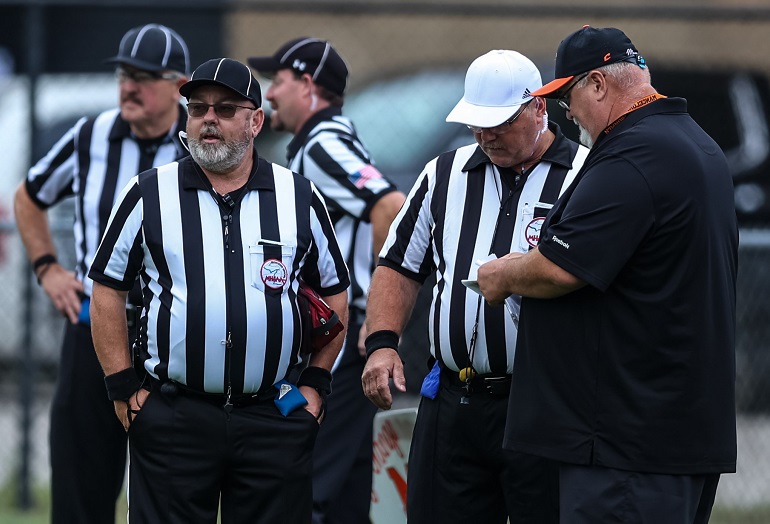 Dechow’s crew has seen a lot of changes in MHSAA football during their careers. Rules to improve safety have been their favorites. They have also seen the addition of 8-player football and the use of two-way radios.
But it’s positive changes in sportsmanlike conduct among players, coaches and fans Dechow excitedly singles out.
Everyone, Dechow notes, is noticing the lower number of recruits joining the current officials in all MHSAA sports.
“More people appreciate the fact that we have to be out there, and we’re not out there to get anybody,” he said. “By and large the coaches are great.
“Of course they are emotional and of course they are pulling for their team and they’re going to argue for the right outcome for them,” he continued. “Over the last several years we have seen an absolutely marked change in people – spectators, players and coaches — all providing a lot more respect the officials.”
The crew had tonight’s game on its schedule at the beginning of the season. The guys couldn’t help looking ahead to how big a game it could be.
St. Francis coach Josh Sellers and Kingsley coach Tim Wooer probably had a better idea of how big a game it could be when they — and football enthusiasts all over Northern Michigan — likely circled it on the calendar. Kingsley won last year’s match 36-23 at Thirlby Field, the Gladiators’ home turf.
This year the Stags host with the Northern Michigan Football Conference’s Legends division championship on the line.
“Sports mean a lot to kids,” Dechow pointed out. “They meant a lot to us.
“That’s why we’re out there.”
 Tom Spencer is a longtime MHSAA-registered basketball and soccer official, and former softball and baseball official, and he also has coached in the northern Lower Peninsula area. He previously has written for the Saginaw News, Bay County Sports Page and Midland Daily News. He can be reached at [email protected] with story ideas for Manistee, Wexford, Missaukee, Roscommon, Ogemaw, Iosco, Alcona, Oscoda, Crawford, Kalkaska, Grand Traverse, Benzie, Leelanau, Antrim, Otsego, Montmorency, Alpena, Presque Isle, Cheboygan, Charlevoix and Emmet counties.
PHOTOS (Top) “White hat” Joe Dechow talks things over with crew members Roark Pargeon (left) and Brett Spalding during this season’s Mancelona/LeRoy Pine River varsity football game. (Middle) Those three plus Jeff Bretzke (middle) and Joe Johnson (second from right) huddle up. (Below) Dechow and Johnson confer with Mancelona coach Dan Derrer. (Photos by Miles Postema.)