

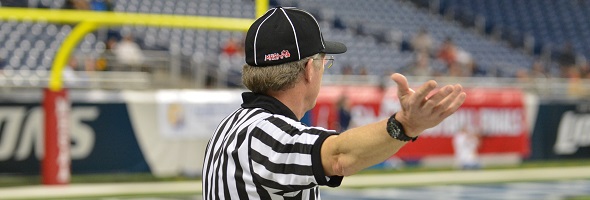
Be the Referee: 40-Second Play Clock
August 30, 2018
In this week's edition, assistant director Brent Rice explains how Michigan is continuing to experiment with a 40-second play clock in football.
Be The Referee is a series of short messages designed to help educate people on the rules of different sports, to help them better understand the art of officiating, and to recruit officials.
Below is this week's segment – 40-Second Play Clock - Listen
There’s an experiment taking place on a number of high school football fields across the state again this year. Michigan is experimenting with a 40-second play clock in football.
This is designed to provide more consistency from play to play as the ball must be snapped 40 seconds after the end of the previous play and is not dependent on the referee’s subjective signal.
When play is continuing without a stoppage, the 40-second play clock will be used. If play has been stopped for a time out or penalty, the play clock will be set at 25 seconds.
After two seasons, the feedback received from coaches and officials has been very positive, and there’s a possibility the Michigan experiment may become a new national playing rule soon.
Past editions
August 23: Football Rules Changes - Listen
Former Official in League of Her Own
September 26, 2018
By Geoff Kimmerly
Second Half editor
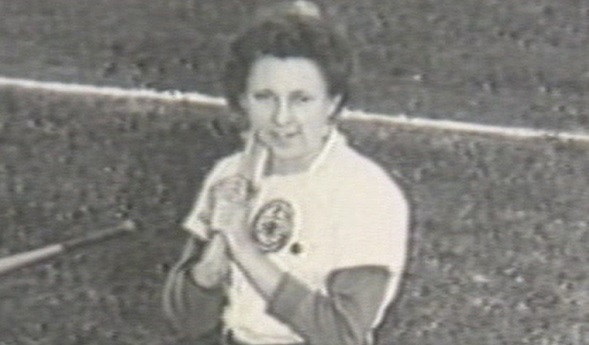
Retired MHSAA official Dolly Konwinski – previously a player in the All-American Girls Professional Baseball League who consulted on the 1992 film “A League of Their Own” – died Saturday at the age of 87.
Konwinski umpired both baseball and softball as an MHSAA registered official for more than a dozen years into the 1990s. She brought to the diamond playing experience from the AAGPBL; she played for four teams between 1948-52, including most of three seasons with the Grand Rapids Chicks.
The AAGPBL has been honored by the National Baseball Hall of Fame in Cooperstown, N.Y., and Konwinski consulted on and made a brief appearance in “A League of Their Own,” which was nominated for Grammy and Golden Globe awards.
She most recently lived in Caledonia and is survived by her husband of 63 years Robert and four children, plus many grandchildren and extended family.
Click for recent Grand Rapids Press coverage of her death. A Mass of Christian Burial will be held at 11 a.m. Thursday at St. Mary Magdalen Catholic Church in Kentwood. Click for her obituary.
The feature below, reported by Rick Berkey, aired as part of the coverage of the 1990 MHSAA Girls Basketball Finals on PASS Sports.