


Be the Referee: 40-Second Play Clock
August 30, 2018
In this week's edition, assistant director Brent Rice explains how Michigan is continuing to experiment with a 40-second play clock in football.
Be The Referee is a series of short messages designed to help educate people on the rules of different sports, to help them better understand the art of officiating, and to recruit officials.
Below is this week's segment – 40-Second Play Clock - Listen
There’s an experiment taking place on a number of high school football fields across the state again this year. Michigan is experimenting with a 40-second play clock in football.
This is designed to provide more consistency from play to play as the ball must be snapped 40 seconds after the end of the previous play and is not dependent on the referee’s subjective signal.
When play is continuing without a stoppage, the 40-second play clock will be used. If play has been stopped for a time out or penalty, the play clock will be set at 25 seconds.
After two seasons, the feedback received from coaches and officials has been very positive, and there’s a possibility the Michigan experiment may become a new national playing rule soon.
Past editions
August 23: Football Rules Changes - Listen
Be the Referee: Minimum Number of Volleyball Players
By
Paige Winne
MHSAA Director of Brand Management
September 29, 2026
Be The Referee is a series of short messages designed to help educate people on the rules of different sports, to help them better understand the art of officiating, and to recruit officials.
Below is this week's segment – Minimum Number of Volleyball Players - Listen
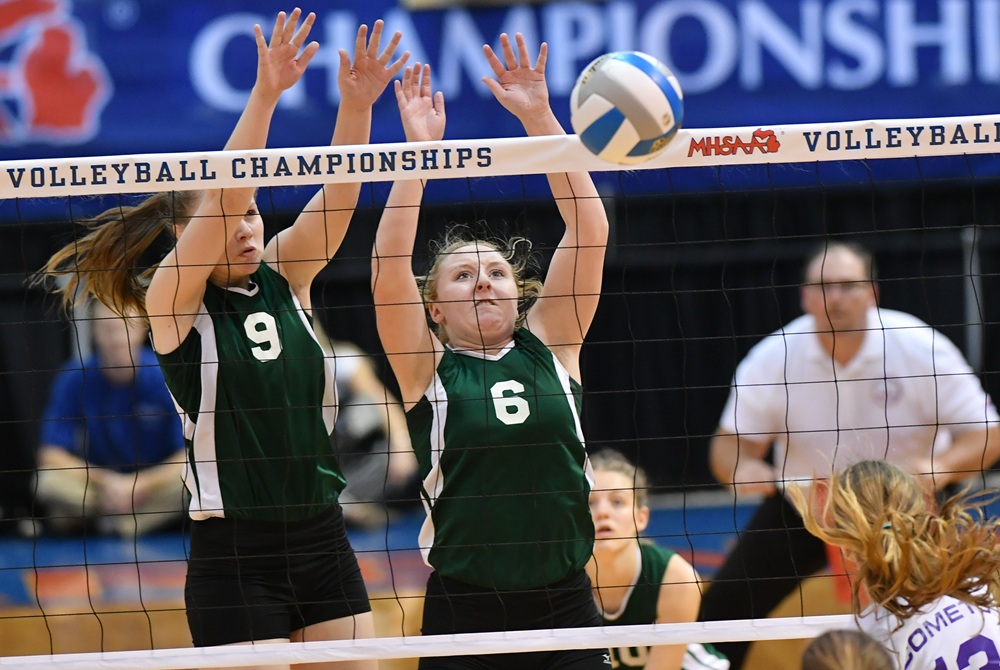
We’re on the volleyball court today, where the home team starts the match with only six players.
Midway through the first set, one of those six players suffers an ankle injury and can’t continue – leaving the home team with just five players.
What should happen?
Is the home team forced to default the match for not having enough players?
Does the home team just continue playing with five?
Or do they continue playing with five, but with the loss of rally or point every time the player lost to injury’s position rotates to serve?
If you said they can continue playing but lose a rally or point every time the injured player’s position rotates to serve, you are correct!
A minimum of six is needed to start – but you can finish a match with fewer than that.
Previous 2026-27 editions
Sept 22: Soccer Changes - Listen
Sept: 15: Dead Ball Penalty - Listen
Sept. 8: Libero Ejected - Listen
Sept. 1: Soccer Foul After Shot on Goal - Listen
Aug. 25: Fumble Out of Bounds - Listen