

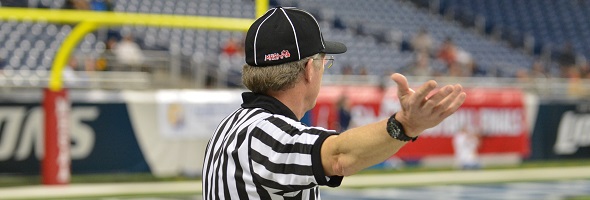
Be the Referee: Always 1st-and-Goal
October 3, 2018
This week, MHSAA assistant director Brent Rice explains how every series of high school football overtime in Michigan begins with 1st-and-Goal.
Be The Referee is a series of short messages designed to help educate people on the rules of different sports, to help them better understand the art of officiating, and to recruit officials.
Below is this week's segment – Always 1st-and-Goal - Listen
In Michigan, football overtime for each team starts with 1st-and-goal at the 10-yard line. Other states which allow overtime to begin anywhere from the 10 to the 25-yard line, and in some of those states, you could actually pick up a first down while on offense.
But Michigan is always 1st-and-goal. Even in those situations where a dead ball foul from the end of the first team’s possession in an overtime may start the second team’s series at the 25 – it is still 1st-and-goal.
The only way a team on offense can pick up a first down in overtime is on a penalty providing yardage plus an automatic first down, and those are only the roughing calls – roughing the passer, the kicker, the holder and the long snapper.
Past editions
September 27: Unique Kickoff Option - Listen
September 20: Uncatchable Pass - Listen
September 13: Soccer Rules Change - Listen
September 6: You Make the Call: Face Guarding - Listen
August 30: 40-Second Play Clock - Listen
August 23: Football Rules Changes - Listen
Soccer Hall of Famer Seitz, NFL Analyst Pereira Headline Officiate Michigan Day 2026
By
Geoff Kimmerly
MHSAA.com senior editor
July 14, 2026
Officiate Michigan Day 2026 will welcome more than 1,000 Michigan High School Athletic Association-registered game officials July 25 to DeVos Place in Grand Rapids, where they will receive knowledge and instruction from several high-profile voices headlined by recent National Soccer Hall of Fame inductee Kari Seitz – a Brighton High School graduate – and one of television’s most recognizable rules analysts, Mike Pereira.
Officiate Michigan Day is designed to benefit officials with any level of experience, veteran to beginner. High-profile clinicians representing several sports and all levels including the NFL, NBA, MLB, NCAA, FIFA and the National Women’s Soccer League (NWSL) will provide face-to-face training during four sport-specific breakout sessions throughout the conference.
Pereira, a past collegiate and NFL football official who also has served as the NFL’s vice president of officiating, will present the opening address at 9 a.m. He has provided his knowledge during FOX Sports football broadcasts since 2010, explaining rules scenarios on-air as situations unfold in-game.
Seitz, also a graduate of Michigan State University, refereed Women’s World Cups in 1999, 2003, 2007 and 2011 and Olympics tournaments in 2004, 2008 and 2012, and will deliver the conference’s closing message. She’s currently the vice president of refereeing for U.S. Soccer and formerly served as FIFA’s heading of refereeing.
This will be the third Officiate Michigan Day, joining events in 2013 and 2018. OMD 2026 will accompany the annual National Association of Sports Officials (NASO) Summit that will take place July 26-28, also at DeVos Place.
Officials may continue to register on the Officials page. Cost is $50. Additional details, including the full lineup of speakers and clinicians, also is available at that link.