

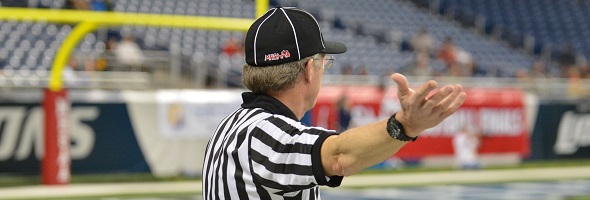
Be the Referee: Automatic 1st Downs
October 16, 2014
This week, MHSAA assistant director Mark Uyl explains the differences between high school and college and pro football when it comes to awarding automatic first downs.
"Be the Referee" is designed to help educate people on the rules of different sports, to help them better understand the art of officiating and to recruit officials. The segment can be heard on Mondays, Wednesdays and Fridays during the school year on The Drive With Jack Ebling on WVFN-AM, East Lansing.
Below is this week's segment - Automatic First Downs - Listen
Today we are going to talk about one of the biggest rule difference areas in high school football from those rules used in college and pro games and that deals with automatic first downs.
When watching that college game on Saturday or the pro game on Sunday, all of us know there are several defensive fouls that give the offense an automatic first down. However, under high school rules, the opposite is true most of the time.
The only high school fouls that result in an automatic first down for the offense are the roughing fouls - roughing the passer, the kicker, the holder and the long snapper. Fouls such as defensive pass interference or any other personal foul do not bring an automatic first down under high school rules.
Past editions
Oct. 8 - Officials & Injuries - Listen
Oct. 1 - Overtime - Listen
Sept. 25 - Field Goals - Listen
Sept. 18 - Tackle Box - Listen
Sept. 11 - Pass Interference - Listen
Aug. 25 - Targeting - Listen
What's My Why: Official Tim Erickson
October 1, 2026
Tim Erickson, Rockford
Erickson first registered as an MHSAA official during the 1978-79 school year and then again in 1981-82, which began a string that has now reached 46 straight years this fall.
Erickson has officiated wrestling from his start and is currently also registered for football – both 11 and 8-player – after previously officiating basketball, baseball and softball as well.
He also was a mainstay in athletic administration, retiring at the end of the 2018-19 school year after 36 in Rockford schools including his final 12 as athletic director. He received an Allen W. Bush Award from the MHSAA in 2017 for his vast behind-the-scenes contributions to educational athletics.
As a high school athlete, I enjoyed participating in three sports. I wanted to continue to enjoy that experience, so when I was in college, I registered to officiate wrestling.
This begins my 46th year as an MHSAA-registered official, primarily in wrestling but I also officiate six other sports.
I officiate to give back to something I love, and I want to stay connected to educational athletics. I also enjoy the brotherhood of working with some amazing officials across the state of Michigan.
“What’s My Why” is a weekly feature telling the stories of MHSAA-registered officials in their own words. If you’re an MHSAA official and would like to share your reason why, please submit a 15 to 45-second video, taken horizontally, to director of officials Sam Davis at [email protected].
What's My Why
Sept. 23: Patricia Treman, Grand Rapids - Watch
Sept. 16: Tony Bertuca, Coloma - Watch
Sept 9: Jenna Schroeder, Berkley - Watch
Sept. 2: Joey Crawford, Newton Square, Pa. - Watch
Aug. 26: Ron Torbert, Hanover, Md. - Watch
Aug. 19: Kari Seitz, Mill Valley, Calif. - Watch
Aug. 13: Mike Pereira, Sacramento, Calif. - Watch
Aug. 5: Dino Paganelli, Wyoming - Watch
Aug. 3: Stacy Smith, Caledonia - Watch
July 22: Jason Nickleby, Lake Elmo, Minn. - Watch
July 15: Sam Davis, Lansing - Watch
July 9: Candace Cox, Quincy - Watch
July 1: Robert Williams, Redford - Watch
June 24: Will Godfrey, Jackson - Watch
June 19: Jarrett Skorup, Midland - Watch
June 12: Brady Driver, Sturgis - Watch
June 8: Cindy Tyzo, West Bloomfield - Watch
June 3: Jeff Spedoske, DeWitt - Watch
June 1: Mike Carrier, Commerce Township - Watch
May 27: Stan Wright, Warren - Watch
May 26: Murray Rose, Zeeland - Watch
May 22: Mike VanLaan, Alto - Watch
May 18: Clint Abbott, Newaygo - Watch