

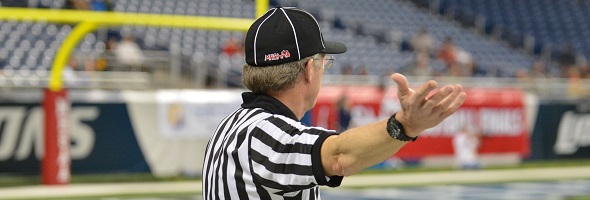
Be the Referee: Automatic 1st Downs
October 16, 2014
This week, MHSAA assistant director Mark Uyl explains the differences between high school and college and pro football when it comes to awarding automatic first downs.
"Be the Referee" is designed to help educate people on the rules of different sports, to help them better understand the art of officiating and to recruit officials. The segment can be heard on Mondays, Wednesdays and Fridays during the school year on The Drive With Jack Ebling on WVFN-AM, East Lansing.
Below is this week's segment - Automatic First Downs - Listen
Today we are going to talk about one of the biggest rule difference areas in high school football from those rules used in college and pro games and that deals with automatic first downs.
When watching that college game on Saturday or the pro game on Sunday, all of us know there are several defensive fouls that give the offense an automatic first down. However, under high school rules, the opposite is true most of the time.
The only high school fouls that result in an automatic first down for the offense are the roughing fouls - roughing the passer, the kicker, the holder and the long snapper. Fouls such as defensive pass interference or any other personal foul do not bring an automatic first down under high school rules.
Past editions
Oct. 8 - Officials & Injuries - Listen
Oct. 1 - Overtime - Listen
Sept. 25 - Field Goals - Listen
Sept. 18 - Tackle Box - Listen
Sept. 11 - Pass Interference - Listen
Aug. 25 - Targeting - Listen
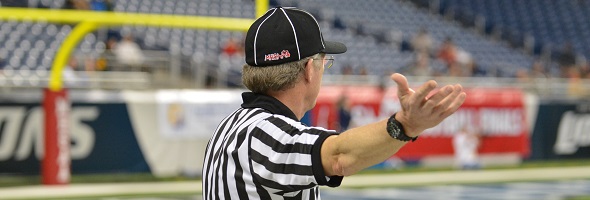
Be the Referee: Registration - Part 2
December 18, 2014
This week, MHSAA assistant director Mark Uyl continues last week's explanation of the steps to becoming an MHSAA registered official.
"Be the Referee" is designed to help educate people on the rules of different sports, to help them better understand the art of officiating and to recruit officials. The segment can be heard on Mondays, Wednesdays and Fridays during the school year on The Drive With Jack Ebling on WVFN-AM, East Lansing.
Below is this week's segment - Registration Part 2 - Listen
Today we are going to build on last week’s segment which dealt with how a person becomes an MHSAA Registered Official.
Once a person completes the first step in the process – passing the basic Officiating Exam through the MHSAA Office, the next step is to get that person connected with a local officials association that specializes in that sport across our state.
These local associations are the ones that do the training – whether it’s on the court, on the field or video training – to get, for example, that person interested in basketball completely immersed in the rules, mechanics and coverages of what it takes to become a good basketball official.
Past editions
Dec. 10 - Registration Part 1 - Listen
Dec. 3 - Legacy Program - Listen
Nov. 26 - Sideline Management - Listen
Nov. 19 - 7-Person Mechanics - Listen
Nov. 12 - Blocking Below the Waist - Listen
Nov. 5 - Tournament Selection - Listen
Oct. 29 - Uncatchable Pass - Listen
Oct. 22 - Preparation for Officials - Listen
Oct. 15 - Automatic First Downs - Listen
Oct. 8 - Officials & Injuries - Listen
Oct. 1 - Overtime - Listen
Sept. 25 - Field Goals - Listen
Sept. 18 - Tackle Box - Listen
Sept. 11 - Pass Interference - Listen
Aug. 25 - Targeting - Listen