


Be the Referee: Block/Charge Call
March 26, 2015
This week, MHSAA assistant director Mark Uyl dispels the myth of what constitutes the difference between a block and charge.
Be The Referee is a series of short messages designed to help educate people on the rules of different sports, to help them better understand the art of officiating, and to recruit officials.
Below is this week's segment - Block/Charge Call - Listen
Today we’re going to talk about one of the great myths in all of basketball rules, that a defensive player must be completely stationary to take a charging foul against an offensive player either on the drive or on the dribble.
The reality is that a defender only has to obtain what is called a legal guarding position. A legal guarding position is when the defender is facing the offensive player and has essentially beaten him or her to that spot on the floor.
Once the defender is in this legal guarding position, the defender can be moving, and can even have one or both feet off the floor at the time that contact occurs.
Past editions
March 9 - Dive on the Floor - Listen
March 2 - Primary Areas - Listen
Feb. 23 - Too Much TV - Listen
Feb. 16 - Video Clip Library - Listen
Feb. 9 - Cheer Safety - Listen
Feb. 2 - Basketball PA Announcers - Listen
Jan. 26 - Wrestling Health Concerns - Listen
Jan. 19 - Basketball Physical Contact - Listen
Jan. 12 - Video Review Part 2 - Listen
Dec. 29 - Video Review Part 1 - Listen
Dec. 17 - Registration Part 2 - Listen
Dec. 10 - Registration Part 1 - Listen
Dec. 3 - Legacy Program - Listen
Nov. 26 - Sideline Management - Listen
Nov. 19 - 7-Person Mechanics - Listen
Nov. 12 - Blocking Below the Waist - Listen
Nov. 5 - Tournament Selection - Listen
Oct. 29 - Uncatchable Pass - Listen
Oct. 22 - Preparation for Officials - Listen
Oct. 15 - Automatic First Downs - Listen
Oct. 8 - Officials & Injuries - Listen
Oct. 1 - Overtime - Listen
Sept. 25 - Field Goals - Listen
Sept. 18 - Tackle Box - Listen
Sept. 11 - Pass Interference - Listen
Aug. 25 - Targeting - Listen
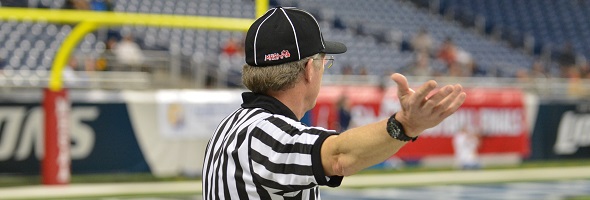
Be The Referee: Catch Momentum
October 17, 2019
This week, MHSAA assistant director Brent Rice offers a "You Make the Call" regarding catch momentum after an interception near the goal line.
Be The Referee is a series of short messages designed to help educate people on the rules of different sports, to help them better understand the art of officiating, and to recruit officials.
Below is this week's segment - Catch Momentum - Listen
Here’s another edition of a football You Make The Call. On a passing play, a defender intercepts the ball at the 2-yard line, and the momentum of the catch carries him across the goal line.
The defender is allowed to come out of the end zone on this play. But while breaking free from the grasp of an opponent, the ball is fumbled out of the back of the end zone. What’s the call?
Since it was the momentum of catch that carried the defender into the end zone to begin with and the ball remained in the end zone and was declared dead there, a rules exception places the ball 1st-and-10 at the 2-yard line.
Past editions
Oct. 10: Golf Rules Changes - Listen
Oct. 3: No Tackle Box - Listen
Sept. 26: You Make the Overtime Call - Listen
Sept. 19: Swimming Finishing Touch - Listen
Sept. 12: Curbing Gamesmanship By Substitution - Listen
Sept. 5: Football Safety Rules Changes - Listen
Aug. 29: 40-Second Play Clock - Listen