

Be the Referee: Correcting a Down
September 10, 2015
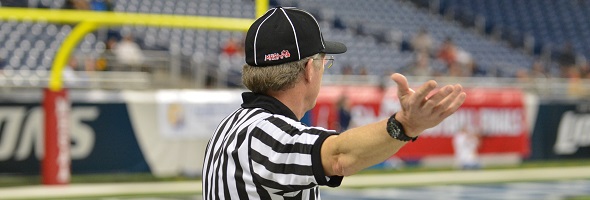
This week, MHSAA assistant director Mark Uyl discusses how officials at the high school level have the authority to correct an error in what down is being played.
Be The Referee is a series of short messages designed to help educate people on the rules of different sports, to help them better understand the art of officiating, and to recruit officials.
Below is this week's segment - Correcting a Down - Listen
For anyone who has followed football for a long time, perhaps the most famous “5th down” game was back in 1990 between Colorado and Missouri.
In that game, the officials mistakenly gave Colorado an extra down while trailing by four points. On the “fifth down” play, Colorado scored a touchdown on the final play of the game to win 33-31.
Under high school rules, the officiating crew has the ability to correct an error of the wrong down as long as it is done before the next snap. For example, if the crew realizes a team has been given an extra down, that play would be nullified and the ball would correctly go over to the other team.
Past editions:
Sept 3: Spearing - Listen
Aug. 27: Missed Field Goal - Listen

Be the Referee: Held Ball or Traveling?
February 13, 2020
This week, MHSAA officials coordinator Sam Davis offers a basketball "You Make the Call" that comes into play when defensive and offensive players wind up in a stalemate.
Be The Referee is a series of short messages designed to help educate people on the rules of different sports, to help them better understand the art of officiating, and to recruit officials.
Below is this week's segment - Held Ball or Traveling - Listen
Let’s try a basketball “You Make the Call” play today. The offensive player jumps in an effort to either take a shot or make a pass. The defensive player reaches out and is able to place his or her hands on the ball to keep the offensive player from releasing it, and the offensive player returns to the floor with the ball.
You Make the Call? There was no contact, so there is no foul. Is it a traveling violation, or is it a held ball with the ball going to the team with the possession arrow in its favor?
Some old-timers out there might remember that up until about 1990, a traveling violation would have been called on this play. But the rules now call for a held ball in the situation with the possession arrow, which had just been introduced five years earlier in 1985, prevailing.
Past editions
Feb. 6: Hockey Rules Chart - Listen
Jan. 30: Cheer Safety - Listen
Jan. 23: Goaltending - Listen
Jan. 16: Wrestling Tie-Breaker - Listen
Jan. 9: Pregame Meeting - Listen
Dec. 19: Alternating Possession - Listen
Dec. 12: Ratings - Listen
Dec. 5: Video Review Success - Listen
Nov. 28: More Injury Time - Listen
Nov. 21: Football Review - Listen
Nov. 14: Sideline Safety - Listen
Nov. 7: Officials Playlist - Listen
Oct. 31: Most Important Line - Listen
Oct. 24: Automatic 1st Downs - Listen
Oct. 17: Catch Momentum - Listen
Oct. 10: Golf Rules Changes - Listen
Oct. 3: No Tackle Box - Listen
Sept. 26: You Make the Overtime Call - Listen
Sept. 19: Swimming Finishing Touch - Listen
Sept. 12: Curbing Gamesmanship By Substitution - Listen
Sept. 5: Football Safety Rules Changes - Listen
Aug. 29: 40-Second Play Clock - Listen