

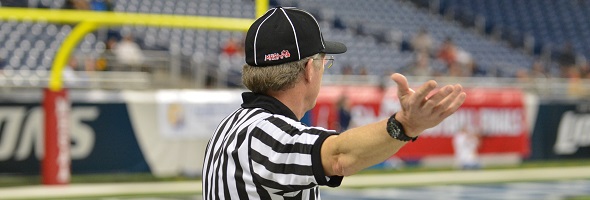
Be the Referee: Correcting a Down
September 10, 2015
This week, MHSAA assistant director Mark Uyl discusses how officials at the high school level have the authority to correct an error in what down is being played.
Be The Referee is a series of short messages designed to help educate people on the rules of different sports, to help them better understand the art of officiating, and to recruit officials.
Below is this week's segment - Correcting a Down - Listen
For anyone who has followed football for a long time, perhaps the most famous “5th down” game was back in 1990 between Colorado and Missouri.
In that game, the officials mistakenly gave Colorado an extra down while trailing by four points. On the “fifth down” play, Colorado scored a touchdown on the final play of the game to win 33-31.
Under high school rules, the officiating crew has the ability to correct an error of the wrong down as long as it is done before the next snap. For example, if the crew realizes a team has been given an extra down, that play would be nullified and the ball would correctly go over to the other team.
Past editions:
Sept 3: Spearing - Listen
Aug. 27: Missed Field Goal - Listen

Be the Referee: Dog Days of February
February 15, 2018
In this week's edition, assistant director Mark Uyl talks about some of the challenges that arise during a pivotal point every basketball season.
Be The Referee is a series of short messages designed to help educate people on the rules of different sports, to help them better understand the art of officiating, and to recruit officials.
Below is this week's segment – Dog Days of February - Listen
Every summer, we hear broadcasters talk about the “Dog Days” of the major league baseball season during the month of August and into September, when everybody hits the proverbial wall.
During the month of February, we have also arrived at the Dog Days of the high school basketball season. All of the work that’s gone in in the previous three months is beginning to add up, for both coaches and officials alike. For coaches, it’s managing the pressures and expectations within each of their teams; and for officials, all of those miles up and down the floor are beginning to add up.
It’s this time of year where both groups need to refocus and re-energize themselves to give students the best possible experience during the month of March.
Past editions
February 8: National Playing Rules Process - Listen
February 1: Calling Intentional Fouls - Listen
January 25: Points at the Edge of the Mat - Listen
January 18: Behavior Warning - Listen
January 11: Ice Hockey Safe & Sound - Listen
January 4: Why No Shot Clock - Listen
December 21: Coaches Responsible for Equipment - Listen
December 14: Mentoring New Officials - Listen
December 7: Dive on the Floor - Listen
November 30: Wrestling Weight Monitoring - Listen
November 23: Ejections - Listen
November 16: Toughest Call - Listen
November 9: Hurdling - Listen
November 2: The Survey Says - Listen
October 26: Helmet Comes Off - Listen
October 19: Goal Line Rules - Listen
October 12: No 1st-Year Fee - Listen
October 5: Athletic Empty Nesters - Listen
September 28: Misunderstood Football Rules: Kicking - Listen
September 21: Preparation for Officials - Listen
September 14: Always Stay Registered - Listen
September 7: Other Football Rules Changes - Listen
August 31: Pop-Up Onside Kicks - Listen
August 24: Blindside Blocks - Listen