

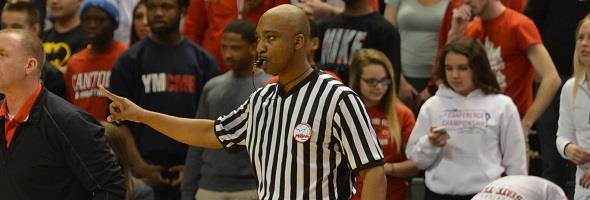
Be the Referee: Dive on the Floor
January 28, 2016
This week, MHSAA assistant director Mark Uyl explains the rule misunderstandings that occur when a basketball player dives on the floor for a loose ball.
Be The Referee is a series of short messages designed to help educate people on the rules of different sports, to help them better understand the art of officiating, and to recruit officials.
Below is this week's segment - Dive on the Floor - Listen
In just about every single basketball game that’s played during the season, a player will hustle and dive for a loose ball that’s on the floor. As that player dives and tries to gain possession of the ball on the floor, yells from every corner of the gym come, screaming for a call of traveling. This is one of the more misunderstood situations under basketball rules.
Once that player dives for the loose ball on the floor and gains possession, there are two ways in which they’re guilty of a traveling violation: The first is if the player takes the ball and attempts to stand up; or the second, the player rolls over from their back to the front or front to back. Other than that, that’s a legal play, and the ball remains in play.
Past editions:
Jan. 21: Hockey Officials' Options - Listen
Jan. 14: Recruiting Officials - Listen
Jan. 7: Wrestling Weight Monitoring - Listen
Dec. 31: Respect for Referees - Listen
Dec. 24: Basketball Instant Replay - Listen
Dec. 17: Basketball Communication - Listen
Dec. 10: Basketball Excessive Contact - Listen
Nov. 26: Pregame Communication - Listen
Nov. 19: Trick Plays - Listen
Nov. 12: 7-Person Football Mechanics - Listen
Nov. 5: Make the Call: Personal Fouls - Listen
Oct. 29: Officials Demographics - Listen
Oct. 15: Make the Call: Intentional Grounding - Listen
Oct. 8: Playoff Selection - Listen
Oct. 1: Kick Returns - Listen
Sept. 24: Concussions - Listen
Sept. 17: Automatic First Downs - Listen
Sept. 10: Correcting a Down - Listen
Sept 3: Spearing - Listen
Aug. 27: Missed Field Goal - Listen
2020-21 Officials Registration Underway
June 8, 2020
By Geoff Kimmerly
Second Half editor
The Michigan High School Athletic Association is accepting registrations online or by mail for game officials for the 2020-21 school year.
The MHSAA annually receives registration by more than 9,000 officials, and had 9,256 during the 2019-20 school year. The highest total of officials registered for basketball, 3,960, with football also with more than 2,000 registered officials during this past school year.
For all new and returning officials, those who register online again will receive a $5 discount off their processing fees. A $16 fee is charged for each sport in which an official wishes to register, and the online processing fee is $40. Officials submitting registration forms by mail or on a walk-up basis will incur a $45 processing fee. Officials registered in 2019-20 will be assessed a late fee of $30 for registration after Aug. 14. The processing fee includes liability insurance coverage up to $1 million for officials while working contests involving MHSAA schools.
Online registration can be accessed on the MHSAA Website. Forms also are available online that can be printed and submitted by traditional mail to the MHSAA Office at 1661 Ramblewood Drive in East Lansing. More information about officials registration may be obtained by contacting the MHSAA by phone at (517) 332-5046 or by e-mail at [email protected].
There is an officials' registration test for first-time officials and officials who were not registered during the past school year. The test is derived from the MHSAA Officials Guidebook, which also is available on the Officials page of the MHSAA Website. Additional exams must be taken by those registering for football or basketball for the first time or those who were not registered for those sports during the previous school year. Manuals for both sports are available on the Officials page. New officials and those who didn’t officiate during 2019-20 also must complete the online MHSAA Principles of Officiating course, also available on the MHSAA Website.
There also are opportunities to officiate for students at least 14 years old and in grades 9-12 through the MHSAA Legacy Program. Juniors and seniors may officiate subvarsty contests, while freshmen and sophomores may officiate contests at the middle school/junior high levels. Mentor officials will work events with Legacy participants to provide guidance and support. Find information on the Legacy Program by clicking here.