

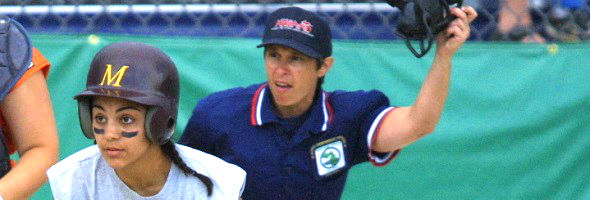
Be the Referee: Fair or Foul Ball?
May 14, 2015
This week, MHSAA assistant director Mark Uyl explains how baselines come into play when deciding if a batted ball is fair or foul in baseball and softball.
Be The Referee is a series of short messages designed to help educate people on the rules of different sports, to help them better understand the art of officiating, and to recruit officials.
Below is this week's segment - Fair or Foul Ball? - Listen
Today’s segment is going to start with a quick “You Make The Call” question.
Baseball batter up at bat hits a line drive directly back toward the pitcher’s mound. The ball hits off the pitching rubber or the pitching plate, and rebounds directly into the first base dugout.
Fair or Foul Ball?
Baseball and Softball are unique in that these are two sports where the lines are actually considered to be in play. A ball hitting the chalk line in Baseball or Softball is a Fair Ball, to where in a basketball game, that player would be considered out of bounds.
Now back to our question – that would be considered a Foul Ball because the ball never settled or passed first base or third base in fair territory.
Past editions
May 4 - Non-Glare Helmets - Listen
April 27 - Vern L. Norris Award - Listen
March 23 - Deciding the Game - Listen
March 16 - Block/Charge Call - Listen
March 9 - Dive on the Floor - Listen
March 2 - Primary Areas - Listen
Feb. 23 - Too Much TV - Listen
Feb. 16 - Video Clip Library - Listen
Feb. 9 - Cheer Safety - Listen
Feb. 2 - Basketball PA Announcers - Listen
Jan. 26 - Wrestling Health Concerns - Listen
Jan. 19 - Basketball Physical Contact - Listen
Jan. 12 - Video Review Part 2 - Listen
Dec. 29 - Video Review Part 1 - Listen
Dec. 17 - Registration Part 2 - Listen
Dec. 10 - Registration Part 1 - Listen
Dec. 3 - Legacy Program - Listen
Nov. 26 - Sideline Management - Listen
Nov. 19 - 7-Person Mechanics - Listen
Nov. 12 - Blocking Below the Waist - Listen
Nov. 5 - Tournament Selection - Listen
Oct. 29 - Uncatchable Pass - Listen
Oct. 22 - Preparation for Officials - Listen
Oct. 15 - Automatic First Downs - Listen
Oct. 8 - Officials & Injuries - Listen
Oct. 1 - Overtime - Listen
Sept. 25 - Field Goals - Listen
Sept. 18 - Tackle Box - Listen
Sept. 11 - Pass Interference - Listen
Aug. 25 - Targeting - Listen
What's My Why: Official Joey Crawford
September 2, 2026
Joey Crawford, Newtown Square, Pa.
Joey Crawford was inducted into the Naismith Memorial Basketball Hall of Fame last month as part of the Class of 2026. He was an NBA referee from 1977-2016 and officiated more than 300 playoff games, including 50 Finals games.
He also is part of a famous officiating family – his father Shag and brother Jerry both served as longtime National League baseball umpires and crew chiefs. Crawford was a clinician at this summer's Officiate Michigan Day in Grand Rapids.
I got involved because I was from an officiating family, to be very honest. And I wanted to be an NBA referee since I was a kid.
So to me, it was like a religion. That’s why I did it.
“What’s My Why” is a weekly feature telling the stories of MHSAA-registered officials in their own words. If you’re an MHSAA official and would like to share your reason why, please submit a 15 to 45-second video, taken horizontally, to director of officials Sam Davis at [email protected].
What's My Why
Aug. 26: Ron Torbert, Hanover, Md. - Watch
Aug. 19: Kari Seitz, Mill Valley, Calif. - Watch
Aug. 13: Mike Pereira, Sacramento, Calif. - Watch
Aug. 5: Dino Paganelli, Wyoming - Watch
Aug. 3: Stacy Smith, Caledonia - Watch
July 22: Jason Nickleby, Lake Elmo, Minn. - Watch
July 15: Sam Davis, Lansing - Watch
July 9: Candace Cox, Quincy - Watch
July 1: Robert Williams, Redford - Watch
June 24: Will Godfrey, Jackson - Watch
June 19: Jarrett Skorup, Midland - Watch
June 12: Brady Driver, Sturgis - Watch
June 8: Cindy Tyzo, West Bloomfield - Watch
June 3: Jeff Spedoske, DeWitt - Watch
June 1: Mike Carrier, Commerce Township - Watch
May 27: Stan Wright, Warren - Watch
May 26: Murray Rose, Zeeland - Watch
May 22: Mike VanLaan, Alto - Watch
May 18: Clint Abbott, Newaygo - Watch