

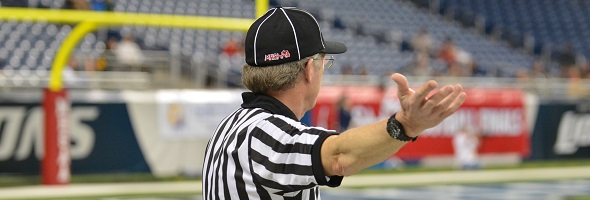
Be the Referee: Field Goals
September 24, 2014
This week, MHSAA assistant director Mark Uyl explains a rule unique to high school football – what results at our level after a missed field goal attempt.
"Be the Referee" is designed to help educate people on the rules of different sports, to help them better understand the art of officiating and to recruit officials. The segment can be heard on Mondays, Wednesdays and Fridays during the school year on The Drive With Jack Ebling on WVFN-AM, East Lansing.
Below is this week's segment - Field Goals - Listen
Today we are going to talk about one of the most unique rules to high school football, and it deals with field goals; in particular, what happens after a missed field goal.
Under high school rules, field goals are really treated just like punts. The only difference for the kicking team is that you can score three points if the ball goes through the uprights.
On a missed field goal that comes up well short, let’s say at the 5-yard line, and the ball either comes to a rest or rolls out of bounds at the 5, the new offense will take over first down and 10 at that 5-yard line. The only time the offense would take over at the 20 is if that missed field goal does break the plane of the goal line.
Never under high school rules would the team take over where the ball was kicked or originally snapped.
Past editions
Aug. 25 - Targeting - Listen
Sept. 4 - Concussions - Listen
Sept. 11 - Pass Interference - Listen
Sept 18 - Tackle Box - Listen
Be the Referee: Hockey Equipment
January 24, 2019
This week, MHSAA assistant director Brent Rice discusses the need to monitor the proper wearing of the ice hockey neck guard.
Be The Referee is a series of short messages designed to help educate people on the rules of different sports, to help them better understand the art of officiating, and to recruit officials.
Below is this week's segment – Required Hockey Equipment - Listen
A number of sports require certain equipment be worn, and be worn unaltered. In ice hockey, one such piece of equipment is the neck guard.
This is something not very well understood. And it’s not just that some players try to either not wear the neck guard or alter it – resulting in a team warning if caught – but that upwards of half of the neck guards on the ice on any given night of high school play are actually altered. Common alterations are putting tape around the guards, removing padding and wearing the donut style way below the collar bone.
Coaches, officials, players, parents and administrators have to treat this risk management issue more seriously than they are now to make the game as safe as it can possibly be.
Past editions
January 17: You Make the Call: 10-Second Clock - Listen
January 10: Tripping in Hockey - Listen
January 3: Sliding in Basketball - Listen
December 27: Stalling in Wrestling - Listen
December 20: Basketball: You Make the Call - Listen
December 13: Basketball Uniform Safety - Listen
December 6: Coaching Box Expansion - Listen
November 29: Video Review, Part 2 - Listen
November 22: Video Review, Part 1 - Listen
November 15: You Make the Call - Sleeper Play - Listen
November 8: 7-Person Football Crews - Listen
November 1: Overtime Differences - Listen
October 25: Trickery & Communication - Listen
October 18: Punts & Missed Field Goals - Listen
October 11: What Officials Don't Do - Listen
October 4: Always 1st-and-Goal - Listen
September 27: Unique Kickoff Option - Listen
September 20: Uncatchable Pass - Listen
September 13: Soccer Rules Change - Listen
September 6: You Make the Call: Face Guarding - Listen
August 30: 40-Second Play Clock - Listen
August 23: Football Rules Changes - Listen