

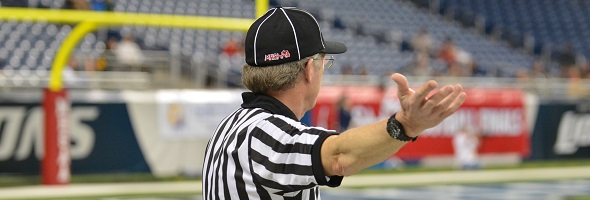
Be the Referee: Field Goals
September 24, 2014
This week, MHSAA assistant director Mark Uyl explains a rule unique to high school football – what results at our level after a missed field goal attempt.
"Be the Referee" is designed to help educate people on the rules of different sports, to help them better understand the art of officiating and to recruit officials. The segment can be heard on Mondays, Wednesdays and Fridays during the school year on The Drive With Jack Ebling on WVFN-AM, East Lansing.
Below is this week's segment - Field Goals - Listen
Today we are going to talk about one of the most unique rules to high school football, and it deals with field goals; in particular, what happens after a missed field goal.
Under high school rules, field goals are really treated just like punts. The only difference for the kicking team is that you can score three points if the ball goes through the uprights.
On a missed field goal that comes up well short, let’s say at the 5-yard line, and the ball either comes to a rest or rolls out of bounds at the 5, the new offense will take over first down and 10 at that 5-yard line. The only time the offense would take over at the 20 is if that missed field goal does break the plane of the goal line.
Never under high school rules would the team take over where the ball was kicked or originally snapped.
Past editions
Aug. 25 - Targeting - Listen
Sept. 4 - Concussions - Listen
Sept. 11 - Pass Interference - Listen
Sept 18 - Tackle Box - Listen
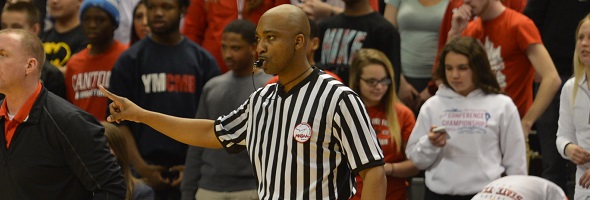
Be the Referee: Ball Stuck on the Rim
March 10, 2016
This week, MHSAA assistant director Mark Uyl explains what happens when the basketball becomes stuck between the rim and the backboard, stopping play.
Be The Referee is a series of short messages designed to help educate people on the rules of different sports, to help them better understand the art of officiating, and to recruit officials.
Below is this week's segment - Ball Stuck on the Rim - Listen
Today, let's see how well you do with this basketball "You Make the Call" scenario:
The offensive team is coming down the floor, passing the ball around the perimeter. A player pulls up for a 10-foot jumpshot that hits exactly between the rim and the backboard. Instead of the ball bouncing off the rim, it actually plugs or sticks between the rim and the backboard. As the ball is stuck there, 10 players look up, thinking, "What do we do now?"
In this case, the ball becomes dead as soon as the ball sticks in the rim, and it actually now becomes an alternating possession. The team that has the arrow will next get to possess the ball.
Past editions:
March 3: Three Seconds - Listen
Feb. 25: Deciding the Game - Listen
Feb. 18 : Cheer Safety - Listen
Feb. 11: Primary Areas - Listen
Feb. 4: Block/Charge Calls - Listen
Jan. 28: Dive on the Floor - Listen
Jan. 21: Hockey Officials' Options - Listen
Jan. 14: Recruiting Officials - Listen
Jan. 7: Wrestling Weight Monitoring - Listen
Dec. 31: Respect for Referees - Listen
Dec. 24: Basketball Instant Replay - Listen
Dec. 17: Basketball Communication - Listen
Dec. 10: Basketball Excessive Contact - Listen
Nov. 26: Pregame Communication - Listen
Nov. 19: Trick Plays - Listen
Nov. 12: 7-Person Football Mechanics - Listen
Nov. 5: Make the Call: Personal Fouls - Listen
Oct. 29: Officials Demographics - Listen
Oct. 15: Make the Call: Intentional Grounding - Listen
Oct. 8: Playoff Selection - Listen
Oct. 1: Kick Returns - Listen
Sept. 24: Concussions - Listen
Sept. 17: Automatic First Downs - Listen
Sept. 10: Correcting a Down - Listen
Sept 3: Spearing - Listen
Aug. 27: Missed Field Goal - Listen