

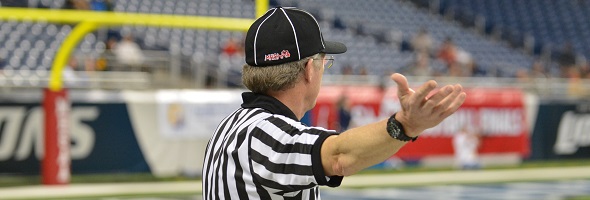
Be the Referee: Football Targeting
August 22, 2014
The series features MHSAA assistant director Mark Uyl's insights on officiating. These weekly messages can be heard on Mondays, Wednesdays and Fridays during the school year on The Drive With Jack Ebling on WVFN-AM, East Lansing.
Below is this week's segment:
"Be The Referee"
Aug. 25 - Targeting - Listen
Today we are going to talk about one of the new rules changes for this fall’s high school football season, targeting. This is yet another example of player safety being the number one priority in our game.
Targeting deals with getting the “head” out of the game of football. Many times when you will see a targeting foul is when a player will use the top or the crown of his helmet to launch or propel himself into an opposing player, making that helmet to helmet contact, which can be so dangerous for both players involved.
When a targeting foul happens, the officials, if they judge it to be flagrant, can not only enforce a 15-yard penalty but also can eject the offending player.
What's My Why: Official Sam Davis
July 15, 2026
Sam Davis, Lansing
Davis serves as the MHSAA Director of Officials and has been on staff since 2017, and previously taught and worked as a school administrator for 32 years and in law enforcement for more than a decade. He also recently completed his 46th year as an MHSAA-registered official and has long been considered one of the state's best on the mat. He received the MHSAA's Vern L. Norris Leadership in Officiating Award in 2015.
When I leave the office, the opportunity to go out and be on the mat …
To watch the competition.
To feel the cheers and the excitement from the crowd.
To work with my colleagues.
To impart rules and regulations.
To make sure kids are safe.
To get paid.
What a great opportunity. I enjoy – no, I love – officiating.
“What’s My Why” is a weekly feature telling the stories of MHSAA-registered officials in their own words. If you’re an MHSAA official and would like to share your reason why, please submit a 15 to 45-second video, taken horizontally, to director of officials Sam Davis at [email protected].
Don't miss Officiate Michigan Day 2026, July 25 in Grand Rapids! Check out MHSAA.com/OMD to register and learn more.
What's My Why
July 9: Candace Cox, Quincy - Watch
July 1: Robert Williams, Redford - Watch
June 24: Will Godfrey, Jackson - Watch
June 19: Jarrett Skorup, Midland - Watch
June 12: Brady Driver, Sturgis - Watch
June 8: Cindy Tyzo, West Bloomfield - Watch
June 3: Jeff Spedoske, DeWitt - Watch
June 1: Mike Carrier, Commerce Township - Watch
May 27: Stan Wright, Warren - Watch
May 26: Murray Rose, Zeeland - Watch
May 22: Mike VanLaan, Alto - Watch
May 18: Clint Abbott, Newaygo - Watch