

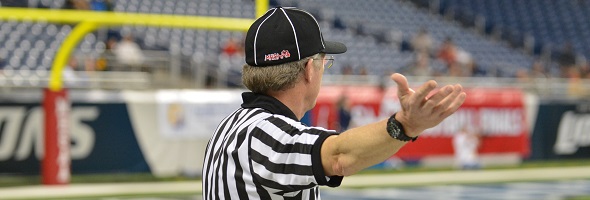
Be the Referee: Intentional Grounding
October 15, 2015
This week, MHSAA assistant director Mark Uyl explains the difference between high school and college/pro rules when it comes to intentional grounding.
Be The Referee is a series of short messages designed to help educate people on the rules of different sports, to help them better understand the art of officiating, and to recruit officials.
Below is this week's segment - Make the Call: Intentional Grounding - Listen
A QB is rolling out wide toward the sideline and is being chased by two large defenders. To avoid a certain sack, the QB throws the ball away deep down the field where no offensive receiver is even in the same zip code of where the ball hits the ground.
What’s the call?
Under high school rules, this is intentional grounding as there always has to be a receiver in the general area of the pass. At the college and pro levels, all the QB has to do is throw the ball beyond the line of scrimmage if he has scrambled outside of the tackle box. When at your next game, know this important difference when it comes to intentional grounding.
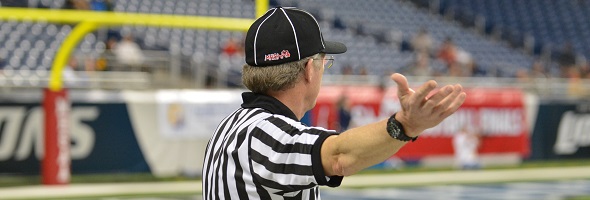
Be the Referee: 7-Person Football Crews
November 12, 2015
This week, MHSAA assistant director Mark Uyl discusses why seven-person football crews are used for MHSAA Semifinals and Finals.
Be The Referee is a series of short messages designed to help educate people on the rules of different sports, to help them better understand the art of officiating, and to recruit officials.
Below is this week's segment - 7-Person Football Mechanics - Listen
Last fall, the MHSAA used seven-person football officiating crews at the Semifinal and Final levels of our tournament for the very first time. These larger crews replaced the traditional five-person crews in the 24 most important games of the football season.
Seven-person crews, which for many years were the size of NCAA and NFL crews, provide for much better coverage in the passing and running games with all of the spread offenses and wide-open attacks that have become commonplace with football in the year 2015 and beyond. By adding the two extra officials on each deep sideline, coaches have now two officials to communicate with on each sideline to answer questions and address concerns.
Past editions:
Nov. 5: Make the Call: Personal Fouls - Listen
Oct. 29: Officials Demographics - Listen
Oct. 15: Make the Call: Intentional Grounding - Listen
Oct. 8: Playoff Selection - Listen
Oct. 1: Kick Returns - Listen
Sept. 24: Concussions - Listen
Sept. 17: Automatic First Downs - Listen
Sept. 10: Correcting a Down - Listen
Sept 3: Spearing - Listen
Aug. 27: Missed Field Goal - Listen