

Be the Referee: No 1st-Year Fee
October 12, 2017
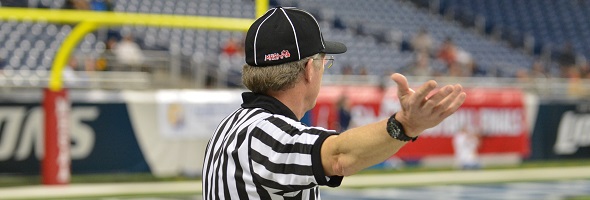
In this week's edition, assistant director Mark Uyl explains the minimal costs of becoming an official and how the MHSAA further helps those signing up for the first time by the waiving registration fee.
Be The Referee is a series of short messages designed to help educate people on the rules of different sports, to help them better understand the art of officiating, and to recruit officials.
Below is this week's segment – No 1st-Year Fee - Listen
We often get asked the question – exactly how much does it cost to become an official?
The first step in the process includes registering with the MHSAA, which costs roughly $50. With this $50, an official gets rules books, case books, mechanics manuals and over $1 million in liability insurance coverage.
For anyone registering for the first time, the MHSAA waives that fee in the first year. With someone who is new to officiating, the cost of purchasing a uniform, equipment, and attending some camps and clinics are going to be first-year expenditures – which is why that first year is free on the MHSAA.
Past editions
October 5: Athletic Empty Nesters - Listen
September 28: Misunderstood Football Rules: Kicking - Listen
September 21: Preparation for Officials - Listen
September 14: Always Stay Registered - Listen
September 7: Other Football Rules Changes - Listen
August 31: Pop-Up Onside Kicks - Listen
August 24: Blindside Blocks - Listen
What's My Why: Official Tony Bertuca
September 16, 2026
Tony Bertuca, Coloma
Bertuca is a 21-year MHSAA-registered official currently set to take the court this winter in basketball and the diamonds next spring in baseball and softball after previously officiating football as well.
Well it started, way 20 years ago, I was coaching rocket football and we needed a registered official on the field. And since I love working with the kids, and coaching and everything, I decided to go into officiating.
And it just grew from there – from football, baseball, softball, basketball. It’s for the love of the game.
“What’s My Why” is a weekly feature telling the stories of MHSAA-registered officials in their own words. If you’re an MHSAA official and would like to share your reason why, please submit a 15 to 45-second video, taken horizontally, to director of officials Sam Davis at [email protected].
What's My Why
Sept 9: Jenna Schroeder, Berkley - Watch
Sept. 2: Joey Crawford, Newton Square, Pa. - Watch
Aug. 26: Ron Torbert, Hanover, Md. - Watch
Aug. 19: Kari Seitz, Mill Valley, Calif. - Watch
Aug. 13: Mike Pereira, Sacramento, Calif. - Watch
Aug. 5: Dino Paganelli, Wyoming - Watch
Aug. 3: Stacy Smith, Caledonia - Watch
July 22: Jason Nickleby, Lake Elmo, Minn. - Watch
July 15: Sam Davis, Lansing - Watch
July 9: Candace Cox, Quincy - Watch
July 1: Robert Williams, Redford - Watch
June 24: Will Godfrey, Jackson - Watch
June 19: Jarrett Skorup, Midland - Watch
June 12: Brady Driver, Sturgis - Watch
June 8: Cindy Tyzo, West Bloomfield - Watch
June 3: Jeff Spedoske, DeWitt - Watch
June 1: Mike Carrier, Commerce Township - Watch
May 27: Stan Wright, Warren - Watch
May 26: Murray Rose, Zeeland - Watch
May 22: Mike VanLaan, Alto - Watch
May 18: Clint Abbott, Newaygo - Watch