

Be the Referee: No 1st-Year Fee
October 12, 2017
In this week's edition, assistant director Mark Uyl explains the minimal costs of becoming an official and how the MHSAA further helps those signing up for the first time by the waiving registration fee.
Be The Referee is a series of short messages designed to help educate people on the rules of different sports, to help them better understand the art of officiating, and to recruit officials.
Below is this week's segment – No 1st-Year Fee - Listen
We often get asked the question – exactly how much does it cost to become an official?
The first step in the process includes registering with the MHSAA, which costs roughly $50. With this $50, an official gets rules books, case books, mechanics manuals and over $1 million in liability insurance coverage.
For anyone registering for the first time, the MHSAA waives that fee in the first year. With someone who is new to officiating, the cost of purchasing a uniform, equipment, and attending some camps and clinics are going to be first-year expenditures – which is why that first year is free on the MHSAA.
Past editions
October 5: Athletic Empty Nesters - Listen
September 28: Misunderstood Football Rules: Kicking - Listen
September 21: Preparation for Officials - Listen
September 14: Always Stay Registered - Listen
September 7: Other Football Rules Changes - Listen
August 31: Pop-Up Onside Kicks - Listen
August 24: Blindside Blocks - Listen
Metro Detroit Crew Recognized as September's "Crew of the Month" by Lions, MHSAA
By
Geoff Kimmerly
MHSAA.com senior editor
September 29, 2026
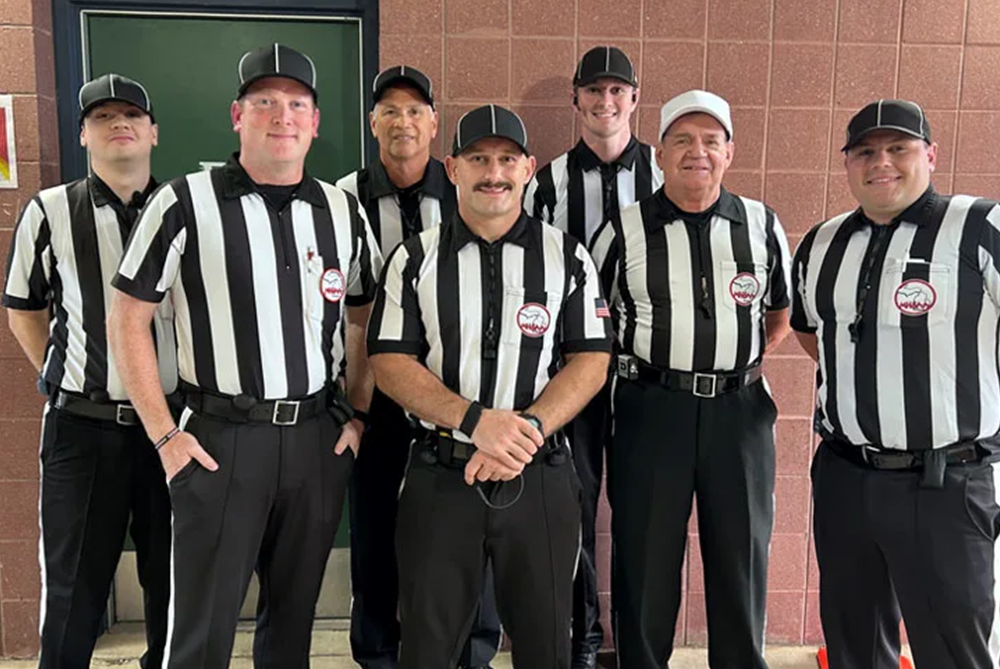
A Metro Detroit football officiating crew has been named the inaugural Michigan “High School Officiating Crew of the Month” by the Detroit Lions.
Shelby Township’s Mike Gentry and Craig Goepper, Grosse Pointe Woods’ David Prince, Ann Arbor’s Shane Smith, Roseville’s Scott Suminski and Jordan Pearson, and St. Clair Shores’ Carson Roose make up the crew, which combined has been part of officiating 10 MHSAA Finals, nine Semifinals and more than 50 District Finals. Gentry received the MHSAA’s Vern L. Norris Leadership in Officiating Award in 2017.
The crew also was recognized for its dedication to the avocation, participation as members of the Motor City Area Officials Association and recruitment of new officials.
The Lions, in partnership with the MHSAA and National Federation of State High School Associations (NFHS), will recognize an officiating crew monthly this season.