

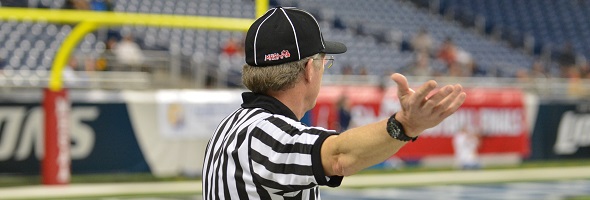
Be the Referee: Officials & Injuries
October 9, 2014
This week, MHSAA assistant director Mark Uyl explains the official's role when it comes to player injuries.
"Be the Referee" is designed to help educate people on the rules of different sports, to help them better understand the art of officiating and to recruit officials. The segment can be heard on Mondays, Wednesdays and Fridays during the school year on The Drive With Jack Ebling on WVFN-AM, East Lansing.
Below is this week's segment - Officials & Injuries - Listen
Player safety is the number one topic in football, from the NFL level to college to high school, all the way down to the youth levels. We often get the question, what is the official’s role when it comes to player injuries?
Officials have no role in diagnosing injuries. However, they must be constantly aware of what’s taking place on the field, and whenever a player is showing signs and symptoms of a possible injury, the game needs to be stopped and that team’s staff alerted to a possible injury.
The decisions on that injury are made by the team’s staff, which often includes a doctor, certified athletic trainer and members of the coaching staff to be certain that the best interests of the student-athlete is being followed in every case.
Past editions
Oct. 1 - Overtime - Listen
Sept. 25 - Field Goals - Listen
Sept. 18 - Tackle Box - Listen
Sept. 11 - Pass Interference - Listen
Aug. 25 - Targeting - Listen
What's My Why: Official Mike Pereira
August 13, 2026
Mike Pereira, Sacramento (Calif.)
Pereira is a former college and NFL football official who later became vice president of officiating for the National Football League. He is currently the head of officiating for the United Football League, and since 2010 has served as a rules analyst for Fox Sports and become one of the leading voices for officials, offering insight to TV audiences which had never been provided before his work.
He also is the founder of Battlefields to Ballfields, a national foundation that provides military veterans with scholarships, training, and mentorship to become sports officials, helping them reintegrate into their communities through the camaraderie of officiating. Pereira was the opening speaker at Officiate Michigan Day in July.
I didn’t want to officiate when they first came to me.
I said, “No.”
I said, “My dad had officiated. I don’t have any desire to.”
And they said, “Well why?”
And I said, “Because I don’t.”
“Because your dad officiated.”
“Maybe that’s it.”
I used to go to games and watch him get yelled at. And then they said, “It’s $10 a game. Three games. Thirty dollars, cash.”
I was a college student with no money. I said, “Yeah, I always thought I wanted to officiate.” And out I went. And it was kind of interesting, that first quarter of the first game, that first Pop Warner game, the parents are yelling at me, I didn’t know what I was doing, little kids running around.
And it was like somebody injected me with adrenaline. I found my passion in life.
As stupid as that maybe sounds, I found my passion in life. Thirty dollars is what I started to work for.
“What’s My Why” is a weekly feature telling the stories of MHSAA-registered officials in their own words. If you’re an MHSAA official and would like to share your reason why, please submit a 15 to 45-second video, taken horizontally, to director of officials Sam Davis at [email protected].
What's My Why
Aug. 5: Dino Paganelli, Wyoming - Watch
Aug. 3: Stacy Smith, Caledonia - Watch
July 22: Jason Nickleby, Lake Elmo, Minn. - Watch
July 15: Sam Davis, Lansing - Watch
July 9: Candace Cox, Quincy - Watch
July 1: Robert Williams, Redford - Watch
June 24: Will Godfrey, Jackson - Watch
June 19: Jarrett Skorup, Midland - Watch
June 12: Brady Driver, Sturgis - Watch
June 8: Cindy Tyzo, West Bloomfield - Watch
June 3: Jeff Spedoske, DeWitt - Watch
June 1: Mike Carrier, Commerce Township - Watch
May 27: Stan Wright, Warren - Watch
May 26: Murray Rose, Zeeland - Watch
May 22: Mike VanLaan, Alto - Watch
May 18: Clint Abbott, Newaygo - Watch