

Be the Referee: Officials & Injuries
October 9, 2014
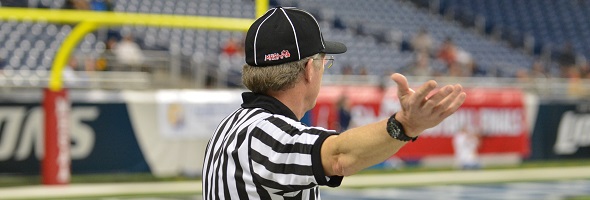
This week, MHSAA assistant director Mark Uyl explains the official's role when it comes to player injuries.
"Be the Referee" is designed to help educate people on the rules of different sports, to help them better understand the art of officiating and to recruit officials. The segment can be heard on Mondays, Wednesdays and Fridays during the school year on The Drive With Jack Ebling on WVFN-AM, East Lansing.
Below is this week's segment - Officials & Injuries - Listen
Player safety is the number one topic in football, from the NFL level to college to high school, all the way down to the youth levels. We often get the question, what is the official’s role when it comes to player injuries?
Officials have no role in diagnosing injuries. However, they must be constantly aware of what’s taking place on the field, and whenever a player is showing signs and symptoms of a possible injury, the game needs to be stopped and that team’s staff alerted to a possible injury.
The decisions on that injury are made by the team’s staff, which often includes a doctor, certified athletic trainer and members of the coaching staff to be certain that the best interests of the student-athlete is being followed in every case.
Past editions
Oct. 1 - Overtime - Listen
Sept. 25 - Field Goals - Listen
Sept. 18 - Tackle Box - Listen
Sept. 11 - Pass Interference - Listen
Aug. 25 - Targeting - Listen
Official's List of 'Favorite' Sports Grows with Dedication to Making Our Games Go
By
Tom Spencer
Special for MHSAA.com
April 8, 2022
Any season. Any MHSAA sport.
 Well, almost any.
You name it, and likely Jeff Brunner has officiated it. He may even have been selected to officiate an MHSAA Final in the sport as well.
He first started as a baseball umpire right out of high school. Family and work life created a 20-year absence from officiating for the 1979 grad of Romeo High, where he had played baseball for the Bulldogs.
Brunner, a 20-year MHSAA registered official, is about to work his favorite sport – softball – again. But, the 60-year-old readily admits he loves games so much, the favorite sport can change regularly for him.
“It’s kind of whatever is in season,” Brunner said of naming a favorite. “I love the pace of the game of softball, and I am a big proponent of providing as may opportunities for girls to play sports, whatever that sport may be.
“For that reason I gravitated towards softball.”
He’ll have to wait though to get on the field. Both of his games were cancelled this week due to weather-related complications.
 “Weather can create havoc with spring sports schedules – more so than any other season – so from an officiating standpoint, you have to count on some games being postponed or cancelled,” he acknowledged. “You just have to go with the flow and be ready to work when the weather allows.
“I feel a bit bad for softball and baseball players in particular, because those seasons are so short to begin with, and every contest date is important,” he went on. “When bad weather causes cancellations as a result of rain or the extension of winter, it makes the high school season that much shorter for the athletes.”
Brunner, a father of four grown children, is currently registered for softball, football, volleyball, swimming & diving and basketball. He once did lacrosse in addition to starting his officiating career with baseball.
“There is only so much time in the week,” he said. “I can’t do everything.
“I have at least one sport for each of the three sporting seasons,” he continued. “It’s fun.”
Brunner watched his three daughters grow up playing softball and competing in swimming. His son played baseball and competed in swimming. They all graduated from Traverse City St. Francis, swimming through a co-op program. His daughters were all pitchers for the Gladiators. Their first pitching coach was Dad.
His youngest daughter, Julia, just finished competing for Wayne State University at the 2022 Division II Women’s Swimming & Diving Championships in Greensboro, N.C.
It was his kids that got him into officiating, along with the extra money. But today, it’s just to be a part of a game.
“We were always around sports,” Brunner said. “I thought about officiating for a while.
“Originally I did it to maybe earn just a little bit of extra money, get a little bit of exercise, and kind of stay close to the game,” he continued. “Now, it is just plain fun — it’s fun to be around a game, whatever that game is.”
During his officiating career, Brunner has been selected to officiate MHSAA Finals in swimming & diving and football. He’s not likely to get the chance to umpire a baseball or softball Final as his other business obligations interfere with MHSAA spring postseason play.
 While working a Final is a goal of most all MHSAA officials, Brunner said it is just another game once it starts. He sees the Final as a great experience for all coaches, participants, fans and officials.
“MHSAA always does a great job of putting on a Final,” he said. “It’s always special.
“You have a few butterflies prior the game or the meet, but once things start you started focusing on the game itself.
The longer Brunner officiate, whatever the sport is, he believes the key to making the right call often comes down to mechanics.
“Mechanics were drilled into me when I first started,” Brunner said. “A lot of making the right call in my opinion is having the right mechanics and knowing where to be.
“You need to be in a good position to make the call.”
Many veteran coaches have noticed Brunner prides himself on being in the right position, and more. It is noted game after game, season after season.
“Jeff Brunner is the consummate professional as an umpire,” said Dave Kennedy, Traverse City West’s varsity softball coach. “He is excellent with his calls and positioning, but he is most concerned about getting the call right.
“Every time I see I have Jeff as part of the umpiring crew for my games, I know the game is going to be very well officiated,” Kennedy continued. “We are lucky to have Jeff as one of our officials in Northern Michigan — he’s definitely one of the best.”
 "As an umpire, Jeff's professionalism and easy demeanor are much appreciated,” Hawkins said. “He runs the games he works in such a way that the focus stays on the players.
“Jeff may not know every player on the field personally, but I'm convinced that Jeff takes on his job, which is a difficult one, for them – the players."
Brunner and his son Andrew’s high school baseball experiences made it easy for Jeff to jump into baseball — and the same was true for softball due to his pitching girls. Swimming & diving, though, has been perhaps the most challenging sport to learn how to officiate for Brunner.
Watching his four children compete in pools over the years was a big help. The physical aspect was much easier, but maybe not the rules.
“The hard part is knowing all the rules … knowing what is a legal stroke and what is not,” he said. “It was an easy transition — we had seen so many swim meets.”
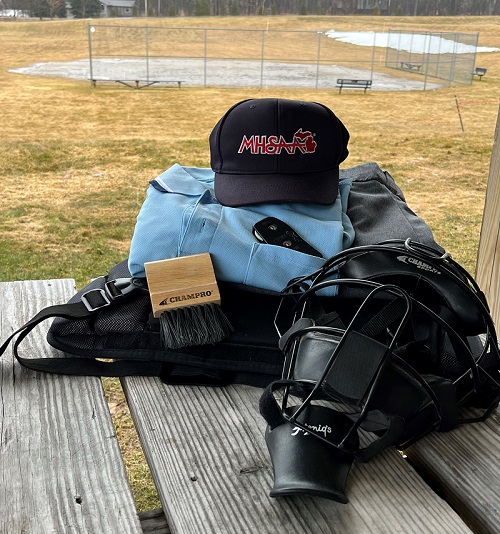
Today Brunner is anxiously waiting to get back on the softball field. He’s got his gear ready in anticipation of calling his first pitch of the 2022 season.
 Tom Spencer is a longtime MHSAA-registered basketball and soccer official, and former softball and baseball official, and he also has coached in the northern Lower Peninsula area. He previously has written for the Saginaw News, Bay County Sports Page and Midland Daily News. He can be reached at [email protected] with story ideas for Manistee, Wexford, Missaukee, Roscommon, Ogemaw, Iosco, Alcona, Oscoda, Crawford, Kalkaska, Grand Traverse, Benzie, Leelanau, Antrim, Otsego, Montmorency, Alpena, Presque Isle, Cheboygan, Charlevoix and Emmet counties.
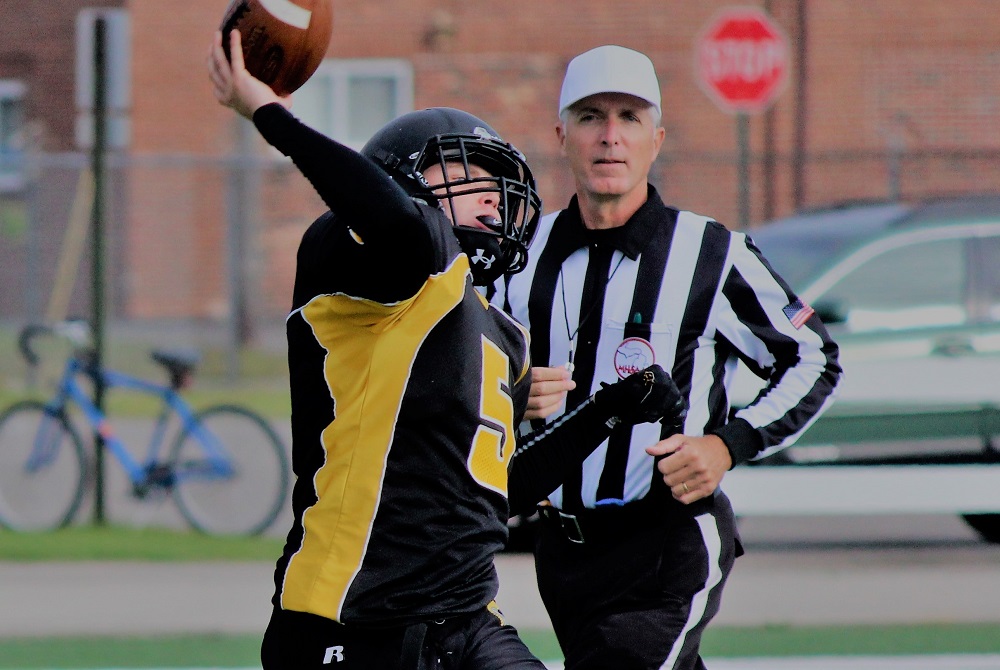
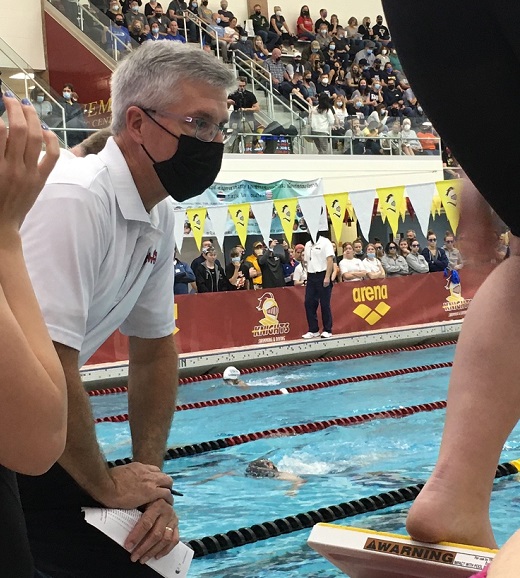
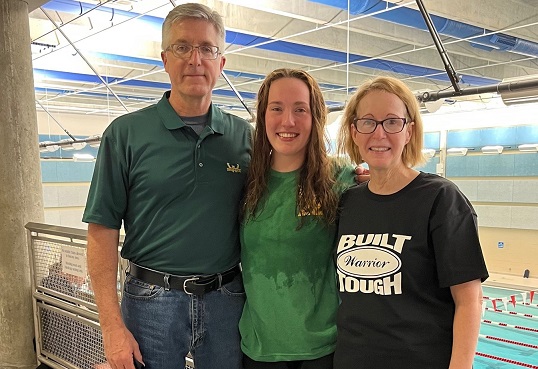
PHOTOS (Top) Official Jeff Brunner has his eyes on the action while officiating a football game. (2) Brunner monitors a starting block during November’s MHSAA Lower Peninsula Division 3 Swimming & Diving Finals at Calvin University. (3) Brunner and his wife Michelle support daughter Julie at March’s Great Lakes Interscholastic Athletic Conference championship meet. (4) Brunner’s gear sits ready for his first game this week before it was canceled due to bad weather. (Photos courtesy of the Brunner family.)