


Be the Referee: Officials & Injuries
October 9, 2014
This week, MHSAA assistant director Mark Uyl explains the official's role when it comes to player injuries.
"Be the Referee" is designed to help educate people on the rules of different sports, to help them better understand the art of officiating and to recruit officials. The segment can be heard on Mondays, Wednesdays and Fridays during the school year on The Drive With Jack Ebling on WVFN-AM, East Lansing.
Below is this week's segment - Officials & Injuries - Listen
Player safety is the number one topic in football, from the NFL level to college to high school, all the way down to the youth levels. We often get the question, what is the official’s role when it comes to player injuries?
Officials have no role in diagnosing injuries. However, they must be constantly aware of what’s taking place on the field, and whenever a player is showing signs and symptoms of a possible injury, the game needs to be stopped and that team’s staff alerted to a possible injury.
The decisions on that injury are made by the team’s staff, which often includes a doctor, certified athletic trainer and members of the coaching staff to be certain that the best interests of the student-athlete is being followed in every case.
Past editions
Oct. 1 - Overtime - Listen
Sept. 25 - Field Goals - Listen
Sept. 18 - Tackle Box - Listen
Sept. 11 - Pass Interference - Listen
Aug. 25 - Targeting - Listen
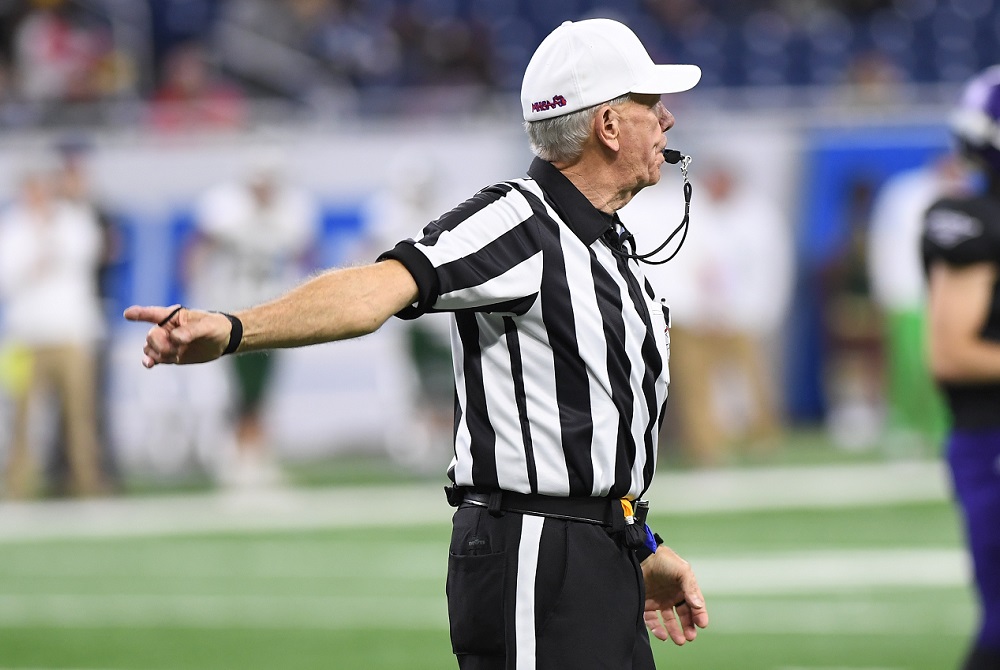
Be the Referee: Tourney Selection
By
Brent Rice
MHSAA Assistant Director
November 18, 2021
Be The Referee is a series of short messages designed to help educate people on the rules of different sports, to help them better understand the art of officiating, and to recruit officials.
Below is this week's segment – Tourney Selection - Listen
Today we are going to talk about how officials are selected for the MHSAA Football Playoffs. Just as the best teams advance in the tournament week after week, the best officiating crews advance in the tournament in much the same way.
For a crew to be eligible for assignment, many requirements have to be met prior to the season – submission of their season schedule, making sure that the crew has completed the annual rules meeting, as well as a football rules test. Much weight is given to ratings – each crew is rated by schools following each game as well as observation reports where officiating experts go out and either watch crews work live or on video in making sure that the best crews advance throughout the tournament.
Previous editions
Nov. 4: Receiver Carried Out of End Zone – Listen
Oct. 28: Volleyball Back-Row Block – Listen
Oct. 21: Soccer Disallowed Goal – Listen
Sept 30: Field Goal Falls Short – Listen
Sept. 23: Volleyball Obstruction – Listen
Sept. 16: Catch or No Catch – Listen
Sept. 9: Intentional Grounding – Listen
Sept. 2: Pass Interference – Listen
Aug. 26: Protocols and Mechanics – Listen