

Be the Referee: Officials & Injuries
October 9, 2014
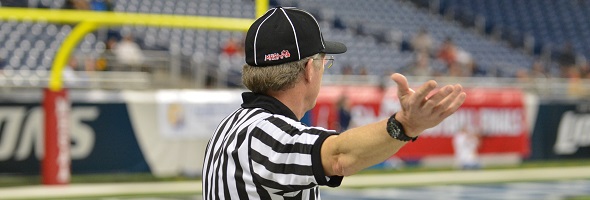
This week, MHSAA assistant director Mark Uyl explains the official's role when it comes to player injuries.
"Be the Referee" is designed to help educate people on the rules of different sports, to help them better understand the art of officiating and to recruit officials. The segment can be heard on Mondays, Wednesdays and Fridays during the school year on The Drive With Jack Ebling on WVFN-AM, East Lansing.
Below is this week's segment - Officials & Injuries - Listen
Player safety is the number one topic in football, from the NFL level to college to high school, all the way down to the youth levels. We often get the question, what is the official’s role when it comes to player injuries?
Officials have no role in diagnosing injuries. However, they must be constantly aware of what’s taking place on the field, and whenever a player is showing signs and symptoms of a possible injury, the game needs to be stopped and that team’s staff alerted to a possible injury.
The decisions on that injury are made by the team’s staff, which often includes a doctor, certified athletic trainer and members of the coaching staff to be certain that the best interests of the student-athlete is being followed in every case.
Past editions
Oct. 1 - Overtime - Listen
Sept. 25 - Field Goals - Listen
Sept. 18 - Tackle Box - Listen
Sept. 11 - Pass Interference - Listen
Aug. 25 - Targeting - Listen
The Official View: It's In Our Blood
By
Brent Rice
MHSAA Assistant Director
September 10, 2019
Some have said that officiating has to be in your blood.
The avocation runs through the veins of nearly 10,000 officials in this state, and “The Official View” returns this week not only to inform those valuable contributors to school sports, but also to provide an inside look at some of the people wearing the stripes – including a daughter who has followed her dad onto the court.

It’s Official!
The MHSAA Officials Guidebook is the main source for rules and regulations and policies and procedures to which MHSAA Registered Officials are to adhere. For the first time in several years, the document has been updated and revised for clarification and the removal of redundancies. It also has a new look and format that will hopefully make it easier for officials to read and review. The updated Guidebook can be found by CLICKING HERE.
Officials Bulletins for the fall season have started. Check out your specific officials sports page for this and more. You can find documents, helpful links and sport-specific information. CLICK HERE.
Rule of the Week
VOLLEYBALL After the first set comes to a close, the coach approaches the officials’ table and removes the lineup sheet to prepare the lineup for the next set.
Ruling: This move is legal … between sets. However, the lineup sheet, along with the roster sheet, must remain at the officials’ table throughout each set.
It’s Your Call
FOOTBALL This week’s clip questions the legality of a block. In the video, No. 64 in white immediately at the snap cut blocks No. 54 in blue.
Is this a legal block? What’s the call?
Official View: A Family Tradition
Interested in getting a job before she headed off to college, Frankenmuth native Megan Jarlock noticed it was difficult to find one that fit around her busy schedule and that could give her the level of saving (or spending) money she sought.
She started officiating at the suggestion of her dad, Mark, who has served as an MHSAA official for nearly 20 years himself. Mark informed Megan she could make twice as much per hour officiating as she could working in traditional college-student jobs, and she could determine for herself what games she did and didn’t want to accept.
Besides the side cash and schedule convenience, officiating provides Megan additional benefits as well. Megan is able to remain around sports she loves, stay active and keep healthy and happy. She officiates volleyball in the fall and basketball in the winter, and has even done some softball in the spring. The most important thing, though, is that she gets to officiate with her dad.
“I am also very lucky to have my dad by my side to help me learn and grow as an official and a person,” says Megan.
One of the best parts of working with her dad is the car rides, where they have a chance to catch up on each other’s busy lives. And like a lot of mentor officials, Mark often takes his daughter out to dinner after the game to discuss things she did well and areas she can improve. She is grateful for the ability to share time with her dad, both doing what they love.
Of her dad and experience, Megan said, “He is a great sports official, but an even better father and role model. I’m really enjoying being an official, and these are the moments with my family that I will remember for the rest of my life.”
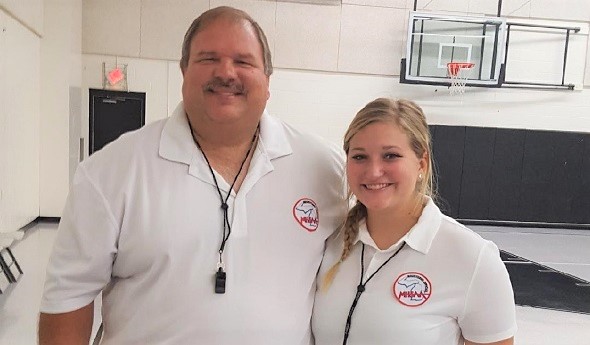
PHOTO: Megan Jarlock and her dad, Mark, prepare to work an MHSAA contest. (Photo provided by the Jarlock family.)