

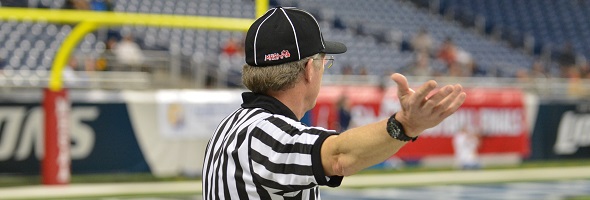
Be the Referee: Other Football Changes
September 7, 2017
This week, MHSAA assistant director Mark Uyl discusses a few final football rules in the final of a three-part series on changes in the sport for this fall.
Be The Referee is a series of short messages designed to help educate people on the rules of different sports, to help them better understand the art of officiating, and to recruit officials.
Below is this week's segment – Other Football Rules Changes - Listen
Today in our final segment of a three-part series on the football rules changes for the 2017 season, we’re going to be looking at three items:
• On passing plays, pass interference will no longer be called when the defender is simply face guarding the receiver with no contact.
• In the final two minutes of a half, the team accepting a penalty will now have the option of restarting the game clock with the snap of the ball, rather than the referee’s ready-for-play signal.
• This is the second year of an experiment in Michigan with a 40- second play clock, which starts shortly after a play is over, replacing the 25-second play clock which was always started by the referee marking the ball ready for play.
Past editions
August 31: Pop-Up Onside Kicks - Listen
August 24: Blindside Blocks - Listen
What's My Why: Official Stacy Smith
August 3, 2026
Stacy Smith, Caledonia
Smith is registered to officiate her 34th season of competitive cheer this upcoming winter, as she began as a competitive cheer judge with the sport's first season in 1993-94.
The reason I officiate competitive cheer is to give back to a sport that I love so much, that’s given me so much. It’s a point of pride and passion, and it keeps me close to the spirit and the energy of those young, amazing athletes.
“What’s My Why” is a weekly feature telling the stories of MHSAA-registered officials in their own words. If you’re an MHSAA official and would like to share your reason why, please submit a 15 to 45-second video, taken horizontally, to director of officials Sam Davis at [email protected].
What's My Why
July 22: Jason Nickleby, Lake Elmo, Minn. - Watch
July 15: Sam Davis, Lansing - Watch
July 9: Candace Cox, Quincy - Watch
July 1: Robert Williams, Redford - Watch
June 24: Will Godfrey, Jackson - Watch
June 19: Jarrett Skorup, Midland - Watch
June 12: Brady Driver, Sturgis - Watch
June 8: Cindy Tyzo, West Bloomfield - Watch
June 3: Jeff Spedoske, DeWitt - Watch
June 1: Mike Carrier, Commerce Township - Watch
May 27: Stan Wright, Warren - Watch
May 26: Murray Rose, Zeeland - Watch
May 22: Mike VanLaan, Alto - Watch
May 18: Clint Abbott, Newaygo - Watch