

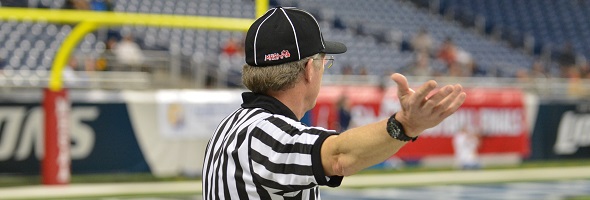
Be the Referee: Penalty Kick Change
October 6, 2016
This week, MHSAA assistant director Mark Uyl explains how soccer penalty kick rules have been changed this year to dissuade players from hesitating before taking the kick.
Be The Referee is a series of short messages designed to help educate people on the rules of different sports, to help them better understand the art of officiating, and to recruit officials.
Below is this week's segment – Soccer Penalty Kick Change - Listen
In the game of soccer, goals are tough to come by. That’s why in some of the most important games, we see those contests head into overtime and ultimately get decided by penalty kicks – or P-Ks.
The rules dealing with penalty kicks have changed for this year. In years past, whenever a player would hear the referee’s whistle and start to move toward the ball to make a penalty kick, any hesitation, delay or stutter-step would make that kick illegal. In past years, that player always got an opportunity to take a re-kick.
But this year, there is no opportunity for that player to take an additional re-kick.
Past editions
Sept. 29: Preparation for Officials - Listen
Sept 22: You Make the Call: Returning Kickoffs - Listen
Sept. 15: Concussions - Listen
Sept 8: Equipment Covering the Knees - Listen
Sept. 1: Play Clock Experiment - Listen
Aug. 25: Clipping in the Free Blocking Zone - Listen
What's My Why: Official Sam Davis
July 15, 2026
Sam Davis, Lansing
Davis serves as the MHSAA Director of Officials and has been on staff since 2017, and previously taught and worked as a school administrator for 32 years and in law enforcement for more than a decade. He also recently completed his 46th year as an MHSAA-registered official and has long been considered one of the state's best on the mat. He received the MHSAA's Vern L. Norris Leadership in Officiating Award in 2015.
When I leave the office, the opportunity to go out and be on the mat …
To watch the competition.
To feel the cheers and the excitement from the crowd.
To work with my colleagues.
To impart rules and regulations.
To make sure kids are safe.
To get paid.
What a great opportunity. I enjoy – no, I love – officiating.
“What’s My Why” is a weekly feature telling the stories of MHSAA-registered officials in their own words. If you’re an MHSAA official and would like to share your reason why, please submit a 15 to 45-second video, taken horizontally, to director of officials Sam Davis at [email protected].
Don't miss Officiate Michigan Day 2026, July 25 in Grand Rapids! Check out MHSAA.com/OMD to register and learn more.
What's My Why
July 9: Candace Cox, Quincy - Watch
July 1: Robert Williams, Redford - Watch
June 24: Will Godfrey, Jackson - Watch
June 19: Jarrett Skorup, Midland - Watch
June 12: Brady Driver, Sturgis - Watch
June 8: Cindy Tyzo, West Bloomfield - Watch
June 3: Jeff Spedoske, DeWitt - Watch
June 1: Mike Carrier, Commerce Township - Watch
May 27: Stan Wright, Warren - Watch
May 26: Murray Rose, Zeeland - Watch
May 22: Mike VanLaan, Alto - Watch
May 18: Clint Abbott, Newaygo - Watch