

Be the Referee: Penalty Kick Change
October 6, 2016
This week, MHSAA assistant director Mark Uyl explains how soccer penalty kick rules have been changed this year to dissuade players from hesitating before taking the kick.
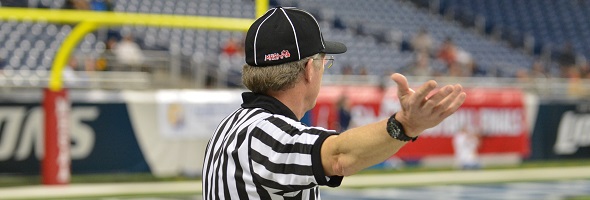
Be The Referee is a series of short messages designed to help educate people on the rules of different sports, to help them better understand the art of officiating, and to recruit officials.
Below is this week's segment – Soccer Penalty Kick Change - Listen
In the game of soccer, goals are tough to come by. That’s why in some of the most important games, we see those contests head into overtime and ultimately get decided by penalty kicks – or P-Ks.
The rules dealing with penalty kicks have changed for this year. In years past, whenever a player would hear the referee’s whistle and start to move toward the ball to make a penalty kick, any hesitation, delay or stutter-step would make that kick illegal. In past years, that player always got an opportunity to take a re-kick.
But this year, there is no opportunity for that player to take an additional re-kick.
Past editions
Sept. 29: Preparation for Officials - Listen
Sept 22: You Make the Call: Returning Kickoffs - Listen
Sept. 15: Concussions - Listen
Sept 8: Equipment Covering the Knees - Listen
Sept. 1: Play Clock Experiment - Listen
Aug. 25: Clipping in the Free Blocking Zone - Listen

Be the Referee: Fumble Out of Bounds
By
Paige Winne
MHSAA Director of Brand Management
August 25, 2026
Be The Referee is a series of short messages designed to help educate people on the rules of different sports, to help them better understand the art of officiating, and to recruit officials.
Below is this week's segment – Fumble Out of Bounds - Listen
We are on the football field today, where the offense has the ball on their own 20-yard line. It’s 3rd-and 10. They run a draw play, with the running back gaining nine yards before fumbling at the 29 yard-line.
The fumbled ball goes forward to the 35-yard line before another offensive player recovers. Where should the ball be marked?
Because the ball was recovered in-bounds, it’s first down for the offense at the point of recovery, the 35-yard line.
If the ball had rolled out of bounds at the 35-yard line, before anyone could recover it, it would have been brought back to the spot of the fumble – the 29-yard line – making it 4th-and-1 for the offense.
(Photo by Larry Arreguin/Team Arreguin Photos.)