

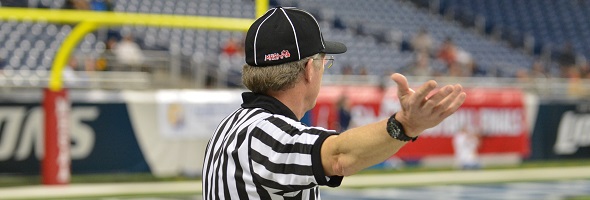
Be the Referee: Point After Touchdown
October 20, 2016
This week, MHSAA assistant director Mark Uyl explains how high school rules differ from those used by colleges when it comes to what's allowed after extra-point tries.
Be The Referee is a series of short messages designed to help educate people on the rules of different sports, to help them better understand the art of officiating, and to recruit officials.
Below is this week's segment – Point After Touchdown - Listen
For many years at the pro and college levels of football, the P-A-T or the extra point kick, really became a ho-hum play.
Last year in the NFL, they tried to make the play more exciting by moving the kickers back, making it almost the distance of a medium-range field goal.
Under college rules, they allow the other team – the defense, whenever they get the ball – to try to return it all the way to the other end with the ability to score two points.
The next high school game you’re at, know this: that once the defensive team gets possession of the ball on an extra point or try for point, the try is over and the defense cannot score any points.
Past editions
Oct. 13: Untimed Down - Listen
Oct. 6: Soccer Penalty Kick Change - Listen
Sept. 29: Preparation for Officials - Listen
Sept 22: You Make the Call: Returning Kickoffs - Listen
Sept. 15: Concussions - Listen
Sept 8: Equipment Covering the Knees - Listen
Sept. 1: Play Clock Experiment - Listen
Aug. 25: Clipping in the Free Blocking Zone - Listen
What's My Why: Official Dino Paganelli
August 5, 2026
Dino Paganelli, Wyoming
Michigan has produced several notable Super Bowl officials, including brothers Dino, Carl and Perry Paganelli from Wyoming Rogers High School. Remarkably, at least one Paganelli has officiated in eight of the 60 Super Bowls.
Dino has been part of three Super Bowls – XLVII, LV, and LVII – and previously was an MHSAA-registered football official from 1986-87 through 2003-04. He also officiated basketball during 14 of those 17 school years.
I think back to my positive experiences in football from high school, college and pros, and some of my fondest memories were working Friday night football.
It fostered that sense of giving back to the community, interaction with coaches and players, and – most importantly – my fellow crew mates.
Officiating has been a big part of our family, although it doesn’t define us, but it is a major beacon or guidance in regards to how we not only conduct ourselves professionally but also as officials. Those are lessons that were valuable, learned through the Michigan High School Athletic Association.
“What’s My Why” is a weekly feature telling the stories of MHSAA-registered officials in their own words. If you’re an MHSAA official and would like to share your reason why, please submit a 15 to 45-second video, taken horizontally, to director of officials Sam Davis at [email protected].
What's My Why
Aug. 3: Stacy Smith, Caledonia - Watch
July 22: Jason Nickleby, Lake Elmo, Minn. - Watch
July 15: Sam Davis, Lansing - Watch
July 9: Candace Cox, Quincy - Watch
July 1: Robert Williams, Redford - Watch
June 24: Will Godfrey, Jackson - Watch
June 19: Jarrett Skorup, Midland - Watch
June 12: Brady Driver, Sturgis - Watch
June 8: Cindy Tyzo, West Bloomfield - Watch
June 3: Jeff Spedoske, DeWitt - Watch
June 1: Mike Carrier, Commerce Township - Watch
May 27: Stan Wright, Warren - Watch
May 26: Murray Rose, Zeeland - Watch
May 22: Mike VanLaan, Alto - Watch
May 18: Clint Abbott, Newaygo - Watch