

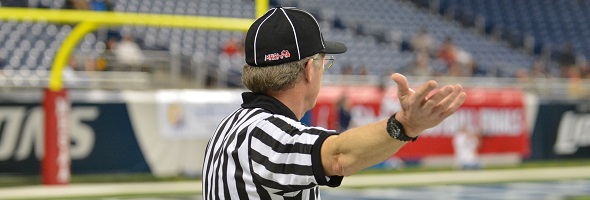
Be the Referee: Tackle Box
September 16, 2014
This week, MHSAA assistant director Mark Uyl discusses the differences between high school and college/NFL rules when it comes to a quarterback's movements within and outside the "tackle box."
"Be the Referee" is designed to help educate people on the rules of different sports, to help them better understand the art of officiating and to recruit officials. The segment can be heard on Mondays, Wednesdays and Fridays during the school year on The Drive With Jack Ebling on WVFN-AM, East Lansing.
Below is this week's segment - Tackle Box - Listen
Today we are going to talk about the rules that govern the quarterback, specifically when the quarterback is being rushed and is looking to throw the ball away and avoid the sack.
Under both pro and college rules, they have what’s called the tackle box. When the quarterback gets outside of the original position of the offensive tackles and throws the ball and it reaches the original line of scrimmage, there is never a foul for intentional grounding. However, under high school rules there is no such thing as a tackle box.
If the quarterback is either in pocket or scrambles outside of the pocket and now is trying to throw that ball away to avoid the sack, there always must be a receiver in the vicinity of the pass to avoid an intentional grounding foul.
Past editions
Aug. 25 - Targeting - Listen
Sept. 4 - Concussions - Listen
Sept. 11 - Pass Interference - Listen

Be the Referee: Backwards Skiing
By
Paige Winne
MHSAA Director of Brand Management
February 17, 2026
Be The Referee is a series of short messages designed to help educate people on the rules of different sports, to help them better understand the art of officiating, and to recruit officials.
Below is this week's segment – Backwards Skiing - Listen
We’re on the hill today, ready to race the Giant Slalom. I’m heading toward the finish and clear the final gate, but as I complete that last turn I lose control. My skis skid out, I spin around, and suddenly I’m sliding toward the finish line backwards. I stay on my feet and cross the line facing uphill instead of down. Is that legal?
Yes, it is.
Ski rules do not require a racer to cross the finish line facing forward. The key is that the skier completes the course correctly and that both feet cross the finish line. It can be on two skis, one ski, or even without skis. Forward or backward does not matter.
If there is a question, the referee and timekeeper make the final decision.
Previous 2025-26 editions
Feb. 10: Faking Being Fouled - Listen
Feb. 3: Bowling Pins - Listen
Jan. 27: Ski Gates - Listen
Jan. 20: Cheer Judges - Listen
Jan. 13: Basketball Over the Back - Listen
Jan. 6: Bowling Ball Bounces Out of Gutter - Listen
Dec. 9: Puck on Goal Netting - Listen
Dec. 2: Goaltending vs. Basket Interference - Listen
Nov. 25: Football Finals Instant Replay - Listen
Nov. 18: Volleyball Libero Uniforms - Listen
Nov. 11: Illegal Substitution/Participation - Listen
Nov. 4: Losing a Shoe - Listen
Oct. 28: Unusual Soccer Goals - Listen
Oct. 21: Field Hockey Penalty Stroke - Listen
Oct. 14: Tennis Double Hit - Listen
Oct. 7: Safety in Football - Listen
Sept. 30: Field Hockey Substitution - Listen
Sept 23: Multiple Contacts in Volleyball - Listen
Sept. 16: Soccer Penalty Kick - Listen
Sept. 9: Forward Fumble - Listen
Sept. 2: Field Hockey Basics - Listen
Aug. 26: Golf Ball Bounces Out - Listen