

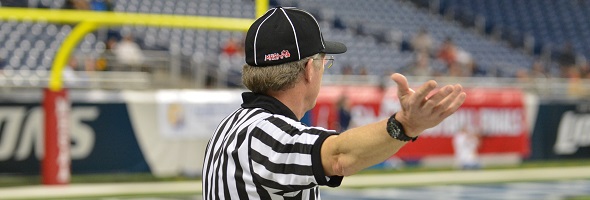
Be the Referee: Toughest Call
November 16, 2017
In this week's edition, assistant director Mark Uyl explains why pass interference is the toughest call for our football officials to make.
Be The Referee is a series of short messages designed to help educate people on the rules of different sports, to help them better understand the art of officiating, and to recruit officials.
Below is this week's segment – Toughest Call - Listen
At all levels of football, far and away the most difficult and controversial call to make is pass interference.
Pass interference can be challenging for officials because so much of it is based on judgment. Were the two players moving down the field making a legitimate play on the football; or did one of the two players initiate contact that created a disadvantaged situation for the opposing player?
Remember, when the ball is in the air, that both players – the offense and the defense – have an equal right to go for the football, making a legitimate play on it. But when that illegal contact occurs, that’s when the flag should come for pass interference.
Past editions
November 9: Hurdling - Listen
November 2: The Survey Says - Listen
October 26: Helmet Comes Off - Listen
October 19: Goal Line Rules - Listen
October 12: No 1st-Year Fee - Listen
October 5: Athletic Empty Nesters - Listen
September 28: Misunderstood Football Rules: Kicking - Listen
September 21: Preparation for Officials - Listen
September 14: Always Stay Registered - Listen
September 7: Other Football Rules Changes - Listen
August 31: Pop-Up Onside Kicks - Listen
August 24: Blindside Blocks - Listen
What's My Why: Official Dino Paganelli
August 5, 2026
Dino Paganelli, Wyoming
Michigan has produced several notable Super Bowl officials, including brothers Dino, Carl and Perry Paganelli from Wyoming Rogers High School. Remarkably, at least one Paganelli has officiated in eight of the 60 Super Bowls.
Dino has been part of three Super Bowls – XLVII, LV, and LVII – and previously was an MHSAA-registered football official from 1986-87 through 2003-04. He also officiated basketball during 14 of those 17 school years.
I think back to my positive experiences in football from high school, college and pros, and some of my fondest memories were working Friday night football.
It fostered that sense of giving back to the community, interaction with coaches and players, and – most importantly – my fellow crew mates.
Officiating has been a big part of our family, although it doesn’t define us, but it is a major beacon or guidance in regards to how we not only conduct ourselves professionally but also as officials. Those are lessons that were valuable, learned through the Michigan High School Athletic Association.
“What’s My Why” is a weekly feature telling the stories of MHSAA-registered officials in their own words. If you’re an MHSAA official and would like to share your reason why, please submit a 15 to 45-second video, taken horizontally, to director of officials Sam Davis at [email protected].
What's My Why
Aug. 3: Stacy Smith, Caledonia - Watch
July 22: Jason Nickleby, Lake Elmo, Minn. - Watch
July 15: Sam Davis, Lansing - Watch
July 9: Candace Cox, Quincy - Watch
July 1: Robert Williams, Redford - Watch
June 24: Will Godfrey, Jackson - Watch
June 19: Jarrett Skorup, Midland - Watch
June 12: Brady Driver, Sturgis - Watch
June 8: Cindy Tyzo, West Bloomfield - Watch
June 3: Jeff Spedoske, DeWitt - Watch
June 1: Mike Carrier, Commerce Township - Watch
May 27: Stan Wright, Warren - Watch
May 26: Murray Rose, Zeeland - Watch
May 22: Mike VanLaan, Alto - Watch
May 18: Clint Abbott, Newaygo - Watch